5 Myths Widows Believe About Healing | BW:217
Oct 27, 2026[TRANSCRIPT BELOW]
Healing after the death of your spouse can feel confusing, especially when your grief does not follow the timeline you expected.
Brave Widow Resources
- Book a call with me to see if Academy is right for you: https://www.bravewidow.com/call
- Free, Live “Four Seasons of Grief” Training + Quiz: bravewidow.com/live
- Rebuild a Life You Can Love Again in the Brave Widow Academy (join the waitlist or book a call): https://bravewidow.com/academy
- Create Calm from Chaos and Heal Your Heart inside Brave Widow Foundations:👉 bravewidow.com/foundations
- Join the free Brave Widow Community: https://bravewidow.com/free
In Episode 217 of The Brave Widow Show, Emily shares five myths many widows believe about healing and explains what healing can actually look like.
The Five Myths
Myth 1: If I’m healing, I should feel better every day.
Healing is not linear. Hard days, grief waves, triggers, and painful seasons do not mean you are moving backward.
Myth 2: Time heals all wounds.
Time matters, but time alone is not the solution. Time plus intentional processing, support, learning, and growth can help you move forward.
Myth 3: To heal, I have to let my person go.
You do not have to erase your relationship or leave your loved one behind. Healing can include continuing bonds through memories, values, rituals, and shared experiences.
Myth 4: If I’m happy again, it means I didn’t love my person enough.
Joy, laughter, travel, excitement, and new relationships do not diminish the love you shared. You can carry grief and happiness at the same time.
Myth 5: Healing means going back to my old self.
You may reconnect with parts of who you were, but grief can also change your identity, priorities, boundaries, and vision for the future.
Healing is not about becoming who you were before your loss. It is about growing your capacity to hold more than grief, including gratitude, peace, new memories, connection, and joy.
If you are struggling, you do not have to walk through grief alone. Join the free Brave Widow community at bravewidow.com/free.
Learn more about Brave Widow Foundations at bravewidow.com/foundations.
Chapters
00:00 Five myths widows believe about healing
00:48 Myth 1: Healing should feel better every day
06:30 Myth 2: Time heals all wounds
12:00 Myth 3: I have to let my person go
18:20 Myth 4: Happiness means I didn’t love them enough
23:20 Myth 5: Healing means returning to my old self
28:30 What healing actually looks like
32:00 Brave Widow community and upcoming opportunities
Research & References
- Grief does not follow fixed stages: Margaret Stroebe, Henk Schut, and Kathrin Boerner (2017). “Cautioning Health-Care Professionals: Bereaved Persons Are Misguided Through the Stages of Grief.” OMEGA—Journal of Death and Dying, 74(4), 455–473. Read the article.
- Moving between grieving and everyday living: Margaret Stroebe and Henk Schut (1999). “The Dual Process Model of Coping with Bereavement: Rationale and Description.” Death Studies, 23(3), 197–224. Read the article.
- Help for persistent, impairing grief: M. Katherine Shear and colleagues (2016). “Optimizing Treatment of Complicated Grief: A Randomized Clinical Trial.” JAMA Psychiatry, 73(7), 685–694. Read the study.
- Maintaining a connection with someone who died: Helen Hewson, Niall Galbraith, Claire Jones, and Gemma Heath (2024; published online 2023). “The Impact of Continuing Bonds Following Bereavement: A Systematic Review.” Death Studies, 48(10), 1001–1014. Read the review.
- Laughter and positive emotion during grief: Dacher Keltner and George A. Bonanno (1997). “A Study of Laughter and Dissociation: Distinct Correlates of Laughter and Smiling During Bereavement.” Journal of Personality and Social Psychology, 73(4), 687–702. Read the study.
- Rebuilding identity after losing a spouse: Erin C. Wehrman (2023). “‘I Don’t Even Know Who I Am’: Identity Reconstruction After the Loss of a Spouse.” Journal of Social and Personal Relationships. View the research summary.
💬 If this episode helped you, please:
* Hit Subscribe
* Leave a quick rating & review – it helps more widows find this support
* Share this with a friend who’s facing grief or the holidays without their person
If you’re new here, my name is Emily Tanner. I’m the founder of Brave Widow and Brave Widow Academy.
I help widows move from barely surviving their loss… to rebuilding a life they can actually love again without feeling like they’re betraying their person.
By day (and for 20+ years), I’ve led large teams and complex operations in the corporate world.
After my husband Nathan died in 2021, just shy of our 20-year anniversary, I took everything I knew about leadership, systems, and change — and started applying it to grief.
Since then, I’ve:
Shared my story publicly to make widows feel less alone.
Launched the Brave Widow podcast, now with 180+ episodes and listeners around the world.
Coached hundreds of widows 1:1 and in groups, and talked with thousands more through the podcast, communities, and events.
Built Brave Widow Academy, a 6-month coaching program with a clear framework for moving from deep grief to rebuilding a life you can love again.
I don’t teach “just think positive” grief tips.
I teach widows how to:
Heal their heart.
Stop waiting on “time” to fix everything.
Take small, brave steps toward a life that feels meaningful again.
How I Got Here…
2021: My husband Nathan dies unexpectedly. I’m 4 kids in, overwhelmed, and drowning in paperwork, decisions, and pain. Therapy helps, but I still feel stuck with no roadmap.
2021–2022: I start devouring books, interviewing widows, trying grief groups, and studying coaching — desperate to find something that actually helps me feel different.
2022: I start the Brave Widow podcast, recording episodes while terrified and crying between takes — but determined that no widow should feel as alone as I did.
Year 1: I begin coaching widows 1:1. Word spreads quietly. The same patterns and problems keep showing up, so I start building frameworks instead of one-off advice.
Year 2: I launch Brave Widow Academy — a structured, 6-month coaching program with a step-by-step path: from deep grief, to stability, to rebuilding.
Year 3: Brave Widow has listeners around the world. I’ve personally coached hundreds of widows and spoken with thousands more through consults, lives, emails, and DMs.
Today: My work is simple:
Help widows stop surviving each day… and start rebuilding a life that makes them genuinely glad to be alive again.
TRANSCRIPT:
Speaker: [00:00:00] If you've ever felt confused or even guilty about your own healing journey in grief, this episode is for you today I'm gonna talk to you about the five myths that widows believe about healing. This is episode 217 of The Brave Widow Show okay, guys, if you wanna know about upcoming live events, about upcoming happenings that are going on in the world of Brave Widows, stay tuned to the end of the episode and I'm gonna share all of that with you. But for now, I wanna dive right in to these top five myths that widows believe about healing.
Number one, if I'm healing, I should feel better. If I have a bad day or a day that's hard, that means I'm going backwards. That means that I've undone all the healing that I've done in the past we can often think about healing through grief like getting over the flu or having a broken bone, where [00:01:00] we think that each day that we're healing, each day that we're stepping forward, that we should feel better, that it should get easier, that we should get closer to going back to the person that we were and going back to being able to function like we used to in the past.
But that isn't actually true, and there are researchers out there who even advocate for people not to focus on moving through grief as in moving through stages. Now, you all may have heard about the five stages of grief developed by Elisabeth Kubler-Ross back in the late '60s, and that was really a great model of what she created for a certain group of people.
The five stages of grief was never meant to apply to widows or widowers or anyone who had lost a loved one. The five stages of grief was developed for someone who had a terminal illness and was given [00:02:00] a terminal diagnosis, someone who knew, "Oh, I only have this, this much time left in my life," and, and these are the stages of from, you know, denial and bargaining and anger to all the way through acceptance and, like, this is what that looks like up until that day.
But it was never meant to describe grief outside of that setting. And even for me here at Brave Widow, I developed four seasons of grief, and the reason I created that wasn't to say, "Here's a blueprint," "Here's exactly what you need to do and, and it's gonna look perfectly like you're moving through all the four seasons," but it was a way to give widows a marker, a way to identify, where am I today in my journey through grief?
What are the things that would be most helpful to me today, now, in this season? And what might I be looking [00:03:00] forward to in the future? What other seasons are there? What other things may come up? This is based not only on my personal experience, but after coaching hundreds of other widows, talking with thousands of other widows out there, and observing patterns that I would see over and over and over again for people who are proactively taking steps forward.
But that doesn't mean that everyone moves through these seasons perfectly, and what the research tells us through a dual process model by authors I cannot pronounce their name, so I will put the links in the show notes. I cannot, I will just totally butcher that. But that essentially what's more helpful is to think about we move through different modes, right? We have grief and the reconciling we have with grief, and then we also have life.
And we have bills that have to be paid. We have the administrative work that has to get done. [00:04:00] We have just day-to-day functioning of life that we have to deal with. And so over time, we might be functioning in these different spaces, these different modes, but it keeps us from being able to be all in on grief or all in on life.
And so that can also create some volatility with how we're thinking about whether or not we're doing better with grief or we're getting a break from grief or whatever that looks like. I also think about grief as waves, and have a previous podcast episode where I talked about how to deal with hard days of grief, almost like you're surfing.
So as those waves come up, you learn what's helpful to you during those really big waves. You learn how to ride the waves. You learn how to support and to help yourself and to know what you need in those moments. So you get [00:05:00] more skilled at dealing with the waves as they come up, of knowing how to support yourself, and in just normalizing the fact that these waves are gonna come up.
Maybe it's based on the time of year. We have the holidays that are just right around the corner. That's bringing up a lot of grief for people. And that can also feel confusing. So we just launched Brave Through the Holidays last week, and one of the big takeaways for a lot of people during that first call was just normalizing the fact that even though maybe this was their second round of holidays or their third round of holidays, and even though during the year they felt like they were doing better, they were starting to feel some anxiety.
They were starting to feel worry because this next round of holidays is coming up, and so they start to tell themselves that story of, "Well, I thought I was doing better. Why are the holidays so hard? I've already gone through the first set of holidays. Why doesn't this feel normal? Like, [00:06:00] what all is happening?"
And I could do a whole podcast episode on that, uh, and I have done that. But what helps people is understanding why. Why would the holidays be harder? What all is contributing to that? To help normalize that is something that happens. And so grief is not a, I was devastated here, I'm perfectly healed up here.
Grief is a much more jumbled up process full of lots of ups and downs between where we start and ultimately where we find ourselves in the now. So that's the first myth about healing that most widows believe, is that if I'm healing, I should just keep feeling better. Kind of that linear approach
The second myth that widows believe is that time heals all wounds. Time will heal me, so I just need to give it time and I should be better than now. So unfortunately, what happens, what some people, the myth that people buy into is that they just need to keep [00:07:00] waiting. They just need to keep waiting, let enough time pass, and then they'll feel better. But I'm telling you, the reality is not this. I talk with people every single week. It's been five years, it's been seven years, it's been 10 years.
I've talked to people, it's been 20-plus years. And they still hold on to this belief that I just need to give it more time. But the other side of that coin is there is hurt and shame and confusion because they believe time is the answer, but they don't understand why they don't feel better, why time isn't helping them.
And that's the place I found myself at even just almost two years out, was I felt that there w- was quite a bit of time between the counseling, talking, interviewing other widows, talking with other widows, diving into grief. Like, understanding all of [00:08:00] that, getting to a place where I wasn't in deep grief anymore, but I felt so empty.
I felt so hollow. And I just kept asking people, like, "What else can I do? Is this just how it's always gonna be? What else can I do to have a life I enjoy again?" And everyone just kept saying, "You gotta give it time." But I was so adamant, like, time is not helping me. Time is not helping me. I'm not in deep grief, but also time isn't helping me.
So what does the research support? For most people, grief symptoms will lessen over time. So you may not be in that raw, stabbing pain down the road that you were earlier on. But time alone does not guarantee that severe disabling grief will resolve itself in one of the studies that I'll link in the notes, there was a randomized trial that involved 395 bereaved adults with complicated grief. The targeted grief [00:09:00] therapy produced better outcomes than the comparison condition to those that did not get therapy
Now, that doesn't mean everyone needs to go to therapy or that therapy is a right fit for everyone, or that even your therapist right now is the right fit. Sometimes therapy can be extremely helpful, but sometimes it's a challenge finding a therapist that you connect well with, that resonates with you, that you feel like can truly equip you and help you.
And so if you're someone who's been thinking about therapy or you would like to really unpack some of the things that have happened, I wanna encourage you to keep looking for the right person. Finding the right therapist, finding the right guide, the right counselor, the right person for you can help you leaps and bounds with processing some of the things that have happened in the past.
But the [00:10:00] point is, whether or not it's therapy or it's a grief group or it's processing with a really close friend, there is something very healing about saying out loud the words, unpacking the things, and processing the pain, the hurt, the grief, the loss of the future, the reality and the gravity of what you're dealing with.
There's tremendous power in healing and being in a space where you can share that and you can unpack that with other people versus feeling that you need to shove it down, you need to just power through, you need to just ignore it. There is a substantial difference. And in just this one study, it also demonstrated a significant difference in not just giving it time, but in allowing time to grow and compound what it is that we're doing right now.
So how I [00:11:00] think about it is when we look at healing through grief, time is an ingredient in the recipe. Time is needed. It is a needed component. You cannot just magically heal from grief tomorrow, and you're over it, and you're never sad, and life is perfect, okay? Time does matter. But time isn't the only thing.
The, the key that most people miss in this myth is that it's time plus Time is only gonna give you more of what you're experiencing right now. So if right now you're avoiding grief, you're shoving it down, you're staying busy, you're powering through, you're trying to ignore it, you're trying to be stronger than that, all of that restlessness, all of that turmoil, all of that hurt that's just boiling beneath the surface, time is going to give you more of that.
I have [00:12:00] clients that have struggled with grief for many, many, many, many years, and it wasn't until we started intentionally processing some of the grief they were able to feel a sense of weight come off of their shoulders, a sense of freedom from being dragged backwards and pulled down by grief. And so if we are focused on healing, on learning, on growing, on figuring out this new life after loss, on processing what has happened, time will give us more of that the third myth that widows have about healing through grief is that to heal, I have to let them go. To move forward means I'm leaving my person behind. So what does the research suggest? Bereavement research recognizes that there are continuing bonds. There are ongoing interrelationships with the person who [00:13:00] died through memories, through rituals, through values, and other connections.
In 2023, they did a systematic review that covered 79 studies and found that these bonds can involve both comfort and distress In grief recovery methods, so, I talk often about using grief recovery method as one of the tools with our clients to help them with processing grief. And one of the things that we learn there is that throughout the rest of our lives, we continue to have an emotional relationship with a person even after they've died So how, some examples of how I think about this is maybe you go to a place that you and your person never went to.
You're creating new memories, but there's also that relationship and that, that bond with that person. You might be thinking things like, "Oh, they would love it here," or, "Oh, they really would have hated it here and, and that wouldn't have worked [00:14:00] well, and I wonder what it would have been like if they could have come with me."
Even just earlier this year, I went with my late husband's parents, uh, Nathan's parents, to Italy to celebrate their 50th wedding anniversary, and I went with my husband now, Robert. And so while I was in Italy, of course, I had these thoughts of like, "Oh what would it have been like if Nathan was here?
He never got to come here, but I think he would have liked it, except there's really no air conditioning, so maybe he wouldn't have liked that about it. Maybe he wouldn't have liked this or that." And so the relationship, the memories, the bonds are still there, and I never instruct my clients or teach them that they need to leave their person in the past and they gotta move forward because they're in their new life now and they gotta walk away from what they left.
No We're going to weave the spirit, the essence of that person with us into the present and into the future. [00:15:00] And for as long as you want, you can continue to strengthen that bond, but here's what the research also tells us. This bond Okay? It, this bond can involve both comfort and distress. The evidence did not justify any universal role that keeping that bond is healthy or that relinquishing it is necessary.
What is most impactful is the context and how that bond functions. Okay? So not about I need to let that relationship go, I need to let that bond go, but how is this connection affecting my ability to live now? Do I take that bond and that relationship and require myself to stay a grieving widow? Require myself to do things out of duty to that person and because I think I should?
Or do I look at that bond and that relationship with such deep gratitude [00:16:00] for the time I had with them, for the love that we shared together, for what maybe they might hope and wish for me in the future? How does that bond change how it's affecting my daily life? One of the top struggles that I had was when I was interested in dating again, and people would make comments like, "Oh, Nathan would want you to be happy.
Nathan would want you to date again." And I would just laugh and be like, "Absolutely not." Absolutely not, no. This is the person that would joke that even though the Bible says we're not married in heaven, that we would be married, and that there would be no angel boyfriends. There would be no, like nothing else.
It was me and him forever for life. In fact, I ended up burying him with his wedding ring on because I knew how important it was for him, our relationship, our marriage, our connection. And so while that created a lot of positive [00:17:00] associations, it also was very difficult when I was looking at wanting to date and remarry again because I felt this inner turmoil of he wouldn't be happy about that.
And, how much of our loved ones do they see? Do they know? The Bible says that, you know, there won't be any tears, there won't be any more pain. Trying to wrap your mind around all of that, and to be able to do so from a guilt-free way and experience. I ended up having the most amazing revelation and experience.
I'm not gonna get into that now. But at an event held by my coach, Dr. Betsy, it was amazing, and I was able to find peace And able to have this certainty that it was okay, that I could date again, I could have a little more romance in my life, and that set me free from those things. So when we're talking about bonds and continued relationships [00:18:00] and memories and experiences, it's not necessarily whether or not you're holding onto those or you're choosing to release them.
Maybe you didn't have a great relationship with that person, and so you want freedom from that. But it's more about the context and how is that relationship, that bond, that association, how is it affecting your life today? All right, number four, the fourth myth that widows believe about healing. If I'm happy now, it means I didn't love him enough.
And this belief is very painful, it's very damaging, and it can even show up in judgments from friends and family. We think so much of grief is either/or. Either I'm grieving and I'm sad and I'm just sad all the time, like I need to wear the black veil, I need to be crying, I need to be serious for, two years of my life.
Or I'm happy and I'm alive and I'm just [00:19:00] living my best life out here. We often think of these two Grand Canyon distance dynamics as either one is true or the other is true. It can't both be true But that's a myth
And it's very damaging because it can cause us to believe that pain is evidence of loyalty. That laughter, anticipation, travel, excitement, that's the betrayal. The loyalty is pain, and sadness, and sorrow, and suffering. That's how I prove my loyalty. And I get messages often. I get comments on my video often.
I might get a comment on this video that says, "I choose to stay in my grief because choosing grief means I loved my person."
Sometimes I offer a gentle redirection, and sometimes I choose not to argue with that person and tell them that they're wrong. [00:20:00] But my heart hurts for them because they truly believe that. That the way I show my love is through pain and suffering and sorrow. And I'm not talking about the beginning of grief, okay?
So if you're newly widowed, if you're still in deep grief, if you're struggling on a day-to-day basis, I'm not saying that's wrong. I'm just saying that when you find yourself laughing for about five seconds or enjoying yourself for a tiny moment in time, that doesn't mean that you're no longer grieving.
And as widows, sometimes we have this sense that we need to remind everyone we're not better. We need to remind everyone we're not doing okay. We need to hide behind the grief shield. We don't want people to think we're doing better. I think it's super interesting to unpack why we feel everyone needs to know, "It might look like I'm okay, but I'm not."
That could be a whole 'nother, that could be a whole 'nother podcast [00:21:00] episode
The research tells us Clinical guidance explicitly recognizes guilt about re-engaging with activities and relationships after loss. The research also shows us that positive emotion can coexist with bereavement. There was a study that found that spontaneous laughter among bereaved adults was associated with less anger, greater enjoyment, and better social relationships This is an association.
It's not proof that you need to force yourself to laugh. It's not proof that if you're overwhelmed with grief that you're doing it wrong. Not at all
But it's enough to say that the amount of visible suffering is not a measuring stick for the depth of your marriage That choosing to suffer, choosing to be in pain, refusing to grow your capacity to be able to hold anything other than grief means that you are being disloyal to your person I [00:22:00] read something, I don't even remember where I read it, but someone had posted this online that said, " My husband would be devastated if he knew that my life ended the same time that his did."
That at whatever age, my life was destroyed and over and just went downhill after he died
So what I wanna challenge you and what I teach my clients is not that we have to go out and build this great new fun life and forget about our grief, but we start to grow capacity to hold a little bit more than just grief. And one of the ways that we can do this is be- by being open and honest that enjoying life doesn't diminish the love that you shared.
Being able to laugh or look forward to something or enjoy something doesn't mean you don't care about your person. It doesn't take away. It doesn't diminish the pain. It doesn't mean that you're not still grieving, that you're [00:23:00] not still hurting You learn how to be able to hold both, and I'm gonna talk about that after the fifth myth here Okay, the fifth myth that many widows believe about healing is that healing means I'm going to go back to my old self
And this one's really difficult because we can think that once we're healed, we go back to our old personality, our old confidence, our old interests, our old relationships, our friendships. All of that is restored, and we'll come up with this other future that we'll get back to the person who we were. And a lot of people around me, when I would say to them, like, "I don't feel like this person I was before," a lot of- I got the strangest looks from people, right?
They're like, "What? Oh, yeah. Once you get over this, you're gonna feel like your old self. You're gonna go back to the way that you were." So this one is, is hard, and it- it's also hard [00:24:00] in seeing how for many widows, our social circle changes. Our friendships change, our relationships change.
And i- in many cases our people that we spent a lot of time with are waiting for us to go back to our old selves. You know, they kinda have some patience and they have some grace maybe in the beginning. Like, "Oh, I know you would be sad. I know this Christmas might be hard for you," but by the time the second one comes around, you're all better, right?
Like, "Look at you. I'm so glad you're doing better. Like, you're getting back to your old self. This is great." And it's like this expectation that we're gonna go back to who we were, and so if it's been years and we're not back there, then we're broken, or something's wrong, or we're not doing something right.
So what does the research tell us? Bereavement can involve rebuilding identity as well as coping with separation.
There was a small study of 35 people who had lost a spouse that described their process of reconciling their [00:25:00] past and present selves, including changing, changes in their identity and their i- identity with relationships Social support could help that process. Interactions could also hinder it
So how we might interpret this is that healing can include finding familiar parts of yourself from the past and also discovering new preferences, abilities, or boundaries that you didn't have before
And it doesn't mean that you're a better person now because of the loss. It just means that you've grown. Maybe your priorities have changed or shifted You're allowed to feel like yourself, to feel like a normal human again, while also allowing yourself to change. I notice for me, in many ways, it, grief and loss ramped up my anxiety about things, about making decisions, about worrying I was doing things right, but it also significantly reduced my anxiety about [00:26:00] things I just didn't care about anymore I didn't worry so much that everything had to be perfect or I had to be on every call or I had to do things a certain way.
'Cause in my mind, I would just be like what's the worst that's go- I mean, I've already survived the worst," so what if this isn't perfect? I want it to be good, but I'm not gonna stress about it because in the grand scheme of things, this is nothing. A PowerPoint? Yes, I'm gonna do my best, but I'm not gonna have anxiety and I'm not gonna look at it 52 times and make sure it's all perfect.
Like, we're, we're gonna work with excellence, but it's not gonna have to be s- to the point where I'm anxious about sending something, or I'm sending emails and going back and reading the emails that I sent to make sure they sound okay, or I'm getting something to my attorney a- and making sure that our communication is perfect and following up and...
it, it's all right. I've gone through the worst, like I'm not worried about this People can be upset with me. I'm not going to... I don't care about the time and the [00:27:00] effort and jumping through all the hoops and, and people pleasing and, and ignoring my boundaries and burning myself out and, and being irritable because I just give, give, give, and people just take, take, and there's nothing left for me to give anymore.
I just, I don't care if people get upset with me, if it makes them mad, if they no longer wanna talk to me, it's fine. But I have to safeguard myself and my immediate family so that I have something to give So it's not about, healing isn't about becoming the person you used to be. It doesn't mean that you're lost, doesn't mean you can't tap back into some of those things that you used to enjoy or that you liked about yourself.
It means that now you see things through a different lens, and you will get to decide the type of person that you wanna become. You're not lost, even though it might feel that way, but it's an opportunity to decide, who do I wanna be now? What's the kind of person I want to be? And [00:28:00] I'm willing to stop worrying about what other people think and stop doing this little song and dance because I've done it for all of my life, and now this is what is better.
This is what's more supportive. This is what's giving me the courage and the bravery to live life differently now So these are five healing myths that people tend to believe, especially widows. So what is the truth? What is healing? What does that look like? So here's how I think about healing. It's not a beautiful, easy picture, right?
We also know that life circumstances happen, so people might have a big disruption. For example, I was gonna be closing on a house that we were moving to, and two days before the closing date, the entire thing flooded from the second story down. I don't still know perfectly what this outcome is gonna be.
But [00:29:00] life happened, and all of our plans came to a screeching halt, and everything got disrupted. But I have plenty of clients who, in the house they're living in, water pipes burst. They had to unexpectedly move out of a house. They had to sell a house. They had to accommodate other family members. They lost a job.
They got a new job. They had other family members die. Like, sometimes life just piles up other things as external circumstances that we don't control. That also can affect how we're thinking about healing and grief and how we're processing what all is happening. So how I think about healing and grief, I have lots of thought about it, but if I was just to boil it down very simply in how I would view it is we are learning how to grow our capacity to hold more than [00:30:00] just grief.
So in the beginning, we're completely overwhelmed with grief, with hurt, with pain, with sadness, with sorrow. We do not have the capacity for anything else. We can focus on what's in front of us, what we have to do, and that's pretty much it. We don't have the room for joy, for fun, for anything else. For the most part, it's just grief.
Then over time We're able to grow our capacity and maybe now we can hold grief and we can also hold gratitude. That was the first step for me was I miss Nathan. I don't even know how I ended up in this situation I can't believe this is my life now, and also I'm so grateful that for the time we had together, I felt so loved, I felt beautiful.
I know that he loved our relationship and being with me, and I'm really grateful for that. That's what I could hold. [00:31:00] And so in the beginning, maybe it's just grief, and then we add in grief and gratitude. And then maybe we're able to add in grief and peace. I wanted more than happiness, more than joy, more than fun things.
I just wanted to feel at peace ' cause I just felt like the emotions were always swirling and discontented and frustrated and hurt and angry and confused and all that stuff, and I'm like, "I just wanna feel at peace. I just wanna be feel quiet, feel grounded." I want to feel like I'm on this volatile rollercoaster all the time And then maybe it's grief and new memories.
New memories that are positive. New memories that are like, "Wow, I can't even believe this is possible. This is weird." And then grief and joy and so many other emotions, but we grow our capacity and our ability to hold multiple jumbled up emotions all at the same time [00:32:00] versus feeling like, "Oh, all I can handle is grief," or, "In order to feel gratitude, in order to feel peace, that means that, you know, I have to walk away from the grief, or it's not gonna come up, or I'm not ever gonna miss my person."
No, we're able to grow our ability to hold all of that together
All right. So let's recap the five myths that widows believe about healing. Number one, if I'm healing, I should feel better. Number two, time heals all wounds. Number three, to heal, I have to let my person go. Number four, if I'm happy again, it means I didn't love my person enough. And number five, healing means going back to my old self.
Healing means I've become that old version of myself. All right. So that's the end of the teaching portion. If you wanna hear about some of the events we have a- coming up here at Brave Widow, that's what I'm going to dive into next. Um, so we just kicked off Brave Through the Holidays on [00:33:00] October 21st, which was Wednesday.
Our second session is coming up this Wednesday on the 28th, and the initial offer has expired to join straight through Brave Through the Holidays. So if you still want to jump in and join us for the remainder of Brave Through the Holidays, the way to do that is to sign up for Brave Widow Foundations.
And essentially, Brave Through the Holidays was $397. Foundations is $597 for a full year. So think of it as if you wanna join Brave Through the Holidays at that $397 price. Plus, for $200 more, you're gonna get support through the whole year. So the concepts that we learn in Brave Through the Holidays, you'll be able to apply to milestones, to birthdays, to anniversaries, to all those big days that happen throughout the entire year.
It's not just for the holidays. But essentially, what we want to do is to take you [00:34:00] from a place of anxiety, and dread, and nervousness to a place where you can breathe a little bit easier, and you can walk forward knowing that it may not be an easy time at all certainly, but that you are equipped with a plan.
For a plan of how you wanna navigate the holidays in a community of supportive people who are gonna walk through those holidays with you. And you're gonna get support specifically in that group through, all the way through the end of January, so well past the holidays. And then, of course, if you join Foundations, that's support for an entire year.
And you will also get access to our five fundamental building blocks called the Chaos to Calm Blueprint, which is all about coming out of the chaos, coming out of the overwhelm, getting your feet underneath you and Having allowing your heart to heal and your nervous system to start to become more regulated than what it's been in the past.
So to [00:35:00] join that, you can just go to bravewidow.com/foundations to join us there. Also I'm going to Miami, and we have a few brave widows that are joining us for an amazing event hosted by my coach, Dr. Betsy, called the Faith and ... I keep wanting to call it the Faith and Grief Summit, and it's actually the Faith and Growth Summit.
But it will be an amazing all-day event on Thursday, December 3rd, and I have a few seats left at my table. So if you wanna join me, then the only cost is for you to travel there, to stay there, and to travel back home. Uh, there's no cost for the event. I'm sponsoring a table of 10. So if you wanna join, just shoot me a message in Telegram if you're in our community, or send me an email.
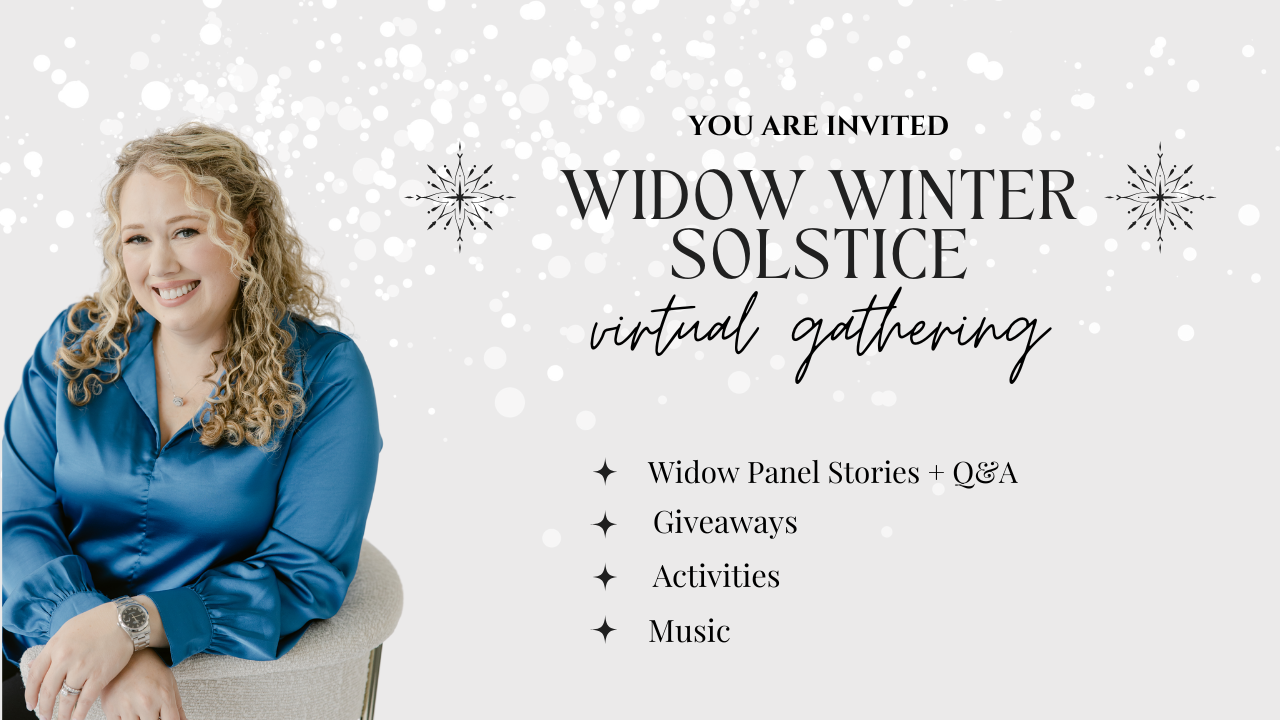
And if we still have space, I will put your name on the list. But I would love to see you there in Miami, especially if you're local. It's like a no-brainer just to be able to join us there. Then another thing we have coming [00:36:00] up is our Widow Winter Solstice event in December. December 21st, it'll be that evening.
It will be an evening you do not want to miss. Um, it's our biggest event of the year, and it's always just a very wholesome, wonderful time of joy, of tears, of community and togetherness right before Christmas. So it's always a really great time, and you'll get more information on how to sign up for that in the next couple of weeks.
Um, so I would love to see you there. And then finally, Academy. Academy is starting on January 20th. And Academy is where we start rebuilding a life that you can love after loss. So if Academy sounds like the place where you are, where you're wanting to rebuild, you wanna add more, you want to step forward, you're ready to figure out who you wanna be now, what you want in life now, you wanna be challenged, [00:37:00] you are ready, then you can join the wait list, or you schedule a consult and we will get you all signed up.
You just go to bravewidow.com/academy. And lastly If you are watching this or listening to this and you're not in the free community, I don't even know what to tell you. You need to be in the free community. It's 100% free for forever. Forever, okay? Name, email gets you in. That is it. Just go to bravewidow.com/free and you'll be in the free community.
All the podcast episodes are free. All the YouTube videos are free. I do a free training live event at least once a month. I was doing it once a week there for a while. But I do weekly calls every Monday called Momentum Monday. I teach every single Monday for free. No one in my group can even believe I offer all that for free.
You get some of my courses for free. It's all for free, and there's not [00:38:00] pressure to have to join anything else. You get a private group chat with other widows for free. So go sign up right now. Pull over the car. Stop the lawnmower. Whatever you're doing, go sign up for the free community and join us because you'll get access to so many amazing things, community, first notice on all the live events, all of that stuff at absolutely no cost.
Bravewidow.com/free. All right. I will see you there
Speaker 13: Hey, thanks for spending this time with me today. If you're listening and thinking, "I don't wanna do this widow thing by myself," I'd love to invite you into the free Brave Widow community. It's a private, faith-based space where you can connect with other widows who really get it, join gentle live calls, and get resources to help you take the next small step forward.
To join us, just go to bravewidow.com/free or click the [00:39:00] link in the show notes. You don't have to walk this road alone. I'll see you inside