5 Foundations for Widows Stuck in Grief | How to Breathe Again When Life Feels Overwhelming | BW 198
Jun 02, 2026[TRANSCRIPT BELOW]
Brave Widow Resources Mentioned
- Learn more about Brave Widow Foundations (gentle, faith‑based support for the first seasons of grief):👉 bravewidow.com/foundations
- Join us for Renew: A Brave Widow Retreat: https://bravewidow.com/retreat
- Join the free Brave Widow Community: https://bravewidow.com/free
- Brave Widow Academy (apply): https://bravewidow.com/academy
- Schedule a free, no-pressure call: https://bravewidow.com/call
If getting through the day feels like your new full‑time job, this episode is for you.
In this faith‑based conversation, Emily shares the 5 Foundations she uses to help widows move from pure survival mode into a little more stability, structure, and hope.
If you’re tired of people telling you to “just give it time,” you’ll learn what to focus on instead so you can actually breathe again.
You’ll learn:
- Why time alone doesn’t heal grief (and what does)
- The 5 Foundations that steady you when life feels relentlessly hard
- How to calm your nervous system when you feel constantly on edge
- Why doing less (not more) is actually wise in early grief
- How to rebuild routine, connection, hope, and identity without leaving your person behind
- What the new Brave Widow Foundations program is and who it’s for
Foundations is a gentle, faith‑centered container for widows and widowers in the “rawness” and “isolation” seasons of grief who need stability and support before they’re ready to fully rebuild life again.
Chapters
0:00 – When getting through the day feels like a full‑time job
6:45 – Why “just give it time” isn’t working
10:30 – The 5 Foundations that help you breathe again
37:10 – “Too broken / too early / I should do this alone” and other stories we tell ourselves
48:10 – Inside the Brave Widow Foundations program and how to join
Links & Next Steps
Learn more about Brave Widow Foundations (gentle, faith‑based support for the first seasons of grief):
👉 bravewidow.com/foundations
Join the free Brave Widow Community and get Momentum Monday calls:
👉 bravewidow.com/free
💛 Ready for deeper support?
Brave Widow Academy is my 6‑month, faith‑based program to help you heal your heart and rebuild a life you can love again. Small group, step‑by‑step roadmap, and weekly support. Learn more and apply here: bravewidow.com/academy
Subscribe for more faith‑based, hopeful grief support for widows:
@BraveWidow on YouTube, TikTok, Instagram & Facebook
💬 If this episode helped you, please:
- Hit Subscribe
- Leave a quick rating & review – it helps more widows find this support
- Share this with a friend who’s facing grief or the holidays without their person
If you’re new here, my name is Emily Tanner. I’m the founder of Brave Widow and Brave Widow Academy.
I help widows move from barely surviving their loss… to rebuilding a life they can actually love again without feeling like they’re betraying their person.
By day (and for 20+ years), I’ve led large teams and complex operations in the corporate world.
After my husband Nathan died in 2021, just shy of our 20-year anniversary, I took everything I knew about leadership, systems, and change — and started applying it to grief.
Since then, I’ve:
Shared my story publicly to make widows feel less alone.
Launched the Brave Widow podcast, now with 180+ episodes and listeners around the world.
Coached hundreds of widows 1:1 and in groups, and talked with thousands more through the podcast, communities, and events.
Built Brave Widow Academy, a 6-month coaching program with a clear framework for moving from deep grief to rebuilding a life you can love again.
I don’t teach “just think positive” grief tips.
I teach widows how to:
Heal their heart.
Stop waiting on “time” to fix everything.
Take small, brave steps toward a life that feels meaningful again.
How I Got Here…
2021: My husband Nathan dies unexpectedly. I’m 4 kids in, overwhelmed, and drowning in paperwork, decisions, and pain. Therapy helps, but I still feel stuck with no roadmap.
2021–2022: I start devouring books, interviewing widows, trying grief groups, and studying coaching — desperate to find something that actually helps me feel different.
2022: I start the Brave Widow podcast, recording episodes while terrified and crying between takes — but determined that no widow should feel as alone as I did.
Year 1: I begin coaching widows 1:1. Word spreads quietly. The same patterns and problems keep showing up, so I start building frameworks instead of one-off advice.
Year 2: I launch Brave Widow Academy — a structured, 6-month coaching program with a step-by-step path: from deep grief, to stability, to rebuilding.
Year 3: Brave Widow has listeners around the world. I’ve personally coached hundreds of widows and spoken with thousands more through consults, lives, emails, and DMs.
Today: My work is simple:
Help widows stop surviving each day… and start rebuilding a life that makes them genuinely glad to be alive again.
TRANSCRIPT:
Speaker: [00:00:00] Hey, hey, and welcome to episode number 198 of The Brave Widow Show. Listen, if getting through the day feels like your new full-time job, then this episode is for you. By the end of today's episode, I'm gonna share with you the five foundations that can actually help you breathe again, and how to take one next step that doesn't feel overwhelming
Now, before I dive in to today's episode, if you are watching or listening to this before June 28th, then I would love for you to join us in Klamath Falls, Oregon for Renew: The Brave Widow Retreat. This is our first retreat ever. We have 11 widows and widowers already signed up, so this isn't a huge conference.
This is gonna be a small, intimate retreat and there is still time to join us. If you go to the website, [00:01:00] you still see the retreat information. There's still time to join us. You can go right to bravewidow.com for the link, or go to bravewidow.com/retreat and read all about it, watch the video overview, and this is gonna be such a beautiful retreat.
This isn't about uncovering and unpacking big, heavy grief. This is about recentering and refocusing on where we are in the grief journey and building hope into a future that can be beautiful after loss. No matter where you are in the journey, we will help you do that. And even better My goal when I was first building the retreat was to create an experience where I just wanted people to get to the airport, and we would help coordinate everything else from there.
So we'll have a shuttle [00:02:00] available, depending on what time you get to the airport, that will take you from the airport to the actual resort. We have a shuttle back to the airport. All of our rooms, our meeting room, everything is in the lodge, and we have activities planned out for you, as well as the option to have some downtime or have some recharge time, depending on your personality and what you prefer.
But this is gonna be a very high touch retreat. I know it sounds a little weird, but high touch retreat, meaning that we are gonna help you with planning out each part of the retreat so you always know where to go, what's happening, uh, you don't feel lost, you don't feel alone, you don't feel like everybody ran off and forgot you.
And for my fellow introverts and wallflowers and people who generally don't love going to [00:03:00] conferences or find them super draining, I've got you, because that is me. And so I see you. And without putting all the pressure on you to, like, come up with all these fun things about yourself and have to stand up and talk in front of everybody or to feel like everyone else is getting the opportunity to share while you're hanging out in the background- I will help you pull in, get connected, and plugged in so that you don't feel forgotten or overspoken or left out.
So I've got you, don't worry. And also, you're gonna have the opportunity to make some new friends before we even go to the retreat. So if you're interested in joining us, go to bravewidow.com/retreat to learn more. All right. So let's talk about five foundational things that you can do when it feels like you're in survival [00:04:00] mode, or when you're overwhelmed, or when life just keeps handing you one loss right after another.
I hear this and see this somewhat often with widows that are part of our community or part of our academy, is that they may go through a season of life that's relentlessly hard.
So maybe they've experienced the loss of their person, and they have multiple losses back to back, is what it feels like. Or maybe they've lost their person and they're having to move, or their house has tons of issues. The water pipe's burst. There's a major remodel that needs to happen. Something has disrupted their everyday life.
Or maybe it's a newer widow who feels like everyone else is moving forward, and they're stuck or they're falling behind or they're just not where they [00:05:00] thought they would be at this point. Or maybe they've come up against a time of year or an anniversary date that just feels really hard. Whatever it is, what I've observed is that there are seasons of life that are just really hard.
And the common themes are overwhelm, stress, a desire to calm their nervous system, to get their feet underneath them, to share just the harsh reality of day-to-day life. And so we have created a room, a container, called Foundations, which I'll, we'll share with you about towards the end.
But I wanna talk to you today about five foundational things that can help you if you find yourself in that situation. The reason I am thinking about this as foundations is because [00:06:00] what I tend to notice is that if widows or widowers don't have a good foundation underneath them, it doesn't matter that they're going out and trying to make new friends, that they're trying new things, that they're changing careers, that they're actively trying to rebuild life in some way.
If they don't have a good foundation, what we see is that widows continue to feel that they're falling backwards in grief, or that they take one step forward, two steps back, or their foundation crumbles underneath them. It's like having a foundation in your home that's cracked and unsteady. Well, you can upgrade your kitchen, you can remodel your living room, but if you don't have a good foundation, your home is gonna remain unsettled.
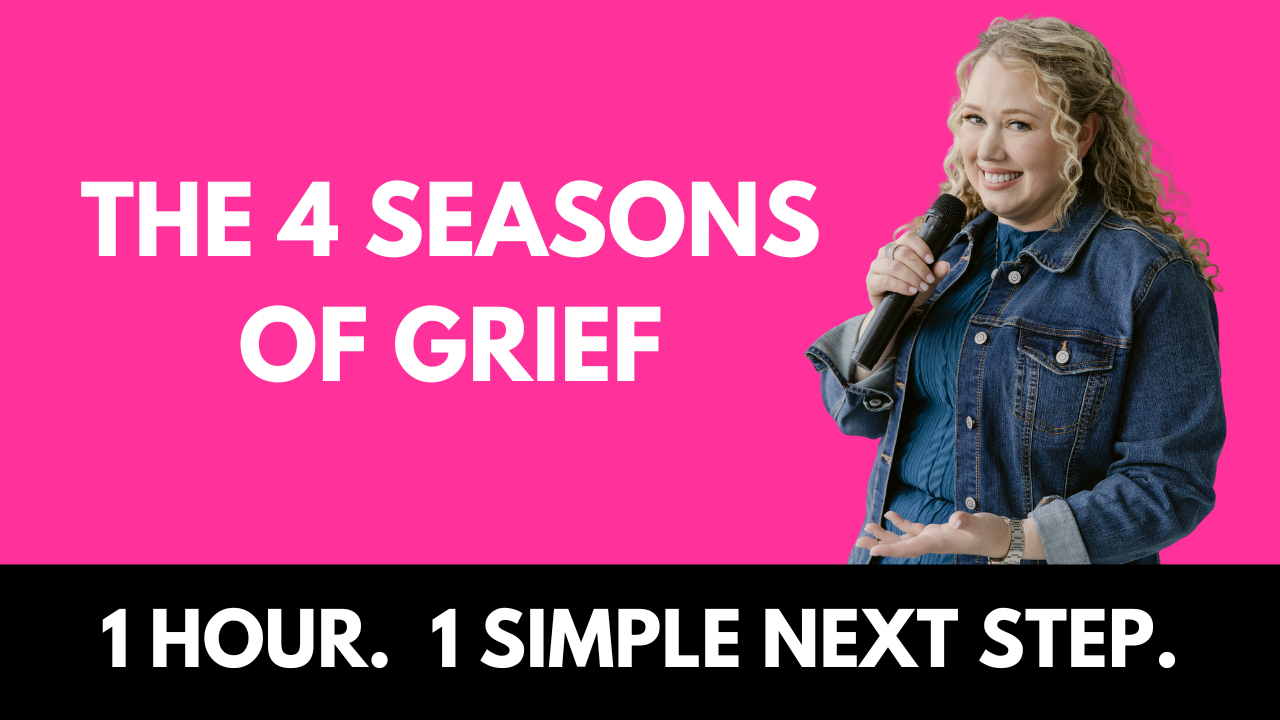
Your life is gonna remain unsettled You may have heard me talk about the four seasons of grief, and if you haven't, [00:07:00] it's totally fine. I'll cover them just very briefly here. We have rawness, which is that utter just devastation of grief. We have isolation. As the dust has settled, we look around and see and feel like we're alone.
The third is self-discovery, when we're starting to explore who we want to be, what life could look like, what might be possible. And the fourth is empowerment. When we're really clear on this is who I wanna be, this is the kinda life I wanna live, and we're building it. We're building it, we're expanding, and we're growing.
Okay, so Foundations addresses the first two seasons, rawness and isolation. Our goal with Foundations isn't that it's going to fix everything. The purpose is to help you breathe again. The purpose is to help you feel that you can calm down out of the chaos, out of the overwhelm, that you can get your feet underneath [00:08:00] you so that then you have the energy and desire to begin to step forward.
It's never too soon to want stability. It's actually wise. And there can be this natural concern or pushback or resistance from our own brain that's like, oh, I already have too much going on. I can't add one more thing. I can't do one more thing. I can't implement one more thing. And so we do a little Brave Widow math is what I call it, right?
And so it's to add stability to our life, to add structure to our life. Th- by adding those things, we subtract chaos. We subtract overwhelm. We remove the things that hang over our head and ping-pong around, and keep us asking, "Oh, when is this gonna get done? When is that gonna get done? I have so much to do, I don't know how I'm gonna do it."
By adding in support, [00:09:00] structure, and stability, like with Brave Widow Foundations, it allows us to then remove the chaos, the overwhelm, the uncertainty, the fear, those types of things. So instead of telling ourselves, "Oh, I can't add another program. I can't add one more thing I have to do," we think about it as adding structure, support, and guidance so that you can navigate through the overwhelm.
You can remove the chaos. You can remove some of that noise that's happening in your life. All right. The fa- five foundational things that I would encourage you to focus on. Are you ready for this? Okay. Number one, one of our goals is we want to calm your nervous system. You might have noticed that after a loss, you maybe don't think the same way you used to think.
You maybe don't function the same way you used to function. You [00:10:00] might feel an underlying anxiety at all times. And so what you might observe is that you have trouble with brain fog or making decisions or thinking through things clearly. And forget about thinking about the future. That's, like, impossible.
And there's actually a reason why this happens, and this is one of the things that we teach, so you get to learn a little bit about neuroscience. And don't worry, I know it's a scary word. But you will get to learn how your brain works, what is happening, why grief is affecting you, and why it's so hard.
That was super helpful for me to learn that. And what's happening in your body and your nervous system that causes that underlying anxiety. It causes those fears that are popping up left and right. It causes you to feel that you're in survival mode, and maybe even that your nerves are on fire. Like, what is actually happening and [00:11:00] what we can actually do about it.
So as you're thinking about your nervous system, what I coach my clients is that we want to carve out time for, like, intentional moments of safety. I know that's... You're... It's, like, a lot of big words. And you're like, "I don't even know what that means." So here's how to think about it. To help calm your nervous system, you wanna intentionally create these moments and experiences where you're reiterating to your brain and to your body that you're safe To oversimplify it, when you experience loss, like a traumatic loss of losing your spouse, your brain, your nervous system, your body no longer feels safe.
And so you become hypervigilant. You're constantly scanning for danger. You... Your brain will give you a lot of resistance if you try to do something new or different, if you're trying to make decisions [00:12:00] because your brain feels like you have to run on survival mode and instinct. Your brain thinks that it has to protect you.
That's the way it was designed, to keep you safe. Your brain is operating like a tiger is chasing you down the street. And so to an extent, and a way to simplify it is, like, we want to reprogram our brain and our body that we are safe. It's okay. We're gonna be okay. And one of the ways, there are several different ways we can do this, but one of the ways that we can do this is to put ourselves in those situations intentionally where we can actually let our shoulders down.
Maybe that's through meditation, maybe it's through exercise, maybe it's through, uh, creative things can really help with this, whether it's crafting or writing or singing or gardening. Anything that's using that creative part of your brain is helping create those moments where [00:13:00] you're s- where you're telling your brain and your body, "I'm safe."
Because a person who's being chased down the street by a tiger isn't doing things like drawing and writing and gardening. Being creative, doing acts of gratitude even. This is why gratitude in grief is so helpful, because a person who's running for their life, who is in fight or flight mode, doesn't slow down to take time to be grateful or to do things that are creative or to do things that just fully allow them to relax.
So the more that we carve out time to do that, the more times we send that message to our brain and our body that we're safe. And the more then our mind and our nervous system can go, "Oh, okay. I can, I can release control. I can come out of running off of instinct because I'm safe now. It's, it's okay. I can calm down."
So one of the five [00:14:00] foundational things that we work on is intentionally calming our nervous system Okay. The second thing that we work on as a foundational item is to do less and not more. And this is a tough one, especially if you're like me and you go into checklist mode, and you go into administrative, workload or crisis management.
If you're really good at crisis management, you're like, "I'm built for this. I will get things done. I will make it happen. I will take care of everyone else around me, and I will worry about myself at some point down the road." And that some point doesn't really happen. And the challenging part of doing less and not more is that we tell ourselves we're not doing enough.
That's kind of the underlying message. I have to do more, to take on more. And in many ways, this is true because overnight you've inherited all of these [00:15:00] tasks and projects and roles that your person used to do. And maybe you know how to do those things and maybe you've done some of them in the past, but maybe you haven't.
Maybe your person always paid the bills or mowed the lawn or did all the cooking or did all the family get-togethers, and all of a sudden you're going, "I've never had to do this before. Should I still do it? I, I feel like I should do it, but w- I, I can't even function with the things I used to do myself, much less now I have to do all this other stuff."
And maybe you have probate and you have paperwork and you have notifications you have to send out and, and titles and deeds and all of these other administrative tasks that all of a sudden are put on your plate. And so the underlying belief in our mind and our body is like, "I have to do more. I have to take on more.
I have to push myself more." And we push and push and push out of a sense of I should, an obligation, and I have [00:16:00] to, when really that is feeding that message to your nervous system, right? I have to do more. I have to, I have to produce more. I have to figure this out and that out and, and I feel like a failure and I can't do this.
And it just feeds all of this frenetic, anxious, overwhelmed energy. And so one of the things I coach my clients on is how, how could it be true that there are more tasks that need to get done, and also there's a way that we can do less, not more? Some of the things that we do is we lower the expectations for ourselves.
We give ourselves so much grace and compassion, and we evaluate things that we used to do, and do we still want to do those things? Do we still want to have those commitments? I coach people through evaluating making some of those decisions with the understanding that just because you [00:17:00] change what you would normally do in a week or a month or a holiday, just because you're gonna change that now, it doesn't mean that you're changing it for forever.
One of the things I'm quoted on the most is, you get to decide. And so we can have a different expectation. We can have a different way of doing things in the short term, and then in the future, we can decide if we wanna return to doing those things, or we never wanna go back to doing them, or we want them to look a little bit different.
It's okay But it is important for your nervous system to be able to heal, for your brain and your body to start to be able to rest. And one of the core ways that we do that is by actually doing less and not more. And this is really hard for a lot of people, especially if you're a high achiever, if you are responsible for other humans, if you're a business owner, if you're [00:18:00] a freelancer, if you are a parent of kiddos that are still in your house, if you are kind of the person who always coordinated things for your family and friends, if, if you were big in the volunteer community, if you were a leader in some way, and you feel this sense of obligation and duty that you have to show up for everyone else, and you have to take care of everyone else, and you can't let your foot off the gas.
This one can be really challenging. But I've got you. I'm here to I'm here to help you with that. Okay? So we calm our nervous system, we do less and not more, and we develop a new routine And I actually have a whole tool set for this of how we can look at your routine and create one that feels realistic.
Not one that's idealistic of like, oh, well ideally these are the things I would be doing, but a routine that's going to be real life and [00:19:00] that's gonna have some buffers in there for when life happens and there are things that we didn't plan. A routine gives us structure. We look at the big rocks of things that have to be done or that you want to build in, like those moments of intentional safety I mentioned earlier.
Like those moments where you're gonna let your shoulders down. So we build in those big rocks of time on the calendar. And I also teach you how to go through and determine on your huge to-do list or this huge project that you want to work on or, or have to work on, you don't really have a choice, how to plug that in so that it does a few things.
We do lots of time blocking and lots of scheduling on our calendar. And if you're a free spirit, you're like, "Oh, I don't like a lot of constraint. I don't like a lot of, you know, managing of my time," I have [00:20:00] something to help you too, okay? In a way that doesn't feel constrictive. But our goal, we have a few goals with creating a routine.
So one is we wanna give you structure so that you know and you start to actually train your brain what to expect on different days of the week or times of the day, depending on how we do your routine. We also want to remove guilt. Remove guilt by having a schedule? What? So think about things like big projects.
Maybe you're wanting to declutter your home. Maybe you're wanting to move. Maybe you want to start exercising, or maybe you walk by and you see all of these little projects around the house and you're like, "Oh, I need to get around to that. Oh, I need to do this. Oh..." And it's like a lightning bolt in your spine every time you walk past that area or that particular thing because you just keep telling yourself like, "Oh, yeah, I need to return that on Amazon.
Oh, yeah, I need to organize this closet. Ah, when am I gonna do that?" [00:21:00] And you feed a lot of negative emotion into your body because you keep circling around on the same thing over and over. I gotta get around to that. I feel bad. And so what can happen is we can generate a lot of shame and guilt and even resentment towards ourselves because we have all these big question marks around us.
When is this gonna get done? When am I gonna get around to doing this? It's too overwhelming. I, I don't have a plan for this. And so what we do as, as our third foundational item is we wanna create a routine that gives you structure. It allows you to know to answer those questions. You will know when you are planning to do those things.
And so then when you walk past them or you think about them, it quiets the noise, and you're like, "Oh, yeah, actually I'm doing that Tuesday. Oh, yeah, I put that on the calendar for next month." And all of a sudden, I'm not shaming [00:22:00] myself. I'm not generating guilt, not generating resentment at myself. I'm able to breathe a sigh of relief like, " Okay.
Yeah. I know what I'm doing. I know what the plan is. That's, that's on the calendar. It's gonna get done. It's fine. I don't have to think about it right now." And so for some of you, that may sound very simple. But for others of you who are living in the chaos and the noise and the overwhelm, maybe that sounds like a bit of a relief, and it sounds like relief of what you've been looking for.
I think about several clients who have wanted to declutter big areas of their house or several rooms in their house, or maybe they're moving and they're like, "Oh, how, where do I even start?" And so they feel guilt for any time they're not working on that. It's like in our mind, we think, "Oh, I have all this work to do in my house to declutter it.
I should be doing that all the time. I shouldn't be resting. I shouldn't be taking a break. I shouldn't be watching TV or [00:23:00] trying to read a book. Like, I, I have these other commitments." But if we will build that into your routine, then you will know, oh, wait, this is my free time to do whatever I want. I have time set aside to work on these other projects.
That's my Tuesday and Thursday afternoons, or that's my Friday from 8:00 to 10:00. That's the time I'm gonna focus on that. This time was created for me to do whatever I want or for me to get exercise or me to just decompress and watch some TV for a while. And so that also removes guilt and shame and all of those other questions around how long is this gonna take?
When is it gonna get done? You'll know. You'll know. Okay, so we wanna calm our nervous system. Number two, we wanna do less and not more. Number three, we wanna develop a routine. Number four, we wanna invite one person [00:24:00] in there's a big difference in having family and friends around you who talk to you or talk at you versus having someone who truly sees you. Even if they've not experienced what you've experienced, they don't try to tell you they understand. They don't try to tell you like, "Oh, yeah, my grandpa died, so I know how sad you must be."
They just sit with you in the suffering. They sit with you in the awkwardness, in the uncomfortableness, in the sadness. They're just there with you. And maybe they're even curious because they want to understand the best they can, and they wanna support you the best that they can. You need that one person more than you need 25 friends or family and friends who try to be helpful and maybe end up hurting you because you don't feel seen.
You don't feel heard. You don't [00:25:00] feel understood. You don't feel like you belong anymore in those circles. So when we're working on this foundational item, it's not about going out, meeting a bunch of people, and making new friends. We work on that in academy. Academy is more where we're pushing ourselves out of our comfort zone, and we are figuring out what we want social life to look like and all of that.
Foundations is more about pulling a resource in, pulling in a support person, pulling in a friendship, and maybe it's connecting with someone over text message. Maybe they're coming in and sitting on your couch with you in your messy hair and your pajamas, and you're just vegging out, watching movies.
Maybe they just listen whenever you need to talk. Maybe you can FaceTime- time them. Whatever it is, it's inviting in a person, a conversation, a [00:26:00] connection that allows you to feel seen, heard, and understood
Isolation is one of the biggest challenges that many widows and widowers face, and
The statistic is that widows will lose 75% of their social circle within the first year. 75%, that's crazy. And when we go through an experience like losing our person, it's like there's a new lens now that we're looking at life through. And a lot of times we realize that maybe the relationships we had weren't as deep as we thought they were.
Maybe they were more superficial. Maybe it was more out of convenience or fun or sharing the good times. And also, maybe those people just don't know how to show up for us the way that we want them to or we need them to. Or maybe their idea [00:27:00] of what showing up for someone looks like is very different.
They're also gonna have their own ideas of, quote unquote, how fast you need to move on, or how you might need a few days to be sad and then you should go back to the way that you were. There are a lot of things that are, that are happening that cause that statistic. But ultimately, what you, we wanna aim for here is not to be in total isolation.
Okay? So I, I coach my clients here that when we're inviting one person in, it's okay that maybe our family and friends don't understand or they aren't fully there for us from a grief perspective. Like, they don't have to understand. I, I just did a Moment to Monday on this, right? Like, people don't have to understand.
It's okay. So where though it is important is that we do need those spaces where we can really lean in. [00:28:00] We can connect with other people who are on a similar journey. Okay? So other widows, other widowers, other people who are going through grief and also are desiring connection and desiring that ability to just share these life experiences together.
It's okay if 99% of the people around you don't get it or maybe don't see you or, or don't show up for you the way that you want. You can decide how much energy and effort you put in those relationships. And you don't have to harbor resentment for those people. But we wanna look for those one or two connections that we might have or that we could develop.
We're inviting them in to be in this season of life with us, to share this season with us. All right, and then the fifth foundational item that we wanna look at is a foundation of hope and identity.
One of the most [00:29:00] disorienting things about grief and about the loss of our spouse is we also have a loss of our identity. And it can be the loss of our identity in who we are, in the role that we played, and even our identity in faith. That can all be changed now, and we can really struggle with this because we're waiting to go back to the way we used to be.
We're waiting to feel the way we used to feel. And we also can be wrestling with all these questions around faith and God, and that we need to trust God more, and we need to pray more, and, um... But we're also questioning, like, I- was it not enough? God, why, why did you not save my person, but you saved this person over here?
And what does this mean? And I- a lot of people will stop praying or stop going [00:30:00] to church because it's so confusing and disorienting on who they are and what they believe and what is right and what is even allowed. As a person of faith, you may think that you're not allowed to question or allowed to express verbally the thoughts and feelings that you have on the inside, that it's wrong to feel angry.
It's wrong to feel confused. And so we shut down, we suppress, we push all of that down into our body. You've heard the expression, we swallow our feelings. We push that down into our body, which by the way, if we don't process, will manifest physically in chronic pain, chronic illness, disorders, all kinds of things
And so one of the things that really helps, especially in the early days of grief and what I wish I would have known, I didn't know for a long time, was that instead of viewing this experience as I want to go back to who I was, [00:31:00] I want to feel the way I used to feel, is this harsh reality. Are you ready for it?
This reality that our old life is in ash. We can't go back to the life that we used to have. We can't go back to the person we used to be. We're not that person anymore
We get to decide to build something new. And people will sometimes say, "I don't want a new life. I don't want a different life. I want the old life that I had." And I f- my heart goes out to them because that's how I felt for a really long time But I would wrestle with like, but how could I feel the way I used to feel?
I'm no longer naive to death. The rug has been pulled out from underneath me. My view of reality has been shattered. I'm not the same person I used to be, and I would tell people that, and they would be so confused. "Oh, what does that even mean?
Of course you're the same person. You'll find [00:32:00] your way back to that person again. You'll find your way back to your old self." Do people tell you that?
You're the same person. No, I'm not. And it doesn't mean that 100% of me is different, but I'm not the same person that I was, and you aren't either. How could you be? You lost half of yourself. You probably feel like you've lost an arm or a leg or your heart or, like, that, that spark inside of you. You might feel hollow or like an empty shell of yourself.
That's how I felt. Of course you can't be the same person that you used to be, and you also can build a new life and bring your person with you into this new life. Building a new life does not mean leaving your person behind. We're not stepping away from them. We're not leaving them behind.
We're not forgetting about them. We're not moving on. I get so tired of that being the preconceived [00:33:00] notion, to move forward means I'm moving on, I'm moving away from my person. No, we're not. You're not. You can bring them with you. You can weave them into your life. And I know it doesn't seem crystal clear.
I know it's confusing. I know you're probably going, "This lady is crazy. How would that be possible? How could I ever enjoy life because my person isn't here?" And they're not going to be here, so how could it be true?
And I'm doing a whole moment- mental Monday call today about this, about building belief, bridging belief, about how in the world do I cross the Grand Canyon of today it feels like a good future for me is not possible all the way over to, wow, I love my life every day. I miss my person, and I'm grateful for the life I how today, have today.
How could that be true? How does that happen? [00:34:00] How can I get there? Covering that today in Momentum Monday. Join the free community. You can get all the Momentum Mondays for free. It's a name and email only, no credit card. If you haven't signed up for the free community, what are you doing? Stop right now, unless you're driving or doing something else dangerous, and go sign up.
Bravewidow.com/free. Okay? That's what I'm talking about today in Momentum Monday is like when you are in a place of a future that seems impossible, how in the world can you believe or even move in the direction of enjoying life again? This is one of the foundational things that's so important in these early days.
When I first started Brave Widow, and even today, if I were to say there's one, one thing of my mission that has never changed since day one, is that I want to give people hope. I wanna speak life into you. I wanna encourage you. I wanna give you hope Because [00:35:00] it is possible to come to a place where grief doesn't hang over you every day like a dark cloud and like a shadow.
It is possible to have a life where every happy moment isn't ruined because grief comes up and reminds you all the reasons why you shouldn't experience any happiness or joy. And I know in the beginning that feels impossible, and that was my number one question I would ask people is, how did you get there?
How did you go from feeling like this, that life is hopeless, and feeling broken, and feeling like you're an empty shell of the person you used to be, like you're t- untethered, drifting in the ocean, anchored to nothing, to you wake up every day and you actually enjoy life again. How? How do I do that? And you know what everybody told me?
" Oh, you just gotta give it time. Just keep giving it time. It just [00:36:00] takes time. You just gotta get back out there and give it time." And they were wrong. So if I come across passionate, it's not directed towards my audience, okay? It's directed at the fact that this industry of grief, of widowhood can do so much more to help people not just reconcile grief, but to fully understand what does it actually mean to rebuild a new life.
That is what we're doing. We're not here to heal grief, and heal our hearts, and send people back out into the world and say, "Good luck." Because my other top question was, w- what do I do now? Okay, I've done the counseling, I've read the books, I've listened to the podcasts, I'd interviewed tons of widows, I've been in all the groups.
But what do I do [00:37:00] now? Well, you just give it time. No, that is not the answer. Time is a component. Yes, things do take time, which is why I created Foundations and why I created it to be a year long. Not because it should take you a year to get through the program. There's no curriculum that you have to get through.
There's no milestones you have to reach over that year. But I wanted to take the pressure off, okay? Of like, "Oh, I'm getting left behind. Oh, I can't keep up. Oh, I'm not able to, to juggle all of these things, and now I feel more like a failure, and now I feel like everyone else is moving on and I'm not." Like, no.
Foundations was created to be like an incubator, a safe, warm place that people could land in, they could be in, they could connect with others and learn in until they have their feet underneath them and they're ready to start [00:38:00] rebuilding again. In Foundations, we wanna create stability, structure, emotional healing, processing all those things that we've swallowed and shoved down and distracted ourselves from and avoided.
Yes, those things are not easy, and also they will change your life. I know people might think I'm exaggerating when I say the things that we do in Brave Widow will change your life. But it will. And I have so many examples of people who come to the calls in the beginning, and you can see their demeanor, and you can see the discouragement, and you can see the slight hopefulness that maybe it could be better, but it's kinda hard to think about that right now. And within months, within six months, within a year, people are showing up to the call beaming with joy or excitement or hope [00:39:00] again.
And other people make comments, right? Other people observe the change that happens in others who show up on the call. And so this isn't something that's gonna take years and years and years. But if you just give it time, it will. Did it for me. Has for many of my clients. You can hear their stories.
You can see their videos on the podcast, on the website, of people who waited for years. And that's okay. They operated with the information they had. They did what I did. They tried to figure it out. But I created Brave Widow because there is a better way. There is a plan, a roadmap. There are things that we can do instead of just giving it time.
I hated that. Don't wanna just keep giving it time. It was almost two years before I felt like I was enjoying life again, and I would have given anything to have the guidance and structure and just the roadmap of what we share here for free. You can find it all on the podcast on [00:40:00] YouTube. I would have given anything to have that.
And so it is my deepest joy and honor to support people in Brave Widow, in Foundations, in our free community, and even in Academy, as people are rebuilding their life. So one of the things that we tend to do as human beings is to look for all the ways something isn't for us, right? I think about this with weight loss.
We see someone who's lost 50 pounds, and we're like, "Oh, I wanna lose 50 pounds" And we're like, "What did you do to lose 50 pounds?" And the person says, "Oh, I did keto." And we go, "Oh, well, I can't do keto. That's not for me, so I can't, I can't lose weight." Right? Or someone'll say, "Oh, I went no carb," and we're like, "Okay, maybe I could do no carb.
No, I like birthday cake too much. Can't do no carb. I guess weight loss isn't for me." Or someone will say, "Oh, I went to the gym six times a week," and we're like, "Oh, I can't do that." Like, we discredit the ability to reach a goal [00:41:00] or to achieve something. Our brain, like, scans for ways that we can discredit.
Like, that won't work for me because... So here are some you might be thinking. Foundations won't work for me because I'm too broken And what I would gently say to you is you are not broken. You might feel heartbroken You might feel like you're broken, but you're not. You're not broken. No one needs to fix you.
I will help you. I will support you. I will elevate you. I will guide you. But nobody needs to fix you You might be thinking, "Oh, it's too early for me. It, it's only been a couple of weeks," or, "Maybe it's too late for me, like, it's been years." Listen, I've had clients who were three weeks out. I've had clients who are 25 years out.
It's not too early, and it's not too late. I just responded to an email today that someone sent me, and she said, "You know, it's been a year and a half for me. I really [00:42:00] wish I would've found you sooner." And I almost wrote back and said, "Yeah, I wish I would've found something like this sooner too." But then I had a different thought, which is, maybe you actually found me at the perfect time.
Like, what if that was true? What if it didn't matter how long it's been, but you are listening to this at the perfect time for you?
You might be thinking, "I should just be able to do this on my own," and I totally understand that. I am a high achiever, self-driven, highly ambitious person. I believe I can do just about anything, except play professional sports. Like, let's be real, that's not gonna happen. But other than that, I feel like just about anything I could do.
I, I will figure it out. I'm very scrappy, I'm very resilient. I... I'm an achiever, right? Like, I can do things. And also, there are some [00:43:00] things I don't wanna do on my own anymore. There's something very luxurious, very comforting, very wise to leverage and utilize the resources of other people's wisdom, experience, tools, and resources. I don't need to go to law school. I use an attorney for my legal matters. I don't need to become an accountant, so I use a CPA. I don't need to become a public speaking expert, so I use a public speaking coach. I don't need to go to medical school. I reach out for support from physicians and nurse practitioners Many of my clients are business owners or executives or people who lead large teams of people.
And some of the reason for that is because they [00:44:00] know their time is worth more than the investment to join Brave Widow. That yes, they could do things on their own. They could try to figure out on their own, which is what I did, right? I spent tons of time in Facebook groups and YouTube videos and podcasts, and all that starts to get really overwhelming.
You don't know who to listen to. It's not really clearly lined out step-by-step what to do. Like, I value more than money, more than most things, I value time. Time is my most valuable asset. And so for other people who really value their time the most, they also know that it's not about trying to be tough.
It's not about trying to be smart or that somehow you get this badge of honor for, like, doing it on your own. You could do that. You could strong arm your way through, or you could save yourself a ton of [00:45:00] time and be guided in the process. Get direct feedback and support on a weekly basis. Foundations, we meet every single week.
And you have a private group chat with other widows and widowers to get support in between those weekly calls Maybe you're thinking, "I've tried counseling. I've tried grief groups. Nothing works. Nothing has helped me." And listen, I'm a big supporter of therapy, of counseling, if it's the right fit for you.
So if it is helping you, if, if it is guided from a grief aspect, if it's resonating with you and it's helping you, continue doing that. If you feel like it isn't helping you, it may just not be the right fit. Or if you feel like it's focusing you always on the past and it just isn't helping you step forward or rebuild life or to think differently about the future, that's common too But [00:46:00] if those things have not helped you, often, not always, I'm just gonna generalize here, okay?
Often people feel that counseling or grief groups haven't helped because they haven't had the right fit counselor or they haven't had the great experience in the grief groups. Uh, Grief Share is a great example. Grief Share, I've heard great things about it. I've heard different experiences about it where people didn't like the experience for whatever reason.
Maybe it was the facilitator. Maybe they didn't like being in a group who shared. What the commonality tends to be is that they feel like they're just talking and talking and talking, and there's no forward movement. So processing grief, emotional healing, all those things we cover in Foundations, will actually also give you a pass to Grief Recovery Method, which is a program, a- an evidence-based program that we facilitate multiple times throughout the year.
It's a program I've sold separately [00:47:00] for $400. So you'll get an access pass to that, plus you'll get the book for Grief Recovery Method. And we do focus on emotional processing and emotional healing. And also, I give you hope for the future. We give you examples of people whose lives have changed. We focus on building belief and allowing your nervous system to calm down, to recenter yourself, to give yourself the time and the space and the energy that you need to heal and to get your feet underneath you so that when you're ready to rebuild, that you have a good foundation to build that life on
So if this is resonating with you, if this is where you are, Foundations was built for you
It's a gentle faith-based program where you focus on coming down out of the [00:48:00] overwhelm, from moving from chaos to calm, and for healing your heart and getting your feet underneath you again. This is actually the first container where you will have access to one of the modules in the Brave Widow Academy.
Brave Widow Academy is a six-month group coaching program where we help widows rebuild a life that they can love again. And this is the first time that I've included our first module, which is called the Chaos to Calm Blueprint, if you're watching this on video, I'm gonna show you this is our textbook for all of our academy students. You can see how thick it is. It's a little over 200 pages. And I'm just gonna show you the Chaos to Calm blueprint. These are all of the lessons and the modules that I'm gonna walk you through.
If you join in the beginning, we'll walk through them live. If you join later, they will be recorded. But, these are, like, worksheets and tools and things that we'll do [00:49:00] together so that you can have a place to keep things organized, that you can start implementing things that will bring you structure and stability and give you more of the bandwidth to be able to start rebuilding life again.
And this is one of the first modules that we go through in academy. Again, the reason I built it that way is because I wanted everyone in academy to have a good foundation, and that's often how I illustrate it, is that we wanna have a good foundation that we can start to rebuild life on top of. So in academy, we do things like rebuild confidence.
We learn how to meet people and make friends. We learn how to rediscover purpose and meaning for our life, and how to have a life where we feel like we are moving forward without leaving our person behind. And so I always articulate and illustrate it as, but we have to start with a good foundation. [00:50:00] So even if someone feels like they've processed grief, even if someone feels like they're not in overwhelm anymore, in the academy, we always start with chaos to calm because we need a good foundation.
Hence, where we got the name Foundations from is that I want you to have a good foundation, and I want you to not feel pressure that you are building this foundation in six weeks and you're moving on to the next module of the academy. Like, you have a year in there. It likely isn't gonna take you a year.
Most likely, I'm estimating it's gonna take a few months, maybe six months. It might take a year. If it does, it's not a problem Many people experience external factors that feed into stress and anxiety, like the example I mentioned of when your house is in utter chaos, when you're in a position you have to financially sell your house.
If you experience additional losses, like I have people [00:51:00] who have lost adult children or they've lost siblings or other parents or people in their lives, and so they're just getting hit with these waves of grief and stress and overwhelm. And so I want them to have a safe place to land to help them find that stability again, and that's exactly what Foundations has been created for.
So let me tell you a little bit about Foundations, and if you would like to join us, you can go to bravewidow.com/foundations
In Foundations, we will have a live call once a week. We're gonna meet on Mondays, and if you can't meet at the time that we have those sessions, we'll also have recorded replays so that you can listen, you can watch, you can go back and pick up anything that you want there. I'm also going to, for people who join...
you're also gonna have access to our [00:52:00] curriculum of chaos to calm, like I talked about, that we go through in the academy. You get an access pass to go through Grief Recovery Method at no cost, and we'll ship you a book to your home. So you'll get to go through that
and if you join by June 22nd, which is when we officially kick off, you're also gonna get a Foundations workbook printed and mailed to your home. So it won't be this big of a book, right? This is our Academy one. We're keeping it simple in Foundations, so it'll be smaller, but it will be a physical copy that's shipped to your home if you join early.
I'm also going to gift you, um, s- what I call seasonal support. So we ran a six-week program called Brave Through The Holidays that was a $300 program, and it really helped people know how to make holidays or milestones lighter and easier. We gave them scripts of what they could say to family and [00:53:00] friends, and I...
It's one of my favorite programs that we have done. I'm gonna include that in Foundations if you join early. And if you join early, we're also gonna do founding members only calls. So if you join before June 22nd, you'll be considered a founding member of Foundations, and I'm estimating we'll probably do calls once a quarter just with the founding members, and that way you all can weigh in on what's helpful about the program, if you wanna see changes, if there's anything you want me to remove 'cause it's confusing or doesn't really apply.
You'll really get to have a voice in how Foundations continues to be developed over time. And lastly, um, if you join as a founding member by June 22nd, then you're also gonna save $100. So the cost of Foundations for an entire year is 497. [00:54:00] After June 22nd, it will be 597, and that gives you access for a full year.
Again, not to put pressure on you, not to make this a big commitment, but actually to take the pressure off, to allow you to know that you have an entire year of support, of tools, of a safe place to come and land. And if you decide in the next six months that you wanna upgrade and you wanna join Academy and you wanna start rebuilding life, I'm actually gonna credit you your full amount that you invested to join Foundations, so that way you don't feel like you spent money you didn't need to, that you invested and that you're having to start over with a new program, but that we're actually gonna roll that credit forward if you decide you wanna join Academy within the next six months.
So to join Foundations, just go to bravewidow.com/foundations and I will see you there.
Emily: If you're tired [00:55:00] of feeling lost, lonely, and second guessing every decision, my coaching program is meant for you. I help clients find clarity, create real connection, and build confidence up for good. Inside
Speaker 9: the Brave Widow Academy
Emily: you'll learn real tools that you'll be able to use for a lifetime.
If you're ready for the next step, go to brave widow.com to book a consult. It's free. It's no pressure, and it can be your brave next step to healing your heart and building a life you love again. Go to brave widow.com today to book your consult.