Life After Losing Your Spouse: How Widows Are Rebuilding Purpose | Brave Widow Academy | BW: 202
Jul 07, 2026[TRANSCRIPT BELOW]
Brave Widow Resources Mentioned
- Brave Widow Academy (apply or book a call): https://bravewidow.com/academy
- Scholarship Application for Academy: https://www.bravewidow.com/scholarships1
- Learn more about Brave Widow Foundations (gentle, faith‑based support for the first seasons of grief):👉 bravewidow.com/foundations
- Join the free Brave Widow Community: https://bravewidow.com/free
If you’re a widow who looks “fine” on the outside but feels empty, stuck, or like you’re just getting through the day, this episode is for you.
In this deep dive, I walk you through:
- Who Brave Widow Academy is really for (and who it’s not for)
- The 5 areas widows struggle with most after the early grief fog lifts
- Real data from Academy graduates (how their scores actually changed over 6 months)
- Honest stories from widows who went from “What’s the point?” to waking up with purpose again
- How our scholarships work, including how much we’ve already awarded and what’s available for this cohort
If you’ve done GriefShare, counseling, or Facebook groups and you’re still asking, “Now what? Is this really the rest of my life?” I made this episode for you.
Our next Brave Widow Academy cohort starts Monday, July 13 at 5–7 pm Central.
Chapters
0:00 – Are you “functioning” but not really living?
2:18 – Why I created Brave Widow Academy (and where I was in my grief)
10:20 – Foundations vs Academy: which season of grief are you in?
17:45 – What you actually get inside Academy (structure, calls, community)
26:30 – How we measure “intangibles” like confidence, purpose, and moving forward
35:40 – Real student results: from dreading days to wanting to live 90% of them
47:05 – Midpoint check‑ins: what current students are noticing in real time
59:10 – Objections: money, time, “maybe it’s been too long,” “maybe I’m broken”
1:09:35 – Scholarships: how they work and what’s available this round
1:16:50 – How to apply and how to know if Academy is your next step
If you’re ready to stop just surviving and start intentionally rebuilding a life you could actually love again, apply for the next Brave Widow Academy cohort (starting Monday, July 13, 5–7 pm CT with coaches Allyson and Nicole).
Apply here: bravewidow.com/academy
Links & Next Steps
Learn more about Brave Widow Foundations (gentle, faith‑based support for the first seasons of grief):
👉 bravewidow.com/foundations
Join the free Brave Widow Community and get Momentum Monday calls:
👉 bravewidow.com/free
💛 Ready for deeper support?
Brave Widow Academy is my 6‑month, faith‑based program to help you heal your heart and rebuild a life you can love again. Small group, step‑by‑step roadmap, and weekly support. Learn more and apply here: bravewidow.com/academy
Subscribe for more faith‑based, hopeful grief support for widows:
@BraveWidow on YouTube, TikTok, Instagram & Facebook
💬 If this episode helped you, please:
- Hit Subscribe
- Leave a quick rating & review – it helps more widows find this support
- Share this with a friend who’s facing grief or the holidays without their person
If you’re new here, my name is Emily Tanner. I’m the founder of Brave Widow and Brave Widow Academy.
I help widows move from barely surviving their loss… to rebuilding a life they can actually love again without feeling like they’re betraying their person.
By day (and for 20+ years), I’ve led large teams and complex operations in the corporate world.
After my husband Nathan died in 2021, just shy of our 20-year anniversary, I took everything I knew about leadership, systems, and change — and started applying it to grief.
Since then, I’ve:
Shared my story publicly to make widows feel less alone.
Launched the Brave Widow podcast, now with 180+ episodes and listeners around the world.
Coached hundreds of widows 1:1 and in groups, and talked with thousands more through the podcast, communities, and events.
Built Brave Widow Academy, a 6-month coaching program with a clear framework for moving from deep grief to rebuilding a life you can love again.
I don’t teach “just think positive” grief tips.
I teach widows how to:
Heal their heart.
Stop waiting on “time” to fix everything.
Take small, brave steps toward a life that feels meaningful again.
How I Got Here…
2021: My husband Nathan dies unexpectedly. I’m 4 kids in, overwhelmed, and drowning in paperwork, decisions, and pain. Therapy helps, but I still feel stuck with no roadmap.
2021–2022: I start devouring books, interviewing widows, trying grief groups, and studying coaching — desperate to find something that actually helps me feel different.
2022: I start the Brave Widow podcast, recording episodes while terrified and crying between takes — but determined that no widow should feel as alone as I did.
Year 1: I begin coaching widows 1:1. Word spreads quietly. The same patterns and problems keep showing up, so I start building frameworks instead of one-off advice.
Year 2: I launch Brave Widow Academy — a structured, 6-month coaching program with a step-by-step path: from deep grief, to stability, to rebuilding.
Year 3: Brave Widow has listeners around the world. I’ve personally coached hundreds of widows and spoken with thousands more through consults, lives, emails, and DMs.
Today: My work is simple:
Help widows stop surviving each day… and start rebuilding a life that makes them genuinely glad to be alive again.
[00:00:00] If you're a widow who's functioning but not actually living a life that you enjoy, this episode is for you. Welcome to episode 202 of The Brave Widow Show. Does this sound familiar? You get through the day, you go through the motions just to crawl in bed at the end of the day and shut out the rest of the world.
On the outside, it looks like you're functioning, you're showing up, you're going through the motions, but on the inside you feel empty, hollow, and lost. You're no longer in survival mode. Grief isn't necessarily overwhelming you every day. But at the same time, you often might ask yourself, "What is the point?
What am I supposed to do next? Is this really the rest of my life?" Today, I'm gonna do a deep dive into Brave Widow Academy, what it is, [00:01:00] why it was created exactly for you if you are this person. And if you are a nerd like me, we're gonna do a little bit of a deep dive into some data analytics around graduates of the Brave Widow Academy.
We're also gonna dive into some real student examples and testimonials of what they have to say about Brave Widow Academy and, most importantly, what they would say to you, to the people who are on the fence about whether or not to join the academy. Today's gonna be a big, beefy episode, and I hope that you are here with me for every single minute of it.
Even if you're still earlier in your grief journey and you're overwhelmed with grief and it's hard to get through the day, I hope that you stick around and you listen, and that you find hope for what may be coming next in your widowhood journey. Our [00:02:00] next round of academy is starting Monday, July 13th, and we'll meet every Monday from 5:00 PM to 7:00 PM Central Time, and we are running scholarships.
So I'm gonna talk about how much we have awarded so far this year to date in scholarships, and what is available for those of you who would love to attend the academy, but financially it really would be a stretch. We've got you covered. All right, let's dive in. So first let's talk about who Academy is designed for. Okay? Academy is really designed for that season of grief where I found myself. It had been well over a year since my husband had died. It had been a year and a half. I had gone to counseling.
I was a lurker in all of the Facebook groups. I had talked to a lot of widows and asked them about their grief journey, and I wasn't living in the acute [00:03:00] throes of grief, but I also felt like my life was just kind of pointless. Like maybe I was there to help my kids, maybe I was there to just keep functioning, but I didn't know if I could ever feel joy and feel it, like, in my core again.
I didn't know could I ever actually get excited about something again. Could I ever actually feel that I could experience a happy moment, like going to my kid's choir concert, and grief wouldn't be right there hanging over my shoulder reminding me of the life I should be liv- living instead of the life that I was living right then.
I, I didn't know if that was possible. And I really saw two camps of people. There was the camp of people who were very adamant, "Grief never gets better. You never get over it. It is always gonna be this way. You just have to learn to deal with it." Well, that's [00:04:00] super depressing. And then you have this other camp of people who were saying, "Grief does get better.
You can enjoy life again. You will get there somehow." And I just remember asking those people, like, "Okay, okay, but how? How do I get there? What do I do? What are the steps?" You know? I'm an operational person. I love processes. I love steps. I love flowcharts. I love roadmaps. I'm very process-oriented, if you haven't figured that out about me yet.
So if you are someone who likes structure and you like steps and you like a roadmap, that's what I've created for you in the Academy. Because every time I would ask people, "Well, what do I do? How am I supposed to get there?" the vague response was always, "Well, it takes time." And I'm like, "Okay, but time isn't helping me.
It's been a year and a half, and time [00:05:00] is not helping me." I'm not in terrible, raw pain like I was for the first six months to a year, but I don't really see how time is going to be making this better for me. So- That is why I created Academy. At that point in where I was in my widow journey of wanting a roadmap, wanting steps, wanting someone to tell me what are the things that I need to work on.
So how I developed the Academy and what actually goes into it is as I began coaching hundreds of widows at this point and talking with thousands of widows at this point I started to notice a lot of patterns, right? So some of the things that people really tended to struggle with, things like having a routine that not only is supportive to them, but they actually enjoy.
Building up confidence. Having [00:06:00] relationships where you feel seen, heard, and understood. Having a sense of purpose and meaning, and knowing how to intentionally build up a life that you could actually enjoy again and even love again. Those were the common things that people really tended to struggle with or wanted to work on or that we would end up coaching through.
And so over time, I developed my own intellectual property, my own proprietary system, methods, and frameworks by pulling from different tools of things that I have learned. I personally have invested tens of thousands of dollars in all kinds of different programs, from the Grief Recovery Institute to life coaching and the Faith-Based Life Coaching Academy, to all sorts of different coaching programs to learn the tools, [00:07:00] the skills, the methods of intentionally building a life that we can enjoy again.
This was really the missing piece for me, was understanding that time can somewhat dull the pain, but time doesn't magically give you a life that you enjoy again. Over time, you will get more of what you're experiencing right now. So if you're on a journey right now of healing, of learning, of growing, of expanding, time is going to give you more of that.
If you're on a journey of avoiding, distracting, waiting, doing the same things over and over, time is gonna give you more of that. But no one explained that to me. People just kept saying, "Just give it time. Just give it time, and you'll start to feel like your old self," and unfortunately, it isn't true. You are not going to go back to how you felt before.
You are not going to go back to the person that you were. You are this [00:08:00] beautiful, new creation, reborn, rising up out of the ashes like a phoenix, more beautiful, more developed, more elevated, more aware. You're no longer naive to the fact that life can change at any moment. You don't live in that world anymore.
Your eyes are wide open. You cannot go back. But you can decide that you are going to fully step into this next season for you, this next version for you, this next life, and together we can help you build it. I teach you tools so that you can life coach yourself My goal isn't to create an environment where you become dependent and the group is the only way that you can get help and you, you have to ask all the quest- my, my goal is to equip you and empower you.
And that along this journey over the next six months, that you are actually implementing, you are actually practicing, you are making the [00:09:00] changes. And at the end of the six months, you know how to coach yourself. You will know. You will be like a miniature life coach for yourself, and you will know how to coach yourself through lots of different situations the rest of your life.
I still use these tools on myself, sometimes daily. I have to coach myself through things. And so that is the goal of Brave Widow Academy. That's where I... why I came up with it, where I was in my journey when I started thinking about it, okay? So who is it for? It's for widows who maybe you've tried getting other support.
Maybe you've tried therapy and it helped you to a certain point. Maybe you've gone through Grief Share. I have clients who've gone through Grief Share, didn't resonate with it. I have clients who've gone through Grief Share three or four times, and they loved it. But they just reach a point and they're like, "Now what?
Grief Share isn't helping me rebuild. Grief Share is helping me [00:10:00] honor and process what I experienced, but it isn't helping me build a life that I can love again." Maybe you have been in different widow groups. Maybe you've listened to all the podcasts, you've read all the books, you've done all the things, and you're just at this point where you feel like there has to be something more.
But I have no idea what, and I'm not sure it's really even possible, and I definitely can't imagine how it would be possible. What does that even look like? I'm in this weird in-between part of life where I'm not living my old life, but I don't know what is this new life gonna look like. How, what could it be?
I don't know. Maybe you also feel a little guilty about investing into yourself. Maybe you feel selfish. Maybe you don't know if you are worth investing in yourself. This is for you.
We are a faith-based program in the academy, and when I say faith-based, what I mean is we pray [00:11:00] at the beginning of our sessions. We talk about God and faith honestly. We don't sugarcoat it. We don't pray away the sadness. We wrestle honestly with God. We bring him our confusion, our anger, our frustration, our grief.
We bring it all to him in a desire to rebuild that relationship or to strengthen that relationship But you do not have to be faith-based. You do not have to pray. You do not have to believe in those things. I just wanna make sure that you aren't offended if we do. That's the point, okay? So this is who Academy is for.
It's not for someone who is looking for time just to make things better. It's not for p- for widows who are overwhelmed with grief, overwhelmed with chaos, overwhelmed with just getting through the day. We have Brave Widow Foundations, [00:12:00] which is meant to support widows through their first few months or years, wherever they are in their journey, when they're in the overwhelm, whether it's overwhelm of grief or overwhelm of life, overwhelm of moving or multiple losses or multiple traumatic things that have happened.
They're trying to get their feet underneath them. When you're in that season, you can't think about the future. All you can focus on is what's right in front of you. So that, if that is you, Brave Widow Foundations is the perfect place for you. Okay, that's Brave Widow Foundations. So Academy is for the widow who is ready for more, and I don't mean taking on more tasks.
I don't mean taking on more homework assignments. You want more in your life. More what? Well, you get to define what you want more of in your life now I wanna share a few examples of what people often say they're experiencing [00:13:00] before they join the academy. So think about, we're gonna talk about the academy, we're gonna talk about before and after, so let me share some of the before examples of what people experience. People may often complain about insomnia or having bad dreams or being haunted by images and memories of things that happened in the past.
They may dread weekends. They may wander aimlessly around the house. They may feel lost in the piles of paperwork, and just the overall level of clutter and disorganization in their house. They struggle with parenting alone, whether they're parenting children at home or they're parenting adult children who often try to take different roles when they become adult children.
But parenting alone is one of the top struggles that people face. They may Google and search for things like, "I can't live the rest of my life like [00:14:00] this. I can't do this. I- am I doing grief wrong? Am I doing widowhood right? Has it been too long for me? Is this how grief always is? Can you ever enjoy life again?"
People often ha- express a desire to move, to buy a house, sell a house, build a house, downsize, relocate. Moves is one of the top items that some of our clients are going through or want to go through, but feel super overwhelmed overall by the process. Widows often talk about feeling stuck or lost, like they're drifting and they feel aimless.
And I often describe it as I felt like I was on a tiny little boat in the middle of the ocean, and all I could see around me was water. And I was getting smacked around by all [00:15:00] these waves of grief, and what felt so unnerving to me was this, this feeling, this sense of being untethered. Like, I was just aimlessly drifting in this huge ocean, and I felt so lost, s- like, just free-floating out there in the ocean.
And the scary part was I didn't even know which way to turn the boat. Like, how am I supposed to step forward? How am I supposed to move in any direction when I don't even know the direction to go? I don't... W- which way do I turn the boat? Meanwhile, I'm just continuously out here in these never-ending waves of this ocean, feeling so lost and alone and isolated.
So if that sounds like you, great news. I can help you inside the academy
We often have widows who struggle with boundaries and people pleasing or feel like people walk all over them or they're in dysfunctional or [00:16:00] toxic or just difficult relationships. And so they struggle with the expectations of friends and family and people around them and what they should do or shouldn't do or what makes them a good widow or a bad widow, or they're moving forward too fast or not fast enough, or maybe something is wrong with them, or they feel broken, or they're just this swirling questions of what should I be doing?
What am I supposed to be doing? Am I doing the right thing? I'm, I'm trying this thing over here, but it feels really hard, so that has to mean I'm doing it wrong. Like, what am I supposed to make of all these emotions and thoughts and, and these endless spirals that I get caught up in? Okay, so let's talk about what the academy actually is, then we'll go through some overall statistical results of what people experience. Then I'll deep dive into some actual examples of students, and then I'll talk about some objections that you might already be having and [00:17:00] building up in your mind.
Okay? So the academy is a six-month group coaching program. It's a small group. We typically have around 15 to 20 people in each group of academy, so this is not a giant sea of people that you're going to be in the middle of. This group is kept small enough so that you can get to know each of the people in your group, and the coaches that are supporting you, the people that are in the group supporting you, they can get to know you.
Now, if you tend to be a wallflower, if you tend to be a lurker, if you tend to be someone who is reserved and you find it hard to speak up, don't worry. I've got you. I have a gentle way, a, a no pressure but also gentle invitation to invite you to speak up on the call so that you can share your perspective with feel- without feeling like you have to talk over other people or any of those things.
In the [00:18:00] academy we meet for six months. It's two hours every week, and this round of academy we start Monday, July 13th. We're gonna meet each Monday from 5:00 PM to 7:00 PM Central Time. So you have to do a little math if you're in a different time zone. We have 5:00 PM to 7:00 PM Central Time. So the first hour, typically from 5:00 to 6:00, we fill out your progress tracker.
That takes around seven minutes to do each week. Everyone pulls up their sheet, they're filling out their progress tracker, and I'm gonna talk about that here in a little bit. Then we dive into the curriculum content that we have for that day. So this is example of your textbook, and you have worksheets every single week that we are filling out together in class. Look how beefy. Over 200 pages of worksheets that we fill out together in class so that you're not just memorizing content, you're not [00:19:00] just vaguely learning tools, but we actually take the time to jot down how these apply to you, where you could actually start implementing them in your life, what you're actually going to implement, and some of your results.
And we get to memorialize this in the textbook so that you can look back and see your progress. You can see the different things that you've worked on, and you can always refer back to this. So you will get this mailed to your home, so you can always keep this handy. Any time you need to go back and, and refresh or practice or just kind of reflect, you'll have that available to you.
So each week we're filling out the progress tracker, we're going through our worksheets, and we're learning that week for the first hour. And in the second hour, everyone has the opportunity to talk about what we learned that day and what came up for them. Like, what resonated with them? What do they [00:20:00] have questions about?
Where do they feel a little stuck with that content? And then once everyone has shared about specifically that week's topic, we also go around and ask people to share any wins that they've had that week, any big or small, any wins at all. We also ask people to share any life updates or if they want to get any specific coaching.
So every single week, every Monday, you can raise your hand. You can speak up and get direct coaching and feedback. So every week you can come and say, "I feel stuck. I don't know how to handle this situation," or maybe, "I need ideas. You know, the one-year anniversary of my husband's death is coming up. I need some ideas.
What ideas do you guys have for me?" Or you can get just very specific feedback on your situation, okay? Inside the academy, you're also going to get access 24/7 to a private group chat. So we use a free app, [00:21:00] it's called Telegram, and we have a private group chat just for people who are in your group of the academy.
So in there, you guys can share, um, updates. You can ask for someone to pray for you, like maybe you go in there and you say, "Today's, you know, my late husband's birthday. It really sucks. I'm having a hard time." And you can get people to encourage you, get people to pray for you, get people to surround you and say, "Oh, yeah, that would be really hard.
I'm so sorry." You also can share, maybe you, maybe you take a beautiful picture of a sunrise or you wanna share about something you're actually looking forward to for the first time, or you're waffling on making a big decision. You can post in there 24/7 and people do respond. People chime in. People encourage you.
People pray for you. Like whenever I log into the group chats , by the time I get in there, and I check it multiple times a [00:22:00] day, when someone has commented something or asked a question, multiple other people have already responded. So it's a really nice way to just build this concept of us doing life together for these six months, okay?
And it also is an amazing way for you to get real time coaching. So you can go in there at 2:00 a.m. and say, "Hey, guys, I'm having a really hard time sleeping. I just can't seem to stop thinking about these things. You know, what ideas do you have?" And the next day, m- me or one of your coaches may be in there giving you some suggestions or ideas or feedback.
So you don't even have to wait till Monday to receive your individual feedback and coaching. You have people who are in there every single day giving you feedback, ideas, coaching, suggestions, and supporting you in between those weekly coaching [00:23:00] sessions now because Academy is one of my highest level groups that we serve, you get access to so much more in addition to just Academy. So you're gonna get access to Grief Recovery Method®, which we host multiple times throughout the year. Grief Recovery Method is the only program that I include that I didn't personally create, okay?
It's a 40-year-old program. It's evidence-based, which means it's proven to be effective with grief recovery, and I just think it's so good. I didn't need to make anything better. So I use that. I also mail the book to your home, so this is yours to keep for forever. You get the book. You also learn some tools in here about how to navigate grief so that when you're struggling with grief, when you're struggling with a difficult relationship, when you're struggling with emotional hurt and pain of the past, you have tools that you can pick up and you can start using, and you can use them the rest of [00:24:00] your life.
Most of my clients do. They don't just go through this once and they're done with it. They use this over and over. They go back to it and continue to use those tools. It's very, very helpful and effective. So you will get access to that. You'll get access to other things that we offer throughout the year.
We have a special pop-up group that meets called Brave Through the Holidays to help you get through those really big holidays that are hard, which, by the way, are coming up in just a few months. Okay, so we have Thanksgiving, we have Christmas, we have New Year's. You could be in this group. You could be in Academy.
You could be in Brave Through the Holidays. You could be fully surrounded and supported as you walk through these really big holidays and milestones. Why not surround yourself with all that support, with all those tools, with knowing, oh, I'm... Emily's gonna make sure [00:25:00] that I'm working on a plan in advance of the holiday.
I'm not waiting till the holidays get here. I'm not waiting till the... before. Emily's already guiding me and saying, "Okay, let's start thinking about what we wanna do for Thanksgiving. Let's think about what we wanna do for Christmas. Let's come up with our guilt-free plan. Let's communicate to family members in advance so they know.
Here's how we handle expectations. Here's how I wanna handle tradition. Here's my backup plan in case I change my mind." Guys, we help you with all of this Okay? This isn't just about grief recovery. This isn't just about honoring the past. We do that and. We do that and all these other things that will help you with actually rebuilding your life.
Okay. So now let's deep dive a little bit into the statistics, okay? And don't worry, I'm not gonna nerd out too much, but I do think this is really helpful in sharing with you how [00:26:00] we track results, how we track proof and evidence that the academy actually works. I'm also in the show notes gonna link to some other podcast episodes of people who have gone through academy who are sharing their own personal story.
And I'm not gonna spend a lot of time right now talking about that, but what I wanna call out is that as a widow, we tend to feel like we want more privacy, we want more confidentiality, we don't want people coming and finding us, right? And so for a widow to raise their hand and say, "Hey, Emily, I'll get on camera, I'll use my name, I'll tell vulnerable parts of my personal private story because Brave Widow has helped me this much and because I wanna inspire other widows," that's a big deal.
That's a big, big deal [00:27:00] for someone to want to be able to do that. So I'm gonna put the link in the show notes if you wanna watch those other episodes. But just know that in itself is a huge deal for people to voluntarily do and, and to be able to put their face on camera when they may not want to.
One of the things that I learned from one of my coaches, I have a few coaches that I work with, but one of my coaches in particular was tracking results on things that are intangible. What is intangible? What is that? So things that I think about intangible are things that are hard to quantify and measure.
Okay? If you're on a weight loss program, your weight is tangible. You can step on a scale. We can weigh you. We can track it. We can track if you've lost 10 pounds, 20 pounds, 50 pounds. Like, I can measure that. That's very easy to measure. But how do we measure progress with [00:28:00] grief? How can we tangibly track, monitor, and measure things like confidence, things like I feel like I'm moving forward, things like I have a sense of purpose now in my life?
H- H- How do I... How can we track that? Well, with a progress tracker in the academy, this is how we do it. So when I initially talk with someone, maybe we do a consult together, I will ask them to rate five categories on a scale of one to 10. So it isn't scientific, okay? I'm not asking them to jump through a bunch of hoops to come up with a number.
I tell people, like, "Go with your gut. If you were to rate this category on a scale of one to 10, like, go with your gut, what would you give it right now? Your satisfaction in this area, what would you give it?" Okay? And there are a lot of examples. I'm going [00:29:00] to give you some averages, and then I'm gonna share some more extreme jumps of people who've made big leaps and progress, just to give you an idea of what is actually possible in tracking these things, okay?
And then every week in our academy, we go through, people update their progress tracker, and every week they're rating these categories on a scale of one to 10. There are five categories that we track every single week.
One is your sense of routine. So how satisfied with you are your sense of routine? The second is confidence. Confidence in yourself, confidence in making decisions. How would you rate that on a scale of one to 10? Number three is relationships. So in your relationships that you have, friends and family, how seen and heard do you feel on a scale of one to 10?
The fourth one that we track is a sense of purpose and meaning. So in your life, [00:30:00] w- how would you rate your sense of purpose and meaning right now? And the last one that we track is direction or moving forward. So on a scale of one to 10, one being I feel lost, I feel stuck, I don't feel like I'm moving forward, to 10 being like I'm consistently taking baby steps, I have traction, I have momentum, I am moving forward, how would you rate that?
So as I walk through these, you might think about how you would rate them right now. If we take the average of the averages, okay, we average all the results over the course of the six-month period that people were in the Academy, the average start number on a scale of one to 10 is five, and the average end number is an eight.
So most people will experience an improvement of three points as they rate things on a scale of one to 10. And for you, that may or may not sound very [00:31:00] impressive, so I'm gonna give you just a few examples I also wanna encourage you to really think about if you were to say today, for example, my sense of purpose is a four. You know, I have some people who depend on me. I know there is a purpose, I'm not sure what. Maybe you're rating your sense of purpose a four. And then six months later, so we're looking at January, you can confidently get on a call and rate your sense of purpose a seven.
From a four to a seven in six months. How would that feel different to you? How might that look different for you? Okay, we're about to get super nerdy on this. Are you ready? Let's break it down by category. So the first category that we have is your sense of routine. Okay? And this could be how satisfied are you with your routine? Not only just from a structured perspective and you have a routine, but do you have a [00:32:00] routine that you are satisfied with, that is full, that is vibrant, that you actually look forward to?
Okay, rating that on a scale of one to 10. Think about in your mind right now your sense of routine. What number would you give that? Okay, the average person starts at a five. They say their routine starts at a five on a scale of one to 10, and within six months, their routine is now listed at an eight. So that's the average.
But I wanna share with you some people who were above the overall group average. Out of all of our respondents, a third, okay, a third of people moved their routine four or more points forward. So I'm gonna share with you what that is. We had one person that started at a one, went to a 10. Another from five to 10. Four to nine. Two to seven. Five to [00:33:00] nine. One to five. Four to eight.
And two to six. So just think about that for a minute. Let me pick one in the middle here. We have someone that started... When she joined, she said her routine on a scale of one to 10 was a two. Six months later, her routine is a seven. So if you're sitting there thinking right now, "Well, my routine would be like a one or a two or a three."
Let's say it's on the lower end. You- you're at a two. What would that look like for you to be able to say that six months later it's a seven? What would be different about your routine? What would feel different about your routine? Okay. Another example. Moving your routine from a five to a nine. Five to a nine.
You're almost rating your routine 10 out of 10 within six months. And both of these examples I'm giving you, they have been widowed for years before they joined the academy. [00:34:00] So for years struggling with grief. For years feeling unsatisfied in this area. And within six months, making these really big leaps in the area specifically of routine. A real client example of someone who saw an improvement in their routine said that Before, they would wake up every morning at 5:00 AM. They would spend three to four hours of devotional time just to feel like they could get through the day they were very task-focused and got lots of things done, but they also really struggled to allow themselves to relax. Now, in this routine, she still wakes up at 5:00 AM, but now instead of three to four hours of devotional time, two hours feels right for her. In the evenings-
Now she still wakes up at 5:00 AM, but only needs two hours of devotion and journaling time. She sleeps well most nights, still gets a lot done, [00:35:00] and can actually enjoy rest
One of the things she said is, "I used to dread living each day. Now I feel that I want to live 90% of my days." Amazing let me give you another example.
Confidence. This is confidence in yourself and confidence in making decisions. For you, go ahead and think about what would you rate your confidence right now on a scale of one to 10
now confidence is an interesting one because a lot of times people might actually come in rating confidence really high. We actually had several people who rated their confidence when they came in at a seven, eight, or nine already before they started the academy. So I would say with confidence that this is really can be a mixed bag of where people are when they come into the academy.
So if you're already a seven, eight,
or nine, your sense of improvement or sense of growing confidence might just be one point, [00:36:00] might be two points. The average in confidence is still a three-point forward movement from a five to an eight. However 37%, so almost 40%, of graduates experience a point movement of four or more within a six-month period.
So let me give you some of those examples of anyone who moved more, four or more points. So we had someone from went, who went from a two to a 10, from a two to an eight, another two to an eight, four to nine, another four to nine, five to 10, and several four to eights and one to fives. So I know we're, we're kinda talking about numbers and, and it can, we can feel a little detached from the number, but let's just think about this for a minute.
If you rated your confidence a one or a two, then you are highly likely, [00:37:00] inside of the academy, to end up at an eight, nine, or 10. What? 40% of people moved anywhere from four points to eight points in improving their confidence in themselves and improving their confidence in making decisions. What does that actually mean?
Okay? I... In the academy, you will learn how to grow your confidence, like building up a muscle. You'll learn how to navigate through fear. You'll learn how to make decisions so the stakes don't feel really high. You don't have lots of anxiety about making the wrong decision. You learn how to form a board of advisors of people around you to help you make decisions and to help you feel confident and at peace with making decisions.
So with confidence, this may or may not be an area that you struggle in, but I think it's a beautiful illustration that even if confidence is something you really struggle with, like a lot of [00:38:00] these people started with twos and fours and fives, and they ended up with eights and nines and tens. That is huge.
In six months. How different would it feel if you could get on the call and say, "My confidence is now an eight or a nine or a 10." What? Where did this come from? In fact- One of my clients, Michelle, she shares in her story, I think she went from a, a two to an eight or something like that.
And I remember in our celebration call of our one-on-ones that I was asking her, we were talking about her results and we were talking about where she was on confidence, and she's like, "Who, who am I on this call? Like, I just am not even the same person. This is crazy. My confidence is through the roof." When she used to look for confidence in her husband, that's where she got her confidence from.
Now she was learning to put confidence in God within herself, not needing to look somewhere externally to find the [00:39:00] confidence. And that is only one example of where we can improve confidence.
An example of a client who improved in the area of confidence. Before, this client said her anxiety was really bad. She felt overwhelmed, indecisive about everything, and had a history of terrible experiences with the motor vehicle department. Now, she's made many decisions on her own. She feels capable.
She leans on experts when needed. And one example is when the motor vehicle department contacted her, she proactively booked an appointment for the next day. She showed up with all of her paperwork, retitled both of her cars, and got through it positively for the first time ever. Amazing
Okay. So now let's talk about relationships. Again, relationships is an average of people come in at a five and they end up leaving or ending the [00:40:00] program at an eight.
So let's talk about some things there. Relationships, this is one the statistic is that widows tend to lose 75% of their social circle in the first year. And that doesn't happen for everyone, but that is the overall statistic. And with relationships, we really get into the details. You will learn about communication styles, attachment styles, boundaries, people pleasing, how family dynamics and family systems theories, and all sorts of fun things when it comes to relationships because I believe this area is crucial and important.
Not everyone around you has to understand what you've been through. They don't have to understand the grief journey. They don't all have to show up for you the way that you want. But you do need a couple people in your life who do. And you also don't need [00:41:00] people close to you who are just draining the energy out of you.
So we teach you some of these skills that, again, you can use the rest of your life All right, so in relationships, again, our average is starting at a five and ending at a eight. So let's see here. Anyone who moved, that's a three-point average. Anyone who moved more than three points. So we have exactly one-third, 33% of people moved more forward more than three points.
Okay, so we have some examples. Man, some of these examples, I know. They're crazy. We have someone that went from a one to a 10. I mean, let's think about this. We have... Just quickly, we have a one to a 10, a two to a 10, a two to a nine, a three to an eight, a two to a seven, a four to an eight, a six to 10, and more.
But I just want [00:42:00] you to think about this. Your, y- if you would rate your satisfaction in the area of relationships a one, two, or three, it is possible that you could be rating them seven, eight, nine, 10 in six months. This isn't always about going out and finding new friends and creating a bunch of new friends and building up this huge social circle, right?
But this is saying, "I am satisfied. I am happy with the relationships I have in my life. I am happy with the boundaries that I have, with the relationships I'm choosing to build or create, so much so that I'm rating them eights and nines and tens." What? In six months. We have people who are changing generational family dysfunction.
We have people who are putting in boundaries with adult children. We have people who are proactively reaching out and building up their social circle with new friends and relationships and people [00:43:00] who show up for them the way that they want. People make really big leaps in the area of relationships, which is so critical, especially for widows who feel so lonely and so isolated.
One client who improved in the area of relationships. Before, even with some support, this client often felt misunderstood and like she was the lesser person at larger gatherings. One example is at dinner with friends, someone kept talking about a situation that was kinda painful for this client, and the old version of this person would've stayed quiet and hurt. However, the new version of this client, she gently shared her own story of widowhood. She talked about how hard it is to lose friendships, and she noticed the other person's attitude completely changed.
My client walked away feeling like an equal, not like an afterthought or a [00:44:00] lesser person the next one that we have here is a sense of purpose. So the average on purpose is that people would start at a four, and they would end at a seven
we had 41, 41% of people who moved four or more points in the area of purpose. Okay? And I wanna honor some people who made huge leaps. Like, I am so adamant, I'm so passionate about this because the academy works. Okay? People are changing their lives and their sense of hope and their sense of purpose and meaning.
And I know I can say it to you all day long, and it may or may not resonate with you, but when we track it statistically, when we get examples, when we have people coming on videos and sharing that their life has changed, that is so powerful. And I just get, like, [00:45:00] so excited and fired up because I know this helps people.
I know it changes their lives. I wanna share something with you. I have the... in the area of purpose, I'm looking at the names right now, I have four people who started at a one who ended at an eight, nine, or ten
And I'm pausing because I don't know if I can articulate how profound that really is. For someone to feel that life is hopeless, and life is pointless, and no one needs them anymore, and there is no purpose, and they're just kinda here to live out the rest of their days, and to say, "Oh, my sense of purpose now is a big fat one."
And in six months, we're not talking years, in six months they can say, "My sense of purpose now is an eight, a [00:46:00] nine, or a 10." How is that possible? What exactly are those people doing in Brave Widow Academy that makes that possible? 41% of people jumped four or more points in the area of purpose, one of the top things that most widows feel that they will lose.
Not every widow loses confidence, not every widow loses relationships, not every widow has a bad routine, but almost every widow will rate purpose low. Notice it's one of the lower ones on the incoming score
In fact I want you to just imagine for a minute if you feel that you have lost your sense of purpose or that you know, "Okay, yeah, I know God has a purpose for me, but I just, I don't see it, I don't feel it. I, I don't know. What is my purpose? Just to take care of my kids? Like, is that it?"
If you feel that way today, that by January, [00:47:00] January, six months from now, not only have you gone through some of the most brutal holidays throughout the entire year, but in January, you hop on a call with me beaming from ear to ear and saying, "I have purpose. I feel it so much so that I'm willing to give it an eight or a nine or a 10."
Like, what? And even if you're like a few of the other clients here in the mix that went from a one to a five, or from a four to an eight, or a two to a five, that is still remarkable to be able to say your sense of purpose shifted that much in a six-month period. Imagine how much more it will shift in another six months. Here's an example of a client making improvement in their sense of purpose. Before, this client said, "When I joined the academy, I didn't want to feel a sense of purpose. I was just trying to survive." Now, she acknowledges that [00:48:00] God has chosen her to walk this path, and she sees clear purpose in parenting her children in the nurture and admonition of the Lord.
One example that she gives is that she looks at her children's faces every day, and she knows she still has a great purpose
Our last category, and I'll get off the statistics because I know for some of you, you might have fallen asleep by now. Also sometimes people listen to me to fall asleep so maybe, maybe it's working. Okay, sense of direction, sense of moving forward.
Okay, this is, again, the category where people tend to rate lower. So most people actually move four points on sense of direction moving forward. They tend to start at a four and end at an eight. Okay? And so let's just look at some of the statistics here. So if I just look at the people who moved more than four points, like four points is already impressive, but if they moved more than [00:49:00] four points, we're exactly at 30...
exactly a third, 33% of people who move more than four points. So here are some examples. Again, these are some big, big jumps. We have people that went from a one to a 10, from a two to a 10, from a two to an eight, one to eight, four to nine, five to 10, three to eight, and multiple of those that are in the middle there.
An example of improvement in the area of direction and moving forward One client shared that before she felt every step of her day was just walking her further away from her husband, leaving him behind, and everything just felt really heavy. But now she sees her life with sweet memories. She's no longer constantly searching or reaching for her person, but has brought him with her. The heaviness that she felt has pretty much lifted from her. She's made big decisions that show [00:50:00] forward movement, such as decisions to move, plans to sell her house, scheduling days to sort and go through things that she wants to gift or to donate, and feeling new desires to volunteer and spend more time with family and friends, coming alive inside of her, which is awesome
So again, I just really want you to imagine if you feel lost, if you feel stuck, if you feel that you are not moving forward, if you feel that you have no traction, you're just drifting aimlessly like, like I felt in the ocean, the academy is meant for you. It will take you forward. You will feel that you are moving forward, and guess what?
If you don't, if your numbers aren't improving, if you feel like you're showing up to the calls and you're not making progress and you're still stuck, then we have a risk-free guarantee here at Brave Widow, which is if you're showing up at [00:51:00] least 80% of the time and you still don't feel like you're making progress, I will work with you for free until you do.
I don't care if you think it will take two years or three years. It doesn't matter. I can say that because I know this works. And yes, there are a few people who have joined who after they joined, life just got crazy, right? Maybe they had multiple losses. Maybe they have things going on in their own home, and life is just insanely crazy, or they go through a season of deep suffering, multiple losses, multiple overwhelm, utter chaos I continue to work with them.
I continue to support them in Brave Widow and don't ask them for another dime. Because here at Brave Widow, there is no widow left behind. No one gets left behind. No one gets forgotten about. No one is left unsupported. No one is left feeling that they didn't get out of the academy, [00:52:00] out of Brave Widow what they wanted.
We continue to support them. We continue to give options. We continue to show up for them to make sure that what they experience in Brave Widow is an over-delivery of the results that they wanted to get. In the very first session of the academy, we set your intention. What do you want to get out of the academy?
What's one thing if, if you just picked one thing that you got out of this program would make it worth it to you? And we document that so we can go back and look at where you started. We document your wins every week. We document the things you're struggling with. We document your progress week over week so that you have your own evidence bank of how you are moving forward.
It's easy to discount our wins. It's easy to look back and be like, "Oh, yeah, some things k- maybe kinda changed," but sometimes we forget. We forget the things that we've done, and we may have widow brain. So we [00:53:00] document it all so that we build up our evidence bank, and so that you can remember how far you've come as well the last statistic, I promise this time, I think, that I'm gonna share is how people rate the value. So of our last couple of Academy classes, I asked what would they estimate the value of the Academy? So the Academy is $3,000 investment for the six-month program, and 80% of people said that the value they received was greater than the $3,000 investment that they made.
Some of them even rated it at $5,000 or more. So 80% of people have said, "The value I got out of this program was above and beyond what I spent to be part of it." So I also think that that's huge and a great testament to what people are actually doing [00:54:00] and what they're actually getting out of the program
okay, you're hanging in there with me. That's amazing. Now I wanna share with you what are people who are in the academy right now saying about the academy? So when you are in academy, in week 12, we actually pause the academy and we just do a gut check. We ask some questions.
We ask you to reflect. You're midway through the academy, and so we ask people to share what's working well, what they would like to see different, what's the most supportive to them. And so our academy group who started in April, just barely three months ago, who started the academy, we asked them for what they would say, and I'm gonna share you a few examples of what they would say about being in the academy now that they are halfway through
Number one is I'm allowed to move forward without being shamed for it. One student shared that in real life she feels [00:55:00] judged for thinking ahead, money, houses, cars. But in academy, she says it feels safe to talk about moving forward without people trying to pull you back into the grief and the funk. In the academy, there's no shame for wanting a future and carrying grief at the same time.
Number two, grief isn't over, but my nervous system and my tools are different
The important distinction here that students mention is that the win in this area isn't that there's no anxiety and there's not grief, but now they're able to identify what is happening, and they have people around them, and they have the tools to know how to actually handle it
Number three, there's a forward-focused structure versus just an environment of grief dumping. So one student observed that there is a part of grief that needs to be witnessed, but there are some spaces that can become too [00:56:00] heavy if that's all you do. One- some of the things that she really appreciates about the academy are clear worksheets and structure, an emphasis on stabilizing and then actually moving forward, not getting stuck like someone else she knows who's been widowed over 20 years and still can't do things like carry the groceries without mentioning her late person
On this call, one of our co- coaches even pointed out that this is why we created Foundations versus Academy. Foundations is all about witnessing the grief, processing the hurt, acknowledging the journey, and Academy is all about building this next season of life
Number four, students have been turning triggers into trophies. So one client shared that the first year she couldn't even walk to a restaurant that her and her late husband used to visit. If the waitress asked her about her husband, [00:57:00] she literally felt like she couldn't even speak the words out loud.
Now, as one of her trophies, she can go to different restaurants. She still feels emotional, but she can consciously frame the meals and his letters and Bibles as trophies and memorials and not only pain. Now she can go to restaurants alone and sometimes will say, "This meal is in memory of you," holding grief and life together in one act and number five, there are no rules. Lots of clients mention on this call that there's no rigid right way to grieve inside the group. It's okay if you wanna avoid certain places. It's okay if you wanna go somewhere alone. It's okay if you wanna spend money on photos or symphony tickets or other things.
You do not have to explain yourself to anyone, especially to anyone else who hasn't buried a spouse
There's a general shift that happens in the academy that people on the call [00:58:00] mentioned that's a shift not of I'm all better or I'm over my grief, but now I feel less alone, I have more resources, and I'm allowed to build a future that includes my grief instead of just being defined by it
All right, now let's talk about objections. Let's talk about the thoughts that might be coming up for you that would hold you back from applying for the academy. All right, the first one may be the cost.
So the investment for the academy is $3,000 for everything that we've talked about today. This isn't $3,000 for a six-month group that you hop on, okay? This is a $3,000 investment in yourself to learn the tools to make changes in your life, to know how to shift the grief, the sense of purpose, the relationships, the confidence, all of those things, to [00:59:00] know how to do that, and to be able to know how to coach yourself the rest of your life.
I think about it, of all the programs I've invested in, of all the coaching, I've invested in one-on-one coaching, group coaching, programs, masterminds, courses, all of the things, I view that as an investment into me. Because at the end of the day, I could lose my house, I could lose my business, I can lose people around me, I could lose my office.
I could lose pretty much anything physical in my world, but what I don't lose is my knowledge, the skills that I have, the relationships I have, the tools that I've equipped myself with. So when I'm investing in a program, I choose to truly treat it like an investment in myself, in my learning, growing, and developing.
We do offer a monthly payment plan as well if [01:00:00] that's more accessible, and we do recognize that there are people out there who truly financially cannot afford to join the academy. Now, sometimes we tell ourselves we can't afford something or it's outside of our price scope, and it isn't always true.
Sometimes we might just feel guilty about investing in ourselves versus there are people who factually, truly cannot afford to be part of the academy. So we do offer scholarships for people to participate in the academy. In this past, just the first half of this year, we have offered, I have offered and emailed to people $56,000 worth of academy scholarships.
Four women in particular received full scholarships that alone were worth $14,000. And we also had eight people who accepted partial [01:01:00] scholarships worth around $24,000. And we also have gifted different individuals around $6,000 of additional one-on-one coaching support based truly on their need and the timing of where they were.
So in Brave Widow, we are very generous with the scholarships that we offer. And for this round of Academy, we're going to offer two full scholarships. Okay, so two scholarships that not only include the cost of the Academy, which is $3,000, but we are also going to add in some one-on-one coaching, which the, a value of that will be an additional $2,000.
So two full scholarships worth $5,000 each. And then we will also do partial scholarships for people who are able to pay something towards the Academy, but maybe can't afford the full $3,000. Maybe they can do a [01:02:00] partial payment or half scholarship, something like that. But we are going to be offering that, and I'm gonna put the link to the scholarship in the show notes so that you can access that.
Because of the quick timeframe of when the Academy starts, we're gonna have a quick turnaround on applying for the Academy for the actual scholarship, so I'll put the, the dates for that information in there as well. And then I will turn around the applications and send back the results before the academy actually starts on Monday, okay?
Sometimes people will say things like, "I think maybe this is selfish. It's a lot of money. I, I'm not sure. Am I worth it? You know, I have other things that are going on." And the reality is that, yes, it actually is intentionally set at the investment price it is because I want people to pause before joining.
There are people who join [01:03:00] programs. I do it myself. I join something, it didn't really cost a lot, and it just kinda sits there. I'm not really committed. But if I'm gonna invest in something where the investment feels like a bit of a stretch, I'm gonna take it seriously. I'm going to show up. I'm going to participate.
I am going to get out of that program more than what I invested in it. And so part of the reason why Academy is priced where it is is, number one, to call us to rise up, to call us to take this seriously, to show up, to be determined, to get more than our investment back out of the program, and to help sponsor other widows who might not truly be able to financially afford participating in the Academy or who truly need that additional one-on-one coaching support.
We're able to do some of those things because the people who can invest do [01:04:00] invest.
One of my clients even recently shared on a podcast that she hesitated initially at the investment in the academy and in one-on-one coaching, but she just heard her husband's voice saying, "Oh, just spend it on yourself. You need this. This is gonna help you." And it's so helpful to think about investing in any sort of program as truly an investment in yourself. Whether you invest in something like personal training or maybe you're investing in a therapist, maybe you're investing in coaching, maybe you're investing in learning new courses, it really is investing in learning skills and tools that you can use truly the rest of your life
Another objection that people might have or a concern would be, "Oh, I just don't know if I have the time. I have a lot going on right now. I'm not really sure that this is the right time. But also, on that same podcast where I had a couple of my clients speak up, one of the things they considered is one of my clients joined right before the holidays, and another client [01:05:00] joined in a very busy season of home life and work life. But both of them said, "I don't have time not to get the support through this, not to get the support through the holidays, not to get through the support when I need it the most.
I need that." And how I think about this is we do something around here called Brave Widow Math, which is we add to subtract. Okay? So we add support and structure to subtract chaos and overwhelm. We add community to subtract loneliness. We add prioritizing what's important to us to subtract mindless doom scrolling and feeling that, this feeling that we should be doing something else, or we're wasting our time, and we're not sure what to do.
And so while it might be tempting, while your brain might say, "Well, wait, you can't take on one more thing," I really wanna challenge you to consider if you add in the [01:06:00] structure, the support, the frameworks, the community. If you add in, you plug those things into your life, what will that allow you to subtract so that your life feels less chaotic, and less overwhelming, and less unclear?
Now you have a clear step-by-step path that you can follow. How much more could you gain out of that by cutting out the confusion, cutting out the chaos, cutting out this sense of feeling lost all the time?
Another way I think about this is when I wanted to give a professional speech, I really wanted direct one-on-one coaching because I wanted to save time. Even though it was technically gonna add an hour to my schedule every single week, it was actually gonna save me hundreds of hours of time. Because if I didn't hire someone to help me professionally craft and practice the speech, I was going to have to spend hours and hours on YouTube [01:07:00] researching, looking at tips, figuring out how do you write a speech, how do you make a speech compelling, how many points should I have in this speech, what topics should I talk about, how do I make this memorable and brand it?
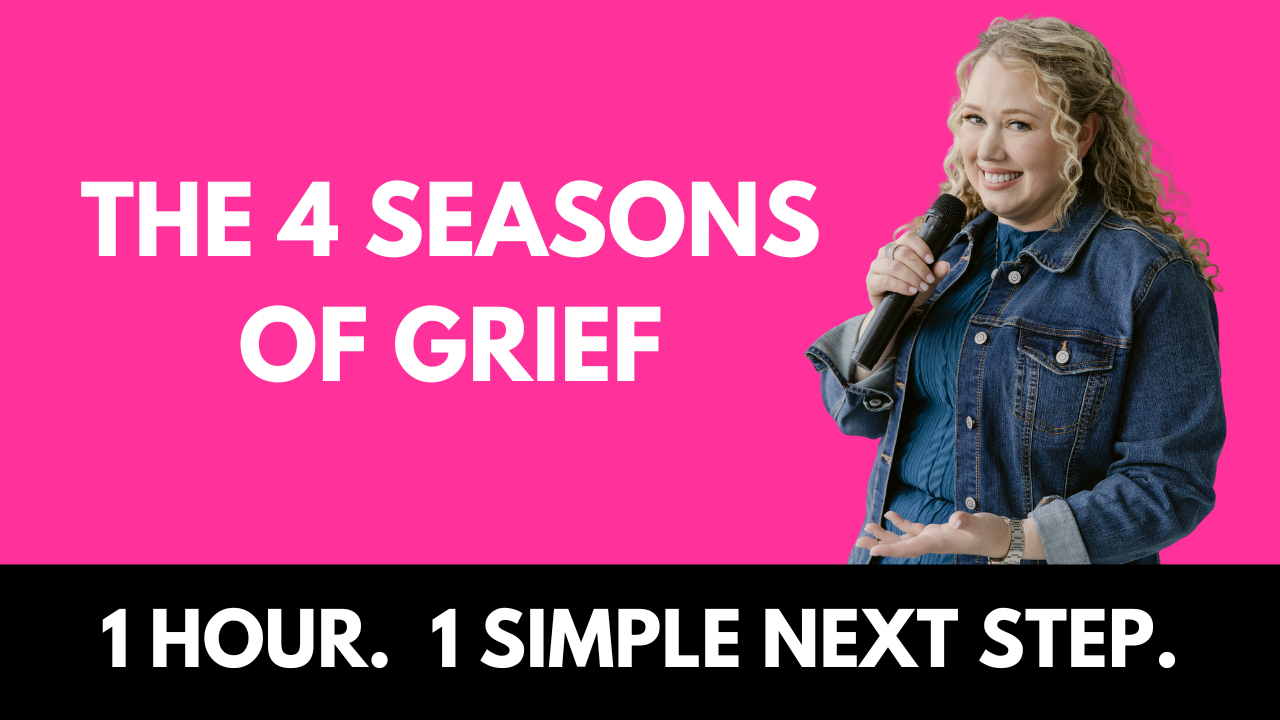
I didn't wanna spend hours and hours and hours and hours on YouTube. I wanted someone to tell me, "This is what you're gonna do this week. Let's brainstorm this. Let's go through that." And actually, through hiring my speaking coach, totally did not plan it for this additional bonus to come out, but through that process, I ended up developing the four seasons of grief, which I teach often, we refer to often.
This whole new concept of the four seasons of grief just was a bonus that came out of hiring this one-on-one coach. That never would've happened if I had not worked with her. So when you are tempted to think about, oh, I don't know, it's two hours a week, that's a lot of time, think about all the other things that you might be doing and how the academy might actually save you time [01:08:00] in the long run.
Okay, the third thing, the third thought that may come up for people would be maybe it's been too long. Maybe I'm broken. And I have so many clients, I'm not gonna spend a lot of time, because I have so many of them, who it's been three years, it's been four years, it's been seven years, it's been over 20 years.
And even though they've been struggling with grief for that long amount of time, it doesn't take that long to notice a huge shift. I think about Karen. I tell her story all the time. She's told her story. She was struggling with grief for right at four years to the point where she was lashing out, she was irritable, she almost got fired from her job.
And within 90 days, not only did she feel different, but everyone around her noticed, including the people at her workplace. She didn't end up losing her job, by the way. Her workplace helped sponsor her to continue what she was doing in [01:09:00] Brave Widow because they saw the change in her. So it doesn't matter how long it's been, it doesn't take that long even to notice a change, a shift, a different way of showing up on the calls.
One of my absolute favorite things is when our academy students start commenting on the changes they see in the lives of the other academy students. When they make comments and say things like, "Oh, I remember you used to get on these calls, and you were quiet, and you looked sad, and you were kind of withdrawn.
And now look at you. You're smiling. You radiate joy. Like, I can see the difference in you." Like, that's amazing. Not only you could experience a shift, and, and growth, and transformation, but that your peers on the call see it too, and they tell you. Like, "Look at you. You're showing up different." It doesn't mean that life is perfect.
It doesn't mean that grief is over and you're never sad again. But it means that you've expanded [01:10:00] your capacity. You have grown to be able to hold grief and gratitude, to hold sorrow and joy, to hold the fact that you love the life that you had and you love your person, and you're starting to enjoy this life.
You're learning how to love this life. It's starting to feel like it could be possible. It's more real. You start to see evidence of how it could be possible. That's amazing. In six months' time, no matter how long that you've been struggling with grief before that point. This is why I'm taking all of this time to walk you through what to really expect in the academy, because it will change your life.
I can confidently say that, not because I have all the magic powers to wave my wand and suddenly your life is changed. But I know how powerful it is to be guided, to have a roadmap, to have people who are walking the journey with you. This is why group [01:11:00] programs are so powerful. If you've heard of masterminds, those are powerful.
If you've heard of small, intimate groups that are walking down a path of journey and transformation, that's why those models work. They're so powerful. Because if you just show up, if you just participate, you can't help but change. It's gonna rub off on you. It will be impossible for you to not be changed in some way, to see progress in some way just by being in the room.
I've joined programs, even one most recently that was a big, big investment even for me. It was really a stretch. But part of the reason I joined it is I want to be in the room. I want to be in the conversations of people who are doing the things I want to do. I want to grow my business. I wanna grow myself.
I wanna stretch my own skills, so I wanna be in the room. I wanna hear how those people are talking. I wanna [01:12:00] see how those people are thinking. I wanna know how the leader navigates challenges, how they think about overcoming problems versus how maybe I think about overcoming them, which aren't helpful.
So just being in the room, being a participant, absorbing it all in, even that will change you. You've, you've heard that quote by Jim Rohn, I'm sure. "You are the average of the five people that you spend the most time with." So who are you spending the most time with? Are you in the right places? Are you in the right room?
If not, get there. Do whatever you have to do to get there
All right, so academy. Our next group is starting July 13th. We already have nine widows who have signed up. They've committed. They're gonna be there. We do cap the room size so that it stays intimate and that it stays a small group. Okay? [01:13:00] We do have scholarships for this round. We have two full schol- scholarships and several partial scholarships that we'll be offering.
The links are in the show notes. Okay? The scholarship applications need to be completed by July 9th, so we really have a tight turnaround. We do keep scholarship applications open throughout the year, so even if you are, are seeing this or hearing this after July 9th, you can still apply for a scholarship for the next round of academy, which most likely, I'm not promising anything, most likely the next group is going to be January.
So if you want support through the holidays, if you want to be in a much better place six months from now, if you wanna be guided and you want to experience a different shift in your grief journey, this is the time to join. This isn't like marketing hype. I have a book that I'm writing. I'm gonna be focusing a lot on finishing the book, [01:14:00] on promoting that, on growing our reach, on growing foundations, which is our, our program for widows who are in deep grief or overwhelmed with life.
I'll be focusing on that a lot through the end of the year. So this is really the time for you to join academy if you want to join this year. I most likely will not start another group until January because I have these other projects I really want to grow and I wanna see through to the end. Okay? So our next group starts July 13th.
We will have applications open for scholarships just for two days, and we will have applications open for the academy through July 13th. So, it's a quick application. It should take less than five minutes, and it's just kind of a gut check to make sure that I feel that you're in a good place for academy.
Also, if you're not sure, you'd like to just have a conversation with me, you can also [01:15:00] click on the link in the show notes to schedule a one-on-one call with me. Okay? It's not a high-pressure sales call. I'm not gonna be asking you to pull out your credit card on the phone with me at all, okay? I'm going to learn more about you.
I'm going to evaluate where you are in the grief journey, and I'm gonna give you your specific plan for your exact next steps. So when you get off the call, whether or not you join academy, you know, "Here are the next two or three things that Emily recommended I focus on, and I'm gonna go do that," or, "You know what?
This lady can help me. I'm gonna jump all... I'm all into academy. Like, I, I just need what she has." That's what I felt like. My coach, Dr. Betsy, when she introduced the Faith-Based Coaching Academy, I had no idea what life coaching was. I wasn't even sure it was, like, a real thing. I thought maybe it was, like, a hobby or something.
But when she told her story, and she talked about the deep grief and the [01:16:00] sorrow and the horror of what she experienced, and yet on that call sharing her story, she also spoke with such joy and love and passion. It just, like, radiated from her. I didn't know about life coaching. I didn't know what this program...
I didn't know how, how often do we meet, what's included, what courses do I get, what books do I get. I didn't know any of that. What I knew was I wanted what that lady had. That lady, psychologist, therapist, amazing woman of God, experienced horror and trauma that I also cannot imagine Things that could have overwhelmed her with guilt and grief the rest of her life.
Yet she spoke with joy and radiated love and possibility and hope, and she was just overflowing with all of these wonderful things. And I'm like, "I don't know about what's in this program, but I know I would give anything
I would give anything, I [01:17:00] would do anything to be at the place where she's at. I wanna learn what she knows. I want her to teach me what I need to do to get to that place. And making that decision changed my life. That program changed my life. And so we just had our Brave Widow retreat and our graduation for our academy students, and we had about 18 widows and widowers that came together in Oregon, and I sent her a picture just the other day, and I said, "I want you, Dr.
Betsy, to see your legacy. I want you to be proud."
Because if it wasn't for her program and what I learned there, and how I learned to intentionally build a life that I could enjoy again, that I could actually wake up and say, "I love my life," every day now. I thought that was impossible. But I took a chance because I wanted to believe if it was possible for her, it could be possible for me, too, and it changed my life.
And so I wanted her to know, this is your [01:18:00] legacy. Look at, look at the ripples you're sending out into the world. These widows and widowers have hope. They're making changes in their life because of what you did for me. And now I get to do it for other people, and it's the greatest honor I could have to help walk people through this.
So Join us in the academy. If there is something in you that is nudging you, if there's a whisper that says, "There has to be more than this. I don't know what it could be. I'm not sure 100% it could be possible for me. Maybe it's possible for other people, I don't know. But I wanna believe there could be more.
I wanna know what Emily knows. I wanna learn what she has learned so I could build a life that I enjoy again." The academy will change your life, and I would be honored to help walk you through what you can do to get there. So if you are listening or watching this before July 13th and you felt yourself in any of these stories or the things that I have shared, [01:19:00] go to bravewidow.com/academy, click on Apply for the Academy, and answer the questions honestly.
If you're not sure, you can also book a call with me, and I will help you decide, not from a place of feeling like you're gonna miss out, not from a place of pressure, not from a place of, "Oh, I have to hurry up and decide," but from a place of peace. From a place of like, "Oh, it's a big investment and I'm a little nervous, but I'm a little excited, and I can't wait to see.
Like, what is this gonna be like? It's gonna be awesome, but ooh, ooh." That energy. If this is... If you are called to this, then, then step into being a brave widow and apply for the academy. And l- or let's talk about it, okay? If you hear after the academy, you can go to that same link and you can apply and you can get on the wait list for the next cohort, which most likely will be in January.
Same with the [01:20:00] scholarship. You can go ahead and apply for the scholarship for the group that will start in January if you hear this after the cutoff time You can stay where you are in the place that you are just getting through the day. You can stay there. Or you can decide that you are worth fighting for.
You are worth investing in. Listening to this episode is just the first step. Filling out the application is step two I would love to see you inside the Academy
Speaker 13: Hey, thanks for spending this time with me today. If you're listening and thinking, "I don't wanna do this widow thing by myself," I'd love to invite you into the free Brave Widow community. It's a private, faith-based space where you can connect with other widows who really get it, join gentle live calls, and get resources to help you take the next small step forward.
To join us, just go to bravewidow.com/free or click [01:21:00] the link in the show notes. You don't have to walk this road alone. I'll see you inside