Replay: Four Seasons of Grief 5/5/26
===
Speaker: [00:00:00] Maybe I've been there. Casey, hello. Hello from Kentucky.
Mindy, I'd love to know where you're from. Michigan. Okay. Sylvia, she's one of our coaches now. Um, she's from Detroit, so I have no clue if that city is close to Detroit, but just know you got a brave widow in that area. Rochester, New York, very nice. I've been to Albany a few times, and I got invited in December by CBS National News to come out to the city during Christmastime.
So that was like a magical, amazing experience. Um, and I worked with some hospitals in the Albany area, so back in my prior life. Lake Hallie, Wisconsin. We have so many, um, widows from Wisconsin. Fort Atkinson, [00:01:00] Eau Claire. Um, oh, an- look, Barbara's from Wisconsin near Chicago. That's amazing. Kenosha, um, Waupaca.
Those are some areas I could think of in Wisconsin. Mindy's still having problem with losing husband, daughter, and son. Oh, I'm sorry, Mindy. Well, hopefully today we'll be able to help you with just recognizing what season of grief that you might be in and at least one next step to help you be able to step forward.
So before we dive in, I'm going to just open this up with prayer. Um, I am faith-based. Brave Widow's, um, a faith-based organization, and so we like to start our sessions off with prayer. So please join me. Um, dear Heavenly Father, thank you for our time together and just the ability to share what I've learned, what I've [00:02:00] seen, what has helped so many other people with this group.
And we just ask for your wisdom, for your guidance, and for you to help, um, bring hope and comfort to the people who are here with us today. Jesus' name we pray, amen. All right, so, f- um, for those of you that may not be familiar with Zoom, um, at the bottom of your Zoom screen, there should be a chat button.
You can click on the chat, and, um, in the chat box it'll say, "To everyone" or "To host." And so if there's something that you wanna share with me but you don't want everyone to see, you can change that everyone to just the host. Um, but the chat, like, keeps me going, because I cannot see your faces. The chat lets me know if what I'm saying resonates with you, if what I'm saying is confusing, if you're like, "Yes, this [00:03:00] is me."
Um, the chat just, like, lets me know what I would normally be able to see if we were there in person. So whether you wanna post emojis or a one word, whatever, in the chat, just keep engaging in the chat, and that helps me out. And then we also, at the bottom, have a Q&A box. And so if you have a question or there's something you want me to expand on, put it in the Q&A box, and that will help me.
What that does is the Q&A box creates a list for me to reconcile towards the end. So, um, sometimes if we get a lot of people going in the chat, then the questions kind of get flooded, and they could get lost, and we don't want that to happen. So, um, put your questions in the Q&A. All right. So if time and grief groups have not helped you to move forward, this next [00:04:00] hour with you will.
And what I'm gonna share with you today, I wish I had hours and hours and hours and months and months to share with you everything that I know, but because we have limited time together today, I'm going to simplify things as much as possible, and my goal is not for you to learn every single thing. It's not for you to absorb every ounce of every second of what we cover today.
My goal for you is to t- walk away with one thing, one thing you can focus on, one thing you can use as a takeaway, one next step, like, one thing to help you get unstuck and feel like you are moving forward. All right. So this is, um, my family, and if you were to ask me almost [00:05:00] five years ago now whether or not I could imagine sitting here having this conversation, my answer would be absolutely not.
Because in July of 2021, I watched as an ambulance took my best friend and my husband of right at 20 years away from our home, never to return. We both had been sick with COVID. It morphed to double pneumonia, and he would ultimately end up being in the ICU for 11 days. And, uh, because these were COVID times and because I was also getting over COVID and pneumonia, um, I wasn't allowed to visit him at the hospital.
And one day they called me to the hospital, and he had some ups and downs, but overall things were looking positive. Things were looking like they were improving. And [00:06:00] so they, they called me to the hospital to talk about next steps on this road to recovery, but really there would be none. So I remember sitting in the room across from the physician.
There was no kindness, there was no warmth, there was no smile. It just felt very cold, and in a flat tone she just said, "We think your husband is brain dead." And I remember in that moment, like, the world just kinda stopped spinning, and I try to wrap my mind, like, "How did we get here?" Like, he was doing better.
How, how did we get here to this point? Like, I was so shocked by what she was telling me. Ultimately, they would run a few more tests, and they would make the decision to stop all life [00:07:00] support. This was three weeks before our 20th wedding anniversary, and thank you for the condolences. Thank you. Um, three weeks later, we'd already been planning a big family get-together for a celebration of our 20th wedding anniversary, and you can see here in this picture I'd already ordered T-shirts.
I was already planning this big celebration. And so we did still host some family and friends over, but it was more of a celebration of Nathan's life. Um, instead of being able to go through that day happy as someone celebrating their 20th anniversary, I faced that day crushed as a young widow and now a solo mom to these four teenagers that we have together.
About a year later, I had this... It was actually close to [00:08:00] kinda where you saw us in the picture there. I had this memorial garden built, um, to the side of our house, and I wanted something very beautiful to remind me of just the love that we had, the life that we had grown together. Like, I was married at 18, and so we grew up together.
Um, all those years together, that's just what I knew. But what I found was that instead of being comforted by this garden, I was just tormented by it. Like, every time I would walk out there and sit on that bench, it would just remind me that he was never coming back And so I remember one afternoon in particular, I was sitting out on this bench, and I was, like, doubled over, and I was crying.
You know, like that guttural cry that comes from your stomach, and it doesn't even... You're like, "What does that sound [00:09:00] like?" It's scary, right? You're just deeply crying. And I remember my chest hurt so bad that I thought my heart was gonna burst, like, right then and there. Like, I had that thought of, "This is it.
Like, this is how people die of a broken heart. Like, they just cannot take it anymore." And when the tears finally stopped, I sat back up, and I was just thinking about how unfair life is, and I was thinking about, like, how unfair it was that, you know, my kids had lost their dad. But basically, they had lost two parents, 'cause even though I was alive, technically I felt dead on the inside.
And being here over a year later didn't seem like life was gonna get better any time soon. But while I was sitting on this bench thinking about the unfairness and thinking about this and just thinking about, like, I just, my [00:10:00] body cannot sustain this much longer. I knew. I felt like I was at a crossroads.
Like, I was going to need to decide to do something different or I didn't know how much longer I could keep going down this path that I was going. And so I remember thinking that, "Okay, if I have to be here another 20 years, 30 years, 40 years, whatever it's gonna be," I was 38 at this time. I was like, "I do not wanna live like this.
Like, I have got to figure out some way, somehow, to get on the other side of grief. Like, I cannot live my life like this anymore." And so I remember closing my eyes and just saying, "Nathan, I love you, and I miss you, and I h- can't live like this anymore. I have to be able to move [00:11:00] forward." And I stood up, and I went inside, and it was like that moment was really the catalyst for me of diving into obsessively learning everything I could about grief.
I ended up, um, taking all kinds of courses and classes, interviewing hundreds of widows. I launched The Brave Widow Show, um, where I had many widows come and tell their story and share what helped them get on the other side of grief and what helped them rebuild their life. I went through a massive journey of healing And intentionally rebuilding life.
And I'm happy to share that now I do love my life every day. I've done things that I never thought I would do, like I started real estate investing, public speaking, um, I've [00:12:00] traveled to five new countries. Um, I even met and married the most amazing, um, supportive husband and gained a bonus son in the process.
I got to meet Dave Ramsey in person and thank him for all the work that he's done. I've just been able to experience a life that is so full and vibrant, but it came with, with intentional rebuilding. It wasn't time that got me there. It wasn't just sitting around and waiting to feel better. It was actually time that allowed me to do that.
And so my approach, just so you know, because I know several of you are new, my approach to serving widows, I was trained by the accredited Faith-Based Life Coaching Academy. I've been licensed and certified by the Grief Recovery Institute, which is, uh, has an evidence-based program, and I was coached by a, a psychotherapist who was a [00:13:00] practicing therapist for 20-plus years.
Um, Brave Widow was born October of 2022, so she's three and a half years old now. Um, we're in 20 countries. We have clients in all kinds of different countries. And, um, my approach to serving widows is emotional healing as our foundation with intentional rebuilding of our life in multiple areas. So I wish I could take everything that I've learned and give it to you right now, hand it to you.
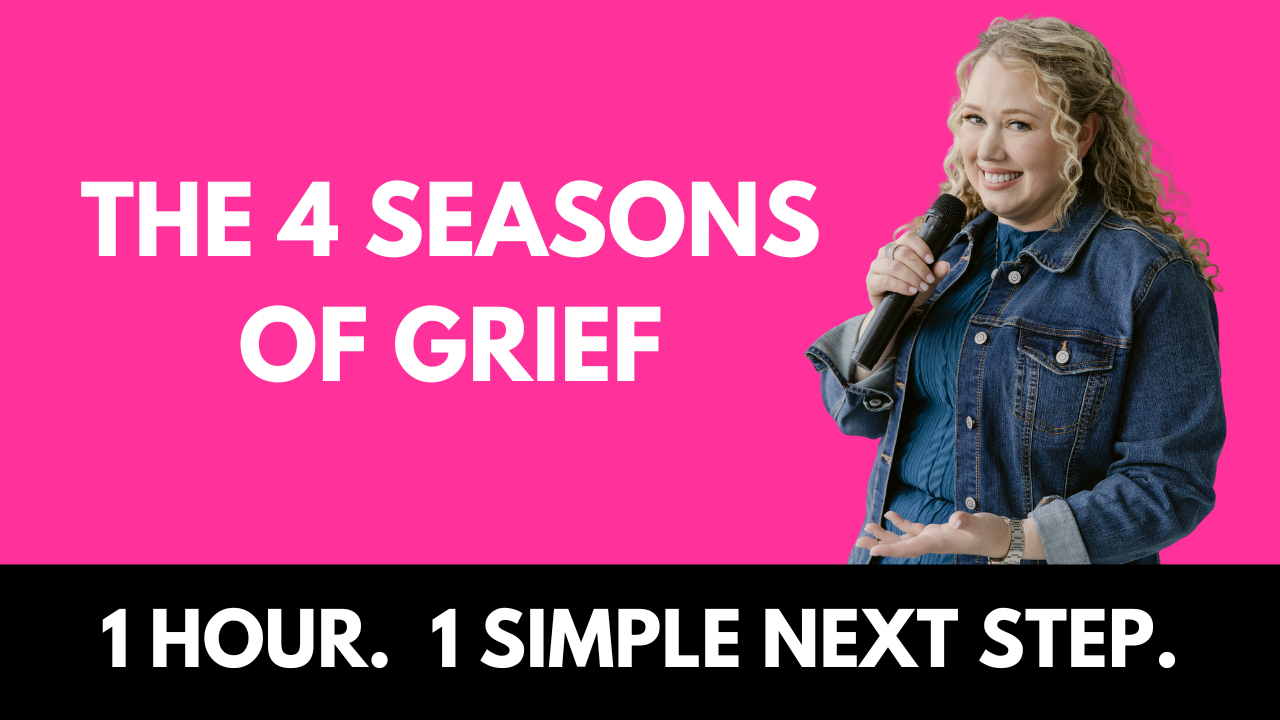
That would be super overwhelming. But what I wanted to share with you today is something that I've developed called the four seasons of grief, and this has come from interviewing, coaching, supporting hundreds of widows, and personally coaching several of them one-on-one. It's come through my own experience and just observing a lot of patterns of what I see [00:14:00] in people on their journey to grief.
And so you may have heard of the five stages of grief, which actually wasn't created for widows, by the way. So if the five stages don't resonate with you, that would be normal. That was created for a different group of people. But we created the four seasons. Um, four seasons being we can be transitional from one to the other, right?
Like right now, the weather here is really crazy, and we're going, like, back and forth. Um, but also because I view life as a series of seasons that we move through, okay? So we're gonna talk about each one of these, and I just encourage you- To identify which one resonates the most with you, I'm gonna share the mistakes people tend to make in those seasons that hold them back.
And again, just one simple step that you can do to help you move forward. Okay, so the first season of grief that we [00:15:00] have here, we call rawness. So this is what we often think of as the early days of grief. This is when we are completely overwhelmed. We are in shock. We have a lot of anxiety, like our whole world.
I, I think about it like a tornado just blew through your neighborhood, and you're looking around and you're like, "Everything kinda looks the same, but it's all different." I go to the grocery store. It feels different. I go to church. It feels different. I go to bed at night. It feels different. Like, things are kinda where they were supposed to be, but it's all different.
Like, the dust is still kinda settling in the air. And it's completely overwhelming. We often live in what we call survival mode. Our nervous system is out of whack. We have a lot-- tend to have a lot of fear and anxiety and what-ifs, and be afraid to make decisions. Does anybody feel like [00:16:00] that? Is anybody resonating with that so far?
And so one of the mistakes that people tend to make in this season is powering through, right? So when we're first widowed or when we're really overwhelmed, we are-- all of a sudden, we inherit all of these new tasks, all of these new to-dos. We have all this paperwork to get through, all of this administrative stuff to get through, and we just, like, take on more.
And what is it that people tell us? Do they tell us to slow down? Do they tell us to do less? No. What do they say? "Be strong. You can do this. You'll get through it. You'll come out the other side, you know? Give it time. You're gonna be okay." And so we tend to think we need to do more. We have to be strong. We have to, like, [00:17:00] like, strong arm and with willpower push our way through.
Like, we think that's what we need to do. And what I teach widows to do instead, so if this is you, if this is a season you resonate with, here's your one simple step, okay? There's a lot of things we focus on in this season, but if I was just to give you one, it would be to do less, not more. And this feels really counterintuitive because it's like, "Oh, Emily, you don't understand.
I gotta do this and I gotta do that, and then these people are waiting on this, and I need to declutter my house, and I gotta figure out where I'm gonna live, and I gotta figure out what this is gonna be like, and, and I've gotta clean out the closets, and I've gotta, you know, do all these things. I can't do less, not more.
I have to keep going and keep going and just be strong," and all of these things. But here's the thing, like, your nervous system cannot heal, your heart [00:18:00] cannot heal, you cannot come down out of the chaos if you are going, going, going. You don't allow that time of rest. You don't allow that time of intentional safety and healing.
As we do more, we keep our nervous system amped up, we keep our brain amped up with all the what-ifs, all the, all the fears, all the things that are happening there, okay? So in the early days of grief, I encourage people to do less and not more, to lower the expectations that you have for yourself, to give yourself so much grace, to rest, to accept help, to ask for help, to do less.
Cara says, or Carrie says, "Exactly what I did the first year. Headed towards the second year, I was a robot." Yes, I felt like a zombie. Like, when you have a [00:19:00] newborn and you're waking up every two or three hours and so you're not getting any sleep and you're just, like, zombified. That's how I felt. Pamela says, "I'm in the rawness stage.
It's been six months for me." Oh, my heart goes out to you, Pamela. This is a really hard place to be. And this is also why we experience brain fog, why things feel hazy, why people tell you not to make big decisions in the first couple of years, right? Because you can't think clearly. Because literally the way your brain is working when you're in grief or when you're post-trauma is not the way your brain works when you're not in that state of mind.
Which is one of the things that we learn about in Brave Widow, 'cause I'm a nerd and we like to nerd out about stuff like that. Okay. So that's the first season of grief, rawness. The second season of grief is what we call isolation. And so think about rawness, the tornado has come through the neighborhood, it's blown [00:20:00] things to smithereens.
The dust is starting to settle, right? And what tends to happen when we're in grief is we tend, not always, but many times we tend to withdraw, right? So we tend to turn inwards and to focus on ourselves or our immediate family or the things in front of us, because that's what we have the capacity for. We are just surviving.
We're not thinking about five years from now. We're not thinking about a positive future. We can't even fathom that in the beginning. We're only focused on what's right in front of us or what's right here. And what tends to happen for most widows, the statistic is that, um, most widows will lose 75% of their social circle within the first year.
So has anybody noticed a change with their friends or family? Maybe people didn't show up for you the way that you hoped or the way that you wanted. [00:21:00] If so, there's nothing wrong with you. It's just normal. It's a normal thing that happens. There's a lot of reasons why it happens that we won't get into today, but that is something very normal.
And so it's like after the service, it's like crickets sometimes. And we look around, and we're like, "Where did everybody go?" It's like in the first season of grief, we pull back into our little cave, and we hibernate, and we, like, bunker down for the storm to blow over. And then in season two, we're looking around, like, where is everybody at?
Yes. Yes. Yes, it's a mess. You find out who your true friends are. Yeah, right? You're, like, looking around like, "Where did everybody go?" And so in isolation, we tend to feel incredibly lonely, stuck, aimless. Like, I felt like a tiny little boat in the middle of an ocean, and I was just getting smacked around by waves of grief.
And the [00:22:00] sad, the scary thing to me was I didn't know which way to turn the boat. I felt so untethered, like I was just drifting. I wasn't anchored to anything, and I couldn't wrap my mind around, like, how, how do I steer the boat in any direction when, when I don't even know which direction to go? Like, I'm just out here, like, floating through life.
Life is happening around me, but I'm, I'm just, I'm just stuck here, just getting smacked around, right? So some of the mistakes that we tend to make in isolation... Casey's like, "Yes, I resonate with this so much." The mistakes we tend to make in isolation, um, one of the biggest ones is giving it time, and we hear that so many times, right?
Like, just give it time. Time heals all wounds. We just, we just gotta give it time. And here, here's the thing. I'm not making this [00:23:00] up. This is part of our evidence-based program. What we learn is that the, the key to recovery in grief is actually action, not time, okay? And so here's how I think about time.
Time is- an ingredient in the recipe to healing your heart and building a life that you love again. It's true. I can't give you all the healing. I can't give you a magical pill today, and tomorrow you're like, "Whoa, no more grief, and I love my life. This is amazing." Like, it, it does take time. It does take time.
But it doesn't only take time, right? So here's how I think about it. Let's say that I wanna go to the gym, I wanna work out, and I wanna lose 20 pounds, okay? Does it take time to go to the gym and work out and lose 20 [00:24:00] pounds? Yeah, it takes time. How much time? Well, depends on the person, depends on a lot of things, right?
Like, if I'm really overweight, I might be able to drop 20 pounds in, like, a month. If I'm not, or other conditions apply, it may take me a year to lose 20 pounds, right? Like, time is needed. I can't just flip a switch and tomorrow I've lost 20 pounds and I'm in great shape, 'cause I have been going to the gym.
But time isn't the only thing. If I just sit around on the couch giving it time, and I don't go to the g- gym, and I don't change what I'm doing, I just keep doing the same things I'm doing right now, I'll never lose the 20 pounds, even if I do that for years. So time is an ingredient in the recipe to healing your heart and rebuilding life, but it's not the only thing.
And that's one thing that I wish I knew way back. [00:25:00] 'Cause I-- people just kept saying, like, "Just give it time," and I'm like, "Yeah, but time isn't helping me." Like, I've been giving it time. I waited a year and a half. I'm like, what? You know? I'm not really feeling any better. Like, when-- w- how? Like, how does it actually change?
And no one could tell me. They're like, "Well, just keep waiting." Like, this isn't working. And so, um, what I suggest that people do when they're in isolation, when they feel lonely, when they feel, um, unseen, when they feel lost, they feel stuck, is to invite... It says invite one in, okay? What does that mean? It means we're gonna send one text message to someone.
It means that we could invite someone to go out to coffee. It means that we're not trying to rebuild our whole entire social circle. It could be that we reach out to another widow. But in [00:26:00] whatever capacity or whatever way is the simplest, we invite another person into our life so that we aren't isolated and we aren't alone, okay?
All right, so we had rawness, we had isolation, and now we have the season of self-discovery. Okay? So this is where most widows get stuck is between season two and season three. So self-discovery is where we have, you know, we're not in survival mode, okay? So we're not totally overwhelmed, we're not just trying to get through the day, but, and we have our feet underneath us, but we're at a point where we're like, "Is this it?"
Right? Like I remember thinking to myself, like, "Okay, I've, I've gone to counseling, I've been part of the groups, I've talked with a whole bunch of other widows. Like I'm feeling better, you [00:27:00] know? Grief isn't overwhelming every day." But like, is this it? This? Like 30 more years of this? Really? Like there has to be more, right?
Is, or is it like, all my best days are behind me and it's just all downhill from here? Like what, what? And so we tend, what I tend to see widows do here is they start trying new things or they start dating or they start going to new places or they start trying new hobbies or whatever it is, and then they get eaten alive by guilt, by fear, by doubting themselves, by wondering like, "Am I doing this right?
Um, it feels so hard and awkward and weird, and I'm not even sure if I should be doing this." Or, you know, "How, how can I laugh at this movie for five minutes? I should be grieving. Like it's wrong for me to laugh when I should be grieving." Or, [00:28:00] uh, you know, I remember one time that I went to see, um, Jordan Peterson.
He was speaking in Tulsa, Oklahoma, which is a couple hours from where I live. And so I remember I was like, "Okay, I wanna start like doing things in life. I don't want my life to just be empty." And so I was like, "Oh, he's doing a conference. I'd love to go hear him." And as I was driving on the way there, I pulled over at a gas station to get something to drink.
And when I got back in my car, I just started sobbing. And it was like all these thoughts that were coming up like, "What are you doing? Why are you doing this? Why are you trying to pretend that you're fine when you're not? What's the point of going and doing these things when Nathan's not here? What do, what does it matter if you're gonna enjoy a little bit of time?
He's not gonna be there to see it. He's not there beside you. You're by yourself." Right? And there's an extended version of that story, but all [00:29:00] throughout the rest of the day, it was so painfully obvious that Nathan wasn't here, that I felt guilty for even trying to think about doing something new, that I felt incredibly awkward like everyone was looking at me.
Everyone knew I was the weird widow that was there by herself. Like, I was so self-conscious about every little thing. And so this is why widows tend to get in this, like, vicious cycle because we have this whisper on the inside that's like, "There has to be something more to life." Like, I- maybe. Like, it's really quiet, right?
Because we're not sure. And in some cases, we don't know how it could be true. Like, how could it be true that I enjoy life again because my person isn't here. Like, that fact doesn't ever change. So how would it be possible to enjoy life again? I- is that even real? But there's something inside of us that's like, "This can't be it, right?"
Like, [00:30:00] there's more. But then when we g- think about doing something new, it's scary, and it's hard, and it's awkward, and it's weird, and it's intimidating. And we get wrapped up in all the what-ifs and how unsafe it is and all of those things, right? How we're gonna be judged, whatever. Home renovations can't stop.
Oh, no. Oh, no, Casey. So the mistakes that I see people make in self-discovery are giving up. People just tend to give up or feel stuck or stop trying or think that they're doing grief wrong. They feel like that they're not doing it correctly, that if they were doing it right, it wouldn't feel so hard. And so here's, here's one of the things that I teach people in Brave Widow, okay?
Is that when you are rebuilding your life from the ground up, which is really what we're doing, where our old life is in [00:31:00] ash, and we can't go back to the life that we had. We can't go back to the person we were, and so we are already in our new life. We don't think of it that way, right? We think of like, "Oh, if I step forward, I'm stepping into a new life."
You're already in your new life. The decision that you get to make is if you're going to rebuild this new life, a life that could feel more full, more vibrant, doesn't feel hollow and empty. You could decide that you're gonna stay where you are, that you could stay in this, this life that, that doesn't feel great, or you could decide that you're going to build something new.
Both of those are hard. It's hard to stay where you are and to stay stuck, and to feel that life's never gonna get better. And people will tell me. They'll say, "Nope, nope. Life's never gonna get better. You're wrong." [00:32:00] And as much as my heart hurts for those people, I'm like, "Well, you're right." If you've made up your mind that your life is gonna be miserable, and it's always gonna be awful, and it's never gonna get better, y- that's your right to decide that and to stay in that.
You get to do that. That you don't have to, but that is something that you can decide. Or you can decide that maybe some way, somehow, it could be possible that life could feel better, that life could be lighter, gentler, whatever that baby step is, that life doesn't have to feel like this for forever. And so we do things.
So what we do is as we're building up this new life, we feel the fear, we feel the anxiety, we feel the awkwardness, we feel the uncomfortableness, we feel the [00:33:00] uncertainty, and we do it anyway.
And what I tell people is we call it brave widow, not fearless widow. Because brave is when we choose to do something even though we're afraid, even though we're not sure, even though we're like, "I don't know how this is gonna ever work out, but okay, I'm gonna give it a shot." That's the brave choice. To say, "I don't know how it would be possible that my life could be better than it is right now, or that I could ever feel at peace, or that I could ever feel content or grounded again.
But, you know, I see other people, or I hear Emily, or I see so and so, and I think, well, maybe if they could do it, I could do it, too. So I'm gonna try, even though it's hard, even though it's scary, even though it's awkward, even though it's weird. I'm going to feel all of those [00:34:00] uncomfortable emotions, and I'm gonna do it anyway."
And I teach you how to rebuild confidence. I teach you how to battle all the thoughts swirling around and around and around that are holding you back and keeping you small, and we do it anyway.
The title Brave Widow is what drew me to this webinar. Amazing. You're in the right spot. All right. Season three can actually be fun. So when we talk about self-discovery, this is where we actually get to have a little fun. We get to experiment. We get to be adventurous. I think about this like we're walking through a forest, and we can't see around the corner We can't see what's on the other side.
It's kinda like a Lord of the Rings adventure. We don't know. Is there monsters that are hiding in the bushes? What's that weird noise? What's going on over there? I don't know anything about this. This is weird, right? [00:35:00] But we take these steps, baby steps forward in faith, one after the other, in belief that on the other side we will have a life that we enjoy.
We will have something that we can look forward to or be excited about or whatever it is that we are looking for. But it takes that s- those steps of faith when we can't see the outcome. All right, so the fourth season here is empowerment, and this is ultimately where we would love to be, um, where I very much feel like I, I am here, and several of my clients, where we feel more purposeful.
We feel expansive and clear on who we want to be now, on what we want more of in our life, and we don't have everything, right? But we're chasing new dreams. We're going after things. We are working towards... We have [00:36:00] something we're working towards in our life. Maybe it's something big, like you ha- you wanna downsize a house or upsize a house.
Maybe you want to change careers. Maybe you want to create a simpler life where life just feels much simpler and gentler. Whatever that is, you have something that you're working towards and that you're able to expand. And so one of the things that we teach, um, widows to do here is... Well, I'll, getting ahead of myself.
Okay. One of the mistakes I see people make in empowerment is that they shrink back. They stay small. And I see this all the time when people are like, um, "Well," and, you know, they'll be like real quiet. "Well, I think maybe I'd like to start a widows group at my church," but then I'm like, "Well, who am I to do that?"
Or, "Who am I to, to do this thing?" [00:37:00] Or maybe they'll say, "Oh, I'd really like to write a book," or, "I'd really like to do this," um You know, Casey has an amazing podcast, by the way, Casey. Um, start this podcast. I'd like to, um, you know, try this pottery class. I'd like to do this, but I don't know. Could I really do that?
Y- who's gonna wanna listen to me? Who... You know, I, I don't really know, right? And so I'm that person just, like, pushing them, not off the cliff, just, like, just on the other side of the comfort zone, right? They tend to just, like, shrink back and think, "Well, well, who am I? And, and why could I do this?" And so what I teach widows to do is to live what I call their and life, okay?
So what we learn and what we do in Brave Widow is not forget about the past, okay? We're not leaving your person behind. We're not [00:38:00] pretending that grief doesn't exist. We learn how to hold, have the capacity to hold emotions that feel opposite but are both true, okay? So and could be, "I miss my person. I love the life that we had together.
I wish I could talk to them one more time, and I'm really enjoying the life that I'm creating now, which wouldn't be possible if my person was here, which also feels really weird, but I'm able to carry both." I just got back over the weekend from a trip to Italy. My late husband, Nathan, his parents were celebrating their 50th wedding anniversary.
So my husband now, Robert, and I went with my in-laws on this whirlwind trip through Rome and Florence and Venice celebrating their 50th wedding anniversary. [00:39:00] And it's not like I forgot Nathan existed. It's not like I didn't have the thoughts of like, "Well, this is weird. How would this trip be different if it, Nathan was here and not Robert?"
It's not like people didn't ask my in-laws, "Oh, is this your daughter or your son?" And knowing that they don't wanna explain the awkwardness of like, "Well, we had a son, and he died, so this is our daughter-in-law and our son-in-law." Like, right? Of hearing how they answered when they're like, "Oh, do you have other children?"
Hmm, how many other children would they say they had, right? I noticed all of those things. I know that there had to be times that they imagined to themselves like, "Oh, what would it be like if Nathan was here?" That's kind of, you know, maybe different that he's not here and Robert is here, and they get along really well, so that's not the issue.
But I'm able to observe that And to notice that [00:40:00] and to feel joy and gratitude and be in the moment, and not let those thoughts overshadow and, like, ruin my experience there. I felt like grief used to ruin everything. And I would sit in my kids' choir events, and I'm supposed to be happy 'cause they get an award at choir, and I'm just bawling my eyes out because all I can think about is their dad isn't here, and that isn't fair.
And not only is he not here, but he's never gonna be here. He won't be here for the wedding, he won't be here for the graduation, he won't be here when they have their kids. He'll never meet one of his grandkids. Like, I would just... Those thoughts would torment me. But now I'm in a place of peace, and I'm very grounded.
So when those thoughts do come up, it's more of an observation. And like, yes, that's true, and I'm so glad that I'm here to watch them make this big [00:41:00] milestone. And I believe that he would be so proud of them if he was here. So it's not about forgetting the past, moving away from the past. It's like how do we weave in our person into this new life that we're building in a way that honors the love that we shared together, the life that we had together, and doesn't feel like we're leaving them behind?
All right, so I just wanna share with you, um, about a few of the clients that I have worked with, um, just to give you some examples of what we've, what we do at Brave Widow. So Karen, that you see here, she was on the podcast if you wanna watch that. She goes a lot into her story. Um, what I would say here about her, when I, we first met, she'd been widowed for four years, okay?
So remember me saying that time didn't matter. She'd been widowed for four years, and she wasn't feeling better, [00:42:00] okay? So when I first met Karen, she was really struggling with grief. She was just put on a performance improvement plan with HR, which if you don't know what that is, it's like official documentation that's basically like, "If you don't change your behavior, you're going to be fired."
Okay? It's like HR, we're all covering our bases. We're all gonna sign on this. She had been mandated by her employer to go to counseling, and her counselor told her it was time for her to move on. It'd been four years, and so she quit going to that. She tried going to grief groups. She just didn't really resonate there.
And when we first started working together, I took her through, um, one of the, the classes I teach called Grief Recovery Method, and we also started doing some one-on-one coaching. And within- 90 days, okay? So it had been four years. Within 90 days, she had her check-in back with her HR [00:43:00] department and they asked her, like, "Karen, what is different?
Like, what, what have you been doing that's different? 'Cause we notice, like, you show up here very differently than you did in the past." And so she told them about Brave Widow. She told them about some of the things that we had done, and not only did they take her off the Performance Improvement Plan, but they also started to pay for her coaching so that she could continue that.
So I want you to think about how drastic of a change that is, not only for her to feel a shift and to feel something different. Now, didn't mean her grief went away in 90 days, but she felt heard. She was able to process a lot of the grief that she'd held inside of her for a long time, and she began to show up every day to life and to work differently than she used to show up in the past.
So much so that her employer is like, "Well, we're gonna keep paying for it for you because you have to keep doing this. Like, this is helping you." [00:44:00] So you can hear more about her story there. Um, Sue. Sue's an OG Brave Widow lady. She's been with me for three and a half years, and when I first met her she'd been widowed, um, between one and two years.
She hated being called a widow and I totally understood that because I hated it, too. I thought widows were, like, sad cat ladies that were 90 and just sat around in their house all day. And so being 37 and a widow and, like, I just didn't want anything to do with that label, 'cause I didn't understand, like, how amazingly resilient, generous and, I don't know, just full so many widows are.
Like, I had no idea. I had a total misconception on what widows were. And so she wasn't sure what she wanted to do in her future. She, um, a future [00:45:00] relationship was not in the cards for her, but she wasn't sure what she wanted that to look like. And so as we worked together, she started traveling to new places on her own.
She started joining different types of events and groups, and she ended up writing a bestselling book that you see here called The Miracle of Marrying My Heart. And she also co-authored two other bestselling books, and now she is a coach for me inside of Brave Widow, helping to support and guide other widows that are in the group.
She's really- Just an amazing person and someone I would say who's definitely in season four there. And then the last one I'll share about is Wayne. Um, his story is on Brave Widow, on the website there, so you can hear him. Um, when we first met, he actually was referred to me by a friend that, um, was in my group named Allyson, who's also a coach now.[00:46:00]
Um, but he was referred to me because he was going to counseling or grief groups every day. Literally every day he was going to some different group or he was going to counseling, and he just really felt hopeless and he felt stuck, and he just felt like instead of getting better he was just getting worse, and that nothing was helping him.
And in his story he even told Allyson, he's like, "I don't want another counselor. I don't want another grief group. Like, I need something different." And she said, "Just talk to Emily. Like, you, you have to talk to her." And so, um, Wayne first joined the Grief Recovery Method class that I teach, and then he ended up messaging me and saying, "Hey, do you do more than this?
Because, um, this is good, but I feel like, like I want more." And, um, now I'm happy to share that he's actively rebuilding his life. He just moved into a home that he built out on a farm with his [00:47:00] doggies, and he's been reengaged back into things like flying and meeting up with some of the groups that do things like hiking or some of the single groups in his area that he likes to hang out with.
And just, again, in this motion of rebuilding life. But one of the things that he shares is that he had more hope in the first call that we had together than he had had in months. So I just wanna invite you to imagine six months from now, that would be November,
being able to wake up with a sense of hope. Being able to experience not that life is perfect, but having those glimmers and those moments where you actually feel alive again, where you actually [00:48:00] catch this moment of excitement of like, "Oh, I didn't know I could be excited about something." Uh, one of my clients recently shared that she was in a store and she bumped into an acquaintance, and that person was like, "Oh, hey.
How are you?" And she's like, "I c- I wasn't even thinking." And she's like, "The words c- came out of my mouth were like, 'Oh my gosh, I'm doing great. I have so many exciting things going on. I'm building a new home. I'm doing this, I'm doing that.'" And she's like, "It's the first time- That I ever answered it that way.
Like, normally my default is like, "I'm fine. How are you?" But she was able to honestly just instinctually respond, like, "Oh my gosh, I'm doing great. I have so many exciting things going on." And so just imagine if you were able to say that to someone who stopped you in the grocery store and asked you about that.
So I'm gonna share with you, um, [00:49:00] about Brave Widow Academy, because we have a few different things going on at Brave Widow. But specifically with Brave Widow Academy is designed to give you the tools for each season of grief. So we go from season one all the way to season four in equipping you with the tools and getting you to practice using them, so that as you move through these seasons, you don't ever get stuck, you don't ever feel lost, you don't know, like, what should I be focused on, or how do I, like, how do I make new friends?
What do I do with family that is really negative? How do I have boundaries? Like, what am I supposed to do? You will know. You will have the tools to be able to navigate that. So as I think about who Brave Widow Academy is for, this is for you if you've tried things like counseling, grief groups, books, podcasts, but you still feel stuck.
You're [00:50:00] functioning, okay, but you still feel lonely, empty, or without purpose. You desire something that's faith-based, that has evidence-based tools and community, not just talking about how you feel. You're willing to show up and to do- take some small brave steps to move forward. This is not for you if you're in crisis, if you just want to give it time, or if a faith-based approach would offend you.
And so most of our folks are faith-based. Not every single person is, but like I said, we do pray at the beginning of our sessions, so I wanna make sure that everybody's comfortable with that So let me tell you about Brave Widow Academy. So what is the academy? Is a six-month group coaching program. We meet every week for two hours.
The first hour we're going through, um, the tools and [00:51:00] the training and the content, and the second hour we're openly sharing about what you observed or learned, or you can get real-time coaching. And our next group is gonna start in July, and that's gonna be led by two of my coaches, Allyson and Nicole.
And I just wanna show you, because this just came in this week, but this is our textbook. So now all of our students will get this beautiful textbook, um, with the worksheets mailed to their home, and it's spiral bound, so much easier to take notes. This is over 200 pages of worksheets that we do together in class.
So it's not about loading you down with a bunch of homework, but it's not a, "I want you to sit on a Zoom and just listen, and hopefully go do something with it." Real time, in class, we take time to do our worksheets together and for you to [00:52:00] formulate, like, how are you going to apply what you've learned in your life.
Like, what are the things that you could do right now with the information that you've learned, and we help you figure out what that looks like based on where you're at. We also... So as part of the book, um, we... I created a five-course curriculum and a roadmap. So I shared with you the four seasons of grief, and, um, these are the four seasons and each of the courses or the modules that we go through.
So the first one is Grief Recovery Method, which is this purple book if you've ever seen me talk about that. This is a 40-year-old program. It's evidence-based, meaning it was studied by an outside group and proven to be effective to help people with grief recovery. It's the only tool I use that isn't mine, so I didn't create it, but I'm certified in it, [00:53:00] and the coaches who now coach, um, for me, I have invested for them to become certified in it because I believe in it that much.
If you do nothing else after you hear this today, you can take this from anyone online, you can take it in person, you could buy the book. Like, just do it. If you're struggling with grief, this is really, really good to help you with your foundation. Okay? So once we have a good foundation, then, um, the courses that we go through in academy are things like how to escape survival mode, how to rebuild your confidence.
How to meet people and make friends, how to find purpose and meaning in your life again, and how to create a life that you love. And this doesn't mean, again, in six months that your life is perfect and you have no grief and no issues. What it means is that you've learned and you've started to use the tools that will [00:54:00] help you in every single season.
Like, if somebody's stuck in some of these seasons, I always look at, do they have a good foundation? So are we working on these things already? Then I point them to some of these things that they can start working on to build out this life that feels full and vibrant. Okay? So weekly coaching call support, the curriculum that we teach, plus grief recovery method.
We also utilize a private messaging app that's called Telegram, and you can message the group 24/7. And it's a small group, so we limit the number of people in the group to 20, um, because we want people to form close relationships in that group. We don't want anyone to feel like they're just in a big sea of people, and we wanna give time on the weekly calls for anyone who wants to share, anyone who wants coaching, anyone who wants feedback, to all have the opportunity to do that.
And so if the group gets too big, [00:55:00] then we, we may not be able to do that. So we intentionally keep it small so that we can have this sense of like, we're all doing this together, and not that you're just trying ... You're getting left behind, and everybody else is moving forward, okay? So you have the ability to communicate within the group, um, t- at any...
Like 2:00 AM, you know? 2:00 AM Christmas morning, you can post in there that you're, you're struggling, and that you need prayer or support, or you want suggestions, um, for something, and get a response. You also will get a coaching call and a personalized, um, plan. So, um, if you join Academy, I personally onboard you and make sure that I understand where you are in the grief journey, and I will give you your personal plan of like, okay, these are exactly the next steps of what I would focus on, um, and what will help [00:56:00] you with getting unstuck and feeling like you're moving forward.
We have a, um, I did a special holiday, I don't know what I would call it. We call it Brief Through the Holidays, but nobody really knows what that means. But basically, we did a whole series over this past holiday season of, like, how to navigate- Family tradition and expectations, um, how to have boundaries, and I give lots of examples of what you can say to people.
Um, we talk about, like, ways that you may wanna honor your loved one, may- ways that you may want to skip a holiday, all kinds of things to help you through the holidays, through milestone dates, through dates that are really hard for you. Um, that's sold separately, uh, as a program, and so I include it as a bonus here for you.
So all of these things that I've shared with you that are included in the academy, um, I kinda priced out separately [00:57:00] here so you can see what the value is or what I've sold it separately before in the past. So if I were to add all of those up together, it'd be around $7,000 in value, and your investment with the academy would be 3,000 if you wanna have a discounted rate and pre-pay, or you can do a payment plan up to $300 a month, um, if a payment plan works better for you.
And you also have a risk-free guarantee, okay? So there are a couple things that can happen in the academy. Doesn't happen very often at all, but I wanna bring this up in case it's a fear in the back of your mind, okay? So one fear would be, well, let's say I sign up for academy and I... life happens. My life just, like, blows up.
Um, I have a major thing. I can't come to the calls. I thought I was gonna be able to come to the calls. I feel [00:58:00] like I'm behind 'cause I'm not able to participate or I, you know, couldn't watch the replays. Like, I have someone who the water pipes in their house burst, and it, the damage was so extensive that this person was displaced from their home.
So she's been out of her home for over six months. She has kiddos. Like, it's a lot to juggle, right? And so sh- then she starts to feel guilty. Like, "I paid for this, this class, and I haven't even been able to show up, and I just feel overwhelmed." And so my guarantee, right, is, like, life blows up on you and you weren't able to participate, I will place you in another academy cohort at no cost, okay?
So when you're ready and you're like, "Okay, yep. I'm ready for the next one," we put you in there. Or let's say you do show up at least 80% of the time. You're filling out... We do a weekly progress tracker in class. Let's say you're filling out the progress tracker, you're showing up to the calls, and at the end of the six months you're still like, "You [00:59:00] know what?
I didn't make the progress I thought I would make. I don't feel like anything has changed for me." If that were to happen, which that has never happened, but if it were to happen, my guarantee is that I will work with you for free until you do feel that you've made progress. Okay, so we track our progress every week so that we kinda memorialize what has changed, what's been hard, what are the wins, how your f- you know, what your mindset is about things.
And so we can see over time whether or not things are changing or moving for you. But if for some reason you're like, "Nope, not satisfied, didn't get out of it," or couldn't participate in it, then you either can, we can continue to work with you for free until you do, or we'll place you in the next cohort, whatever your circumstance happens to be.
Okay? So I'm taking out all of the risk there. So if you [01:00:00] decide that you would like to a- We do a very simple application process for the academy because it is a small group, and because I wanna make sure, like, I don't wanna just put anyone in there. I wanna make sure that you're at a good par- point in your life where the academy is right for you.
And if you're not, we may have another container or resource that's better for you at this point in time right now. So we do have a small application, um, over at bravewidow.com/academy, and you can apply there. Um, and I'll respond quickly to your application. Um, and, or I should say, if you're not sure whether or not you're ready for this, or this would be a good fit for you, or you're like, "Eh, I'm not really sure.
I'm at a point, like, is this too advanced for me? Am I too advanced for it? Is it gonna cover this topic or that topic?" Like, I'm happy to hop on a consult call with you and just walk you through, understand more about where [01:01:00] you are right now, where you would like to be, or if you're like, "Oh, I don't know where I'd like to be.
I just don't want it to be here." Right? I can help you paint a picture for you of what this next season could look like and decide whether or not academy would be a good fit for you. I don't wanna put you in it if it's not gonna be a good support to you. So, um, I do free consult calls. You can go to bravewidow.com.
There's, like, a Let's Chat button you can click on to set up a call. Um, and it's not a heavy sales call, okay? My intent really is to learn more about you, to help you figure out exact next steps to help you get unstuck, and to determine what would be the best fit for you, um, if anything, of what we offer.
And then because I'm a life coach and because we love helping people make decisions, I love giving bonuses when people join early. So our next academy group starts, um, Monday, July 13th. [01:02:00] And they will meet, um, on Mondays from 5:00 to 7:00 PM Central Time each week. And for anyone who signs up for the academy, so we have four people already signed up, um, but anyone else who decides to join this month, um, I'm going to gift them four private one-on-one coaching calls with any of our trained Brave Widow coaches, and I will help match you to the coach that I think would be the best fit for you.
So, um, I'm just doing that for people who join in May, not for people who join in June or ultimately in July. So I'm gonna answer some of the questions here. Um, if you have any other questions, go ahead and type them in and I'll get those answered. Okay, so one question, "Does the pain ever get easier? I'm trying to move on, but I can't stop."
Um, so yes, the pain... [01:03:00] Well, let me explain it this way. I do not experience that deep, raw, overwhelming grief that I used to experience. And so part of this is, you know, in the beginning, life is super overwhelming, and it's hard, and it's heavy. And when we're in that season, we wanna give ourselves so much grace.
We wanna allow people to help us. Our goal is to stabilize, okay? That's like if I, if I have to sum it up in one word, it's like let's just stabilize you, um, and allow you to heal and to rest, and that takes a period of time. But healing also means processing, right? So it could mean counseling, it could mean, um, grief recovery method, it could mean grief share.
But you need an environment where you're talking about your grief to someone else. [01:04:00] As, um, David Kessler, who's really big in the grief world, he says, "Grief demands a witness," and that's true. We need someone to witness our grief, our experience, our pain in order to help process, like, what we've actually been through.
And so yes, the pain lessens. Like, I still have waves where maybe I miss Nathan or I'm like, you know, I would love to talk to him one more time. But it, it doesn't hurt like the way it used to hurt. It doesn't like... Like I said, it used to overshadow everything. I couldn't experience one good moment because the moment I experienced anything good, it was like, yeah, but remember all this horrible stuff and how you're alone and he's not here and your life is over, right?
I don't experience that. So- I would like to say yes to that answer there. [01:05:00] And then another question, can people dip between seasons back and forth, like circle back to a previous season? Sure. Yeah. And that's, originally I didn't call them seasons. Someone else accidentally called it that, and I was like, "You know, I like that even better."
Because, like, here, our seasons bounce back and forth a lot. So especially as we're transitioning, like, from winter to spring to summer, the weather here has been crazy. So it's like the other night it got down to the 30s, and then tomorrow it's, like, gonna be almost 90, and then another day it might be, like, 25 and then 50.
Like, the weather is really erratic, and so it's like we're going, these seasons, there's no, like, as of this day, you're only gonna have spring weather. Like, you can fluctuate between seasons. And so the goal with the seasons isn't to put yourself in a box or to put yourself in, like, a category, but it's just to help give you a [01:06:00] roadmap to say, "Look, this is what you could expect on your journey through grief as a widow."
Like, these are the things that I see over and over and over again that people go through or experience or where I really see them get stuck. It, like, keeps them from moving to the next season. So that's definitely normal. And for anyone who hasn't... Like, here's how I think about it. Okay, this is our grief recovery book.
This represents emotional healing and grief recovery, right? This is our foundation. This is where in Brave Widow we really start, and then we start, like, building our life on top of that. But if we don't have a good foundation here, we don't have, like, um, if I go here to the curriculum, all of these are like stepping stones, like building blocks.
So when I'm working with people, um, if they're feeling [01:07:00] overwhelmed, if they're feeling overstimulated, if they feel like they're living in chaos, and this can happen even if they have done a lot of healing, right? Like, you can have a season of life that's just hard. You can have a season of life that you have loss after loss after loss, or you have stuff in your personal life that just, like, blows up and you're like, "Gosh, I can't even catch a break here."
And that can throw you back into chaos. So as I think about it with the seasons, I'm like, okay, if we're living in chaos and overwhelm, I come back here to chaos to calm, and I say, okay, within that, there are several things that we can have as our building blocks, that's where I'm gonna look to to say, "Where do we have opportunity?
Where can we focus that will help someone come down out of chaos and come back into calm?" And then once we have that, we build up our confidence. Then once we have confidence, we build up our social circle. As we're building up our social circle, we start to find purpose and meaning again. [01:08:00] And then as we start to find purpose and meaning, all of a sudden we're starting to create this life that we enjoy or that we could enjoy, or we're figuring out more what that looks like.
So to me, these are like building blocks of how we help people move through the seasons, so. All right. I know we ran a little bit over, but thank you guys for hanging out with me. I don't see any other questions. I would love to see you in the academy, um, that starts here in just a couple of months. And, um, again, if, if you're trying to decide if this is right for you, I would be happy to do, um, a call.
It's no pressure. No pressure at all. I want you to feel at peace about it and that it's right for you. Um, and I would love to be able to support you there. So if you're interested, go to bravewidow.com/academy. If you wanna get on a call, bravewidow.com... Well, you can schedule a consult call off that page, too, so.
All right. I will see you guys next time. Thanks. [01:09:00] Bye.