2025 Widow Winter Solstice
===
[00:00:00]
Welcome. Welcome everybody. We are so glad that you are here and that you are joining us for the Widow Win Solstice. Go ahead and as we get started here in just another minute or two, go ahead and type in the chat where you're from, like where you're connecting from. Let us know. We've got people from multiple states, we've got people from other countries, so we'd love to see where you guys are connecting from.
We have Stacy from Texas. Joan, Joan from Kansas, Mississippi, Indiana, Columbus, Ohio, New York. I was just in the big city. Ocala, Michigan, Texas, Florida, Conyers, Bakersfield. Oh, so many awesome places. Wisconsin. We have a lot of people from Wisconsin, including [00:01:00] Karen who is on here now. Got several folks from Ontario as well.
So say hi to your neighbor if you see them on here. Amazing. We are so glad that you guys decided to spend your night with us. All right, so we are going to go ahead and get started. And we are faith-based here at Brave Widow. I know we have a lot of new, new people that are joining us, and so I'll just confirm we are faith-based.
We believe in Jesus and God. And so we are gonna start with a prayer and I will kick us off as you're joining. Feel free to, um, continue to interact in the chat that keeps us pumped up and lets us know we're headed in the right direction. So please take a moment to sending yourself and join me in prayer.
Dear heavenly Father, [00:02:00] thank you for our time together this evening, and thank you for just the generosity and the heart of the panelists that are here with me and for all the people who have made tonight possible, um, for taking time out of their day, their schedule, the busy holiday season, and being willing to be vulnerable and share their insight, to share their experience, to share their story so that ultimately they can give hope to other widows and widowers, that they can encourage them through a very difficult season of suffering.
And sorrow. And we just ask as always, for your guidance, we ask for your comfort and your love, and ultimately for people's hearts to be filled with peace as they move [00:03:00] through the next couple of weeks that are typically very challenging. In Jesus name we pray, amen. Amen. Okay, welcome again everyone. We're so glad that you're here and that you are joining us.
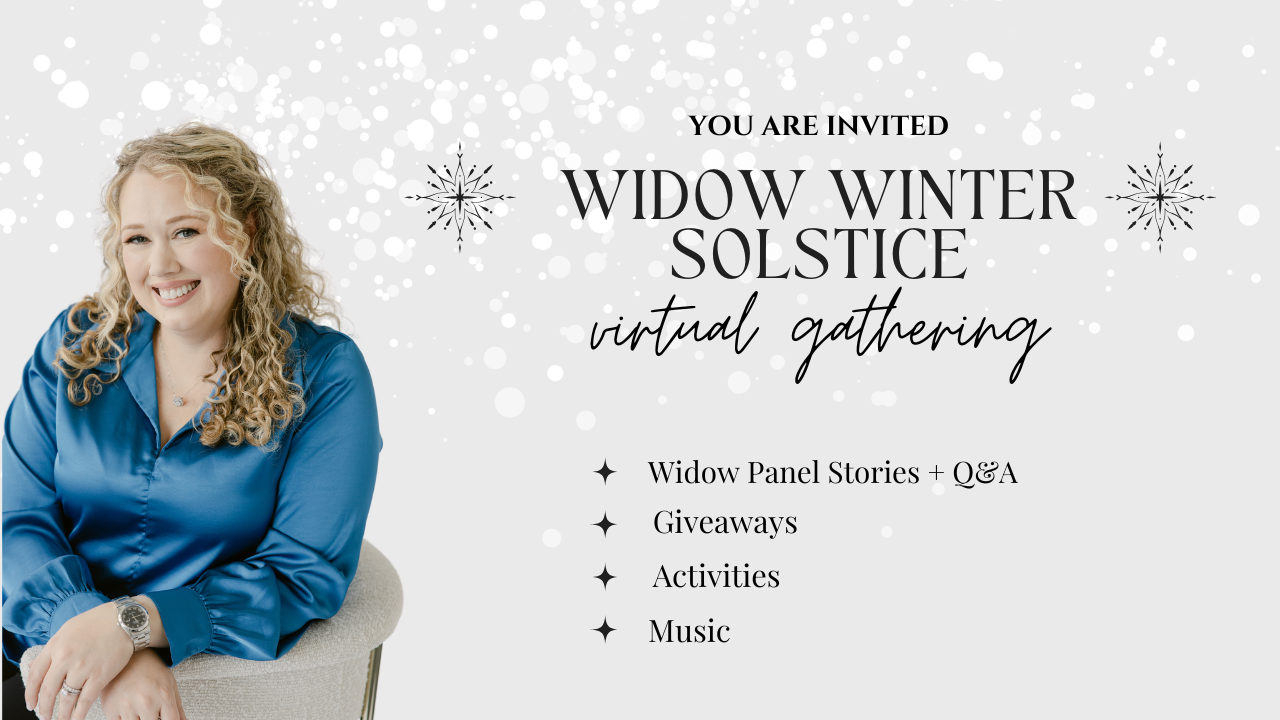
Um, if you're just joining, type in the chat where you're from. We have so many people from Wisconsin. What is going on? That is amazing. I love that. Um. Brad. Hey, good to see you. Thank you. Um, okay, so what to expect tonight? So, I always have a challenging time describing what widow winter solstice is and why we have it.
Why we do, because it's such a full and vibrant event. We normally laugh, we cry, we draw for all kinds of prizes. You will get to hear very heartfelt insights and [00:04:00] stories from the people that you see on the panel. And so I just wanna share with you at a high level what to expect for tonight. So we have four main areas of things that we're gonna work through that I or your panelists are gonna be interacting in discussion.
So one is loneliness, and I'm gonna have each person on the panelist share how they've navigated loneliness in this new normal. Then I'm gonna read some prompt and reflection questions. Then we're gonna ask each panelist to answer the question, will I always feel this way? And to share how grief has changed for them.
We're gonna have an open q and a. So I'll tell you in just a moment how to put your questions in so that we keep track of 'em and we make sure they get answered. And our last segment for the panelists will be questions you might have for them specifically as you hear more about them and their story and what they have to share.
We're also going to be doing some [00:05:00] giveaways in between. So everyone who registered for this event, or everyone who's one of my Brave Widow Academy students, you are registered for the giveaways that we do. And in between each of these segments. So at four different times we're gonna draw four, a variety of prizes that we're gonna give away.
And if you're someone who couldn't be here but you registered because you wanna watch the replay and you wanna be a part of this, then that's totally fine. Your presence is not required. And then you will have one week, once we make the announcement, we send out the emails to everyone who has won to claim your prize, um, or to supply your address.
If it's something that we need to ship to you, um, like a book or another resource, um, you'll have a week to claim that and let me know so we can get that over to you. All right, so very anxious to dive in. Before we do, I know that Zoom is not, everybody's familiar with Zoom [00:06:00] and I wanna make sure that you guys have the ability to interact with us.
Okay? And so the, one of the most important things is using the chat box. So at the bottom of your zoom screen, there should be a button that says Chat. You can click on that. You have a couple of options where it says two. You can send a message to everyone, or you can choose to send a message just to the host in panelists, which is myself and everyone that you see here on camera.
Okay? So if you wanna send a message privately, you don't want everyone else to see it, you can send it just to host and panelists. Otherwise, make sure it says everyone. You can type a message in the chat, put in emoji. You can say, oh yeah, I feel this, or Me too, or What did you mean? I'm confused. Like we can't see your faces.
Okay? And the reason for that is because we want you to be comfortable in what you're here to do tonight. [00:07:00] So the only way we know how you're doing, if it's resonating, if it's landing well with you, is what you put in the chat. So keep, keep it, keep it alive in the chat and that will let us know if we're headed in the right direction.
Now if you have a question that you want us to answer, maybe we're talking about loneliness and you have a question on what to do when you have a dysfunctional family and you feel lonely because it feels like you family is the only one that's dysfunctional. So you wanna ask how we handle that or how a panelist handles that.
Put that not in the chat box, but at the very bottom you will see a q and a button. Click the q and a button, type your question in there. And that generates a separate list for us so we can keep up with the questions and make sure that you get the answers, um, especially at the end if we haven't been able to answer it before then.
So, [00:08:00] alright, with that, enough of that housekeeping stuff. Um, you may just wanna make sure that you have a pen and paper nearby or a way to take notes if you choose during our reflection time, you may want to have a candle or your hot cocoa or whatever it is that kind of sets the, the mood of having a very cozy environment.
And we wanna make sure that you're, you're comfortable. So min way, uh, haven't seen your name in a while. It's good to see you. Okay, so first I'm gonna ask each of our panelists, um, really just to introduce themselves. I almost forgot to explain why we're doing this on winter solstice. Okay. So winter solstice is the longest night of the year.
Okay? It's the shortest day. It is the longest night of the year. It also happens to be during the holiday season when it's a [00:09:00] really difficult time for people. It's a heavy and hard time when you are in a season of grief. And so our goal of coming together for winter solstice is to honor that the holidays are hard for hearts that are hurting and to honor the love that you had and that you shared with your person.
And to come together to say, we know that your nights are really dark right now. Like your days are dark. They're short. It's getting cold outside, but every day going forward is gonna be a little bit brighter. So that's why we choose to do this on winter solstice. Okay. So I'm gonna stop sharing my screen.
That should help you see the speaker view a little bit better. And I'm gonna ask each of our panelists just to give a brief introduction, um, of who they are and a little bit of their background before we dig [00:10:00] into, um, one of our topics. So I. Susan, if you will go first and pass it off to, uh, then we'll pass it off to the next person, just to give a little bit of your background.
Oh, did we get Sue frozen up? Okay. Sylvia, do you mind to go, oh,
hit your mute button for me.
My name is Sylvia and I am a, uh, widow. Uh, my husband passed about six days after my birthday in 2023. Uh, after experiencing, um, this loss, it just really, um, put me in a, a devastated position. I [00:11:00] had been married for 44 years, and so he was my person. And so after, um, his passing, I needed to have some, some type of support.
And so I right away got into counseling and, and subsequently went into GR share and went through it about three times. But even with that, I felt I needed to have a little bit something more, and that led me to, uh, Emily. For coaching. And so I have been with her in coaching for approximately a year and some, uh, recently, uh, I've obtained a certificate of, uh, to become a grief cer certified grief coach, uh, and also a grief share facilitator.
Uh, and my current, my background is in nursing. And, uh, I have been in nursing for several, several years and, uh, and served as a [00:12:00] licensed dis uh, discipleship counselor as well as a, uh, uh, grief coach at this time. And I'm passionately, uh, involved in Bible studies and reading God's word. And, um, my, uh, love is to be with family and friends as well as participating with and connecting with those close family members and, um, my besties.
And so, uh, so that's me. That's me, and that's my story. Thank you, Sylvia. Um, how about Nicole?
Yeah, my name's Nicole. My, my husband passed away 15 months ago. Um, I guess it'll be 15 months, the 26th of this month. Uh, three months, just three months after our 25th anniversary. So married 25 years. Um. Sylvia was saying it was [00:13:00] obviously his was very sudden. Um, we have a 17 and a a 19-year-old at the time, and so I knew at that point that I, I needed to really try to find something to make sure, as you know, Emily, I think has said before that they also didn't lose me.
I, I just knew that I needed to, to find that support. So I tried, uh, some counseling right away. I tried grief share right away, which was just too early for me. Um, it was probably a month after he'd passed away, so I wasn't quite ready. But, um, did also work with another grief coach, and then after that decided I, I needed something as I continued to move.
So that's, I had found Emily on a comment on a Facebook group, so I know God led me to her. Um, it was just a random, that wasn't even a po she was commenting on someone else's post. So, um, we connected and just talked about what I was going to be looking forward, um, or needing. And, um, it's been a great journey.
We've been working together since about August, which was [00:14:00] the one year anniversary of Kirk passing. So this community has been amazing and we'll, I'm sure talk more about that in the rest of the webinar. Thank you, Nicole. Uh, Karen? Hi. I am Karen Martin from Wisconsin and I. My husband Ben, slept into the arms of Jesus on Mother's Day in 2021.
He did not die of COVID. We, I believe that he had Lew body dementia, but because we, our state was closed down, we couldn't go get help. Anything. He, um, faded away, but I couldn't see it. So it was very sudden to me, you know, we thought that, uh, he would hang on till things changed. And ironically, all of the restrictions in our community were lifted the day before his funeral.
But that was the day that God had ordained for him to go to be with him. And, um, I'll never forget seeing him lying there, his bright blue eyes open, looking upward, and he had this expression on his [00:15:00] face of, I've just seen Jesus. I've just seen the Lord. And um, so that helped make it better. And I didn't have a lot of anger towards the Lord over this, but I've had anger and frustration since then because of the struggles of being a solo parent of young adults, trying to send them out into the world and just all sorts of troubles, especially with cars and financial things that sort of plagued us our whole life because we lived a life of service and music was our thing.
That's how we met. He was a world-class musician, opera singer. He trained in Europe, even though he wasn't Finnish. Um, his father led the family there to do a ministry after he graduated from high school. And so he met his first wife there, had three children, came back. We met and we were wonderful friends and an inseparable music team for 10 years before he proposed to me beneath the St.
Louis Arch. And, uh, then we were [00:16:00] married in February the next year. Crazy to do that in Minnesota and went on to have our kids sing in three choirs while we were having our kids. We did have one child that the Lord took directly to be with him. So now my husband, uh, is with our child. I don't know if it's a boy or a girl, but I look forward to finding out one day.
And so we, um. You know, we had a difficult, stressful life, but we did everything together as a family. We homeschooled and we were in homeschool choir together as leaders, 200 kids in this program. And I still help lead that today. Um, theater. We have one son who, uh, his goal is to be a professional, um, actor, and so we just had a rich, rich life.
So I miss him terribly. And, but my life in the last year has changed so much when I let go of a lot of the frustration I was having. And I'll tell you more about that later on and how Emily came into my life and how my life has has changed. So now I am a completely different person than I was a year [00:17:00] ago.
I still serve doing music in my church as organist and, um, and it's not the same without him, but it's new things are happening and I'm just excited to see what the Lord has ahead for me. And, uh, brave Widow was the key. So I will share some of that later. Thank you, Karen and Susan. Hi everybody. I'm Sue Peters from Highland, Indiana, and I am, I have been a widow now for four and a half years going on five.
Um, my husband's name was John. We were married almost 35 years. He got sick the day of our son's wedding. Uh, about two hours before the ceremony. We sent him off in an ambulance with lots of stomach pain and it ended up being his pancreas burst. We didn't know it at the time, but he spent four and a half months in the hospital during time of COVID where they shut it down for two months, and then he died on Valentine's Day of 2021.
So it's been a whole [00:18:00] crazy ride. 'cause he wasn't sick before that. Um, he was my best friend and we've got three kids. They're all married. I have three grandkids. And, uh, our life was supposed to be retiring together, visiting them, and seeing them, and now it's not. And it changed really fast and it's, you know, it, it, the whole thing for me was my whole identity is trying to figure out who am I now.
I, I lost this identity of who I was. And so, um, I luckily started finding people online, found Emily through a, a grief, um, summit that was on, and Emily and I. Hit it up and, and work together. Um, not too long after we both lost our, our husbands and, um, have, she's been a great support to me, helping me through so many things.
Um, the good, the bad, the up and down and all around. And I'm just grateful to be part of a community like this that is so supportive and, and helps us. 'cause as a widow, it's not easy. It's such a big challenge and such a big change in our lives. [00:19:00] And, um, it's not something you expect, but it happens. And it's nice to have people who understand and who, who get us.
So welcome to everybody here tonight. Thank you, Susan. And, uh, we'll talk, I'm sure more about it later, but Susan's also published a few books and, um, while Valentine's Day was a really tough day to lose her person, not that any day is easy, um, but hearts have really become significant for her. And so I'll just sprinkle in that little teaser, um, about how it's become a very beautiful thing.
And then Patty,
uh, hit your, uh, audio button for me. There we go. There we go. Hello everyone. Thank you, Emily. Um, my name is Patty and I met my husband as an answer to prayer. Um, so it, we, we ended up, he, I really wanted to know about God's word and he was the one that was sent to [00:20:00] share that with me. Um, we had a really great friendship for, um, a number of years and, uh, we actually dated for 10 years in that time, grew in God's word.
Also, I think it's wanted to just make this, uh, comment is like in between the time I met him and before I got married I had a serious eye issue that happened. So, um, I lost some vision in my eye. It was very scary and it was something that we really went to God with. And, um, I still have the visual issues that I have to deal with today, but, uh, despite that I was able to be pretty successful in business and do the things I needed to do.
Um, when I married my husband, I was kind of like game on because we had determined that I would stay home once I, I got pregnant and had a son and I did. I had a wonderful son. Do have a wonderful son. His name is Steven. And, um, I ended my career at that time and became a save and home mom and homeschooled [00:21:00] him.
And we grew as a family to love God and his word, and we served in our church. Um, really had a, a wonderful time. It was great homeschooling with Steve and being able to, to just grow together. Um, in 2017, my husband was diagnosed with cancer and for the last six years of our 25 years of marriage. We dealt with a lot of health, you know, related things, doctor's appointments and things like that.
And he passed away in June of 2023. And since his passing, I've, um, continued to grieve him. I've also supported my son and, and worked on rebuilding, working on rebuilding at life. I thank God every day for those who are supportive and kind to me and my son. Um, I continue to work through the challenges and the disappointments and the changes in, in a number of relationships that are in my life.
In the second year of my grief, I dealt with [00:22:00] major health issues, seriously, major health issues. And, um, it was very hard because my house was in chaos for six months, just saying I survived it. Um, in the beginning of my second year, I found Emily, uh, listening to her videos and podcasts at wee hours of the morning, and I started working with Emily.
So Emily walked me through and helped me when I was dealing with those health issues. Um, she worked, walked with me through the earliest part of my grief, and I'm thankful to have the community of Brave Widow and to, um, have the connections that I've, and I'm also thankful for to be on the panel, to be with Emily and these wonderful women and to spend this night with you.
So thank you, Emily. Yes, thank you. And. I always think about Patty and recommend that people connect with her when they're going through a season where life just won't let up and it's [00:23:00] one thing after another. And you just really start to question why you can't catch a break, why you can't catch your breath, why, like, what have you done wrong to make all of these things happen when you are in the middle of it, it's so hard to see that there's light at the, at any point in the future.
And so Patty has, has been one of several folks in our group that have walked through those seasons. And so if that's you, I want you to know that you're not the only one. Patty's a great resource for that. And then I'll just quickly, yeah. Introduce myself. I'm Emily, the founder of Brave Widow. Um, and I lost my best friend and husband in July of 2021.
Just three weeks before what would've been our 20th wedding anniversary. We have four kiddos who were all teenagers at the [00:24:00] time, and my life imploded. I shattered and. I did all of the things that people said to do, like counseling and reading books, and joining all the Facebook groups and talking to people.
And about a year and a half or two years later, I just, I, I wasn't feeling better. Like I felt better in grief, but I was like, now what am I supposed to do? I've gone to counseling, I've done these things, but like, is this my life now? Like, like this, this how I feel right now is the rest of my life really.
And people would just say, oh, give it time. You'll start to feel like your old self. You'll feel normal. Like, just give it time. But time wasn't helping me. I didn't feel as bad as I did in the beginning, but I didn't know if I could ever experience joy again for the future. And so I'm happy to [00:25:00] share with you that today I wake up and I love my life.
Every single day I get to work with some of the most amazing people. I've traveled to five new countries. I've become a real estate investor. I've met Dave Ramsey in person. I ended up getting remarried, um, just over. Almost two years ago and gaining a bonus son. So we have five kids between us, which is insane.
And um, I do, I do love my life that I live today. And so my goal is that every widow and widower can ultimately, number one, have hope for the future. Number two, focus on healing their heart. And number three, begin to build a life that they can love again. That is the goal and the mission of Brave Widow.
So welcome. If you are here with us, you are taking part of those first two things for sure. Having hope and healing your heart. Alright, [00:26:00] so we wanna make sure you're still with us. You're locked in, you're engaged. And so I wanna launch a poll just because I wanna see how, like what type of audience do we have, how long have you been widowed?
So you should notice a poll that pops up and I wanna give everybody just a minute or two to respond. We have about 50% of people who have responded. So just click the button, let us know how long you've been widowed, and then I'll share the results so you can see who all we have in the audience. Thank you Karen.
Okay, we are at 80%. Just a few more people. Just click the button to let us know and I'm gonna end it in just. A few seconds here. All right, we're at like 85%, so I'm gonna end the poll and share the results so you can see. So we have in our [00:27:00] audience today, 31% that are less than six months. A third of us, my heart goes out to you.
Um, 16% between six months in a year, 31% at one to three years, 10% at three to five years, and then 3%, well 6% combined of over five years. And so, wow. Thank you for sharing that. And I hope that you heard of our panelists tonight. We have people that are in different brackets as well. Um, we wanted to make sure that we had that.
So, um, I'm gonna draw for some prizes and then I'm gonna ask each of the panelists to talk about our, to our first topic of the night, which is loneliness, and how they have navigated loneliness in this new life, in this new normal. So while I'm drawing for prizes, I'm gonna ask you in the chat if you are [00:28:00] comfortable to type in the chat, the name of your person.
Your spouse, your boyfriend, girlfriend, your partner, it doesn't matter. Type the name of your person in the chat and then share maybe three words or a quick sentence that describes them so that we can honor and acknowledge the person who you are grieving and who you love. And we can share that with you.
So go ahead and type in the chat, the name of the person, some things that describe them or what you loved about them. And then I am going to draw for a few prizes here. So let me get some music going and hopefully this won't be too loud. Mm-hmm. Okay. And then I'm gonna share this very official tool that we use called The Wheel of Names, which is our prize wheel.
Okay? Now, when you all registered, um, some people put [00:29:00] first names, some people put first and last. And so what I tried to do is if we had a common first name, I pulled a word or a number from your email so that way you know, we have a bunch of Dianes and Dianas. That way you would know which one won the prize.
I will be emailing you to follow up with you probably tomorrow, um, to let you know how to claim your prize. So keep your eyes open for that. But I'm gonna draw, uh, 10 names okay? And I'll tell you what we're drawing for each one, and then we'll do this four times so that 40 people are gonna walk away with something, um, that they can use.
Yes. Okay. So the first thing we're gonna draw for is the Grief Recovery Method book. This is my number one recommended book, um, that I recommend to people who are in grief. And so I'll spin, and that person will be the person who, um, receives Grief Recovery Method book. [00:30:00] Okay? And please help me celebrate people along the way as they win a prize.
So our first winner of the night drum roll is going to be
Maryanne, Maryanne. Amazing. Okay? Then we're gonna draw for a $25 Amazon gift card. Okay? So let's see who wins a $25 Amazon gift card that could be used for anything on Amazon. That is going to go to Eliza Ruiz. Congratulations. All right. Then we're gonna draw for the widow's workbook. This is Nicole Sampson.
This is one of her recommended reads. It is, I believe, a Bible study book, the Widow's Workbook, and this is going to go to
Marthea [00:31:00] Thompson. Amazing. Okay. Another $25 Amazon gift card. Let's see who is going to get this one here. Jill Rest. $25 Amazon card. Amazing. All right, so this is gonna be Elijah Faith and Fire, a Bible study by Priscilla Shire, which is amazing for people who are in the in-between season of life. Peggy and Yorkie was from your email, so Peggy Yorkie, congratulations.
All right. Now, a $50 Amazon gift card. Let's see who's gonna win $50 to use on Amazon. You can use it on yourself. You can use it for Christmas. This is Deborah to, congratulations, Deborah. All right. Our next [00:32:00] one is going to be called, just be Honest. It is an honest way to worship and pray when you are in a season of suffering and grieving Nancy Wall.
Congratulations, Nancy. All right, we have three more to draw for, so hang in there with me. $50 Amazon gift card, $50 to use on Amazon. That is gonna go to Denise Abraham. All right, Denise? Yes. Okay, so now we're gonna draw for the miracle of Marrying My Heart. This is a book that Sue Peters wrote, which is a best selling book, by the way, and an amazing story.
And this is gonna go to, I think it's Renee, Renee Star. I hope I'm pronouncing that right. Congratulations. And then the last one we're gonna draw right now, but we're gonna do this three more times, remember. [00:33:00] So the last one we're gonna draw right now is a hundred dollars Amazon gift card. You think so?
Who will win a $100 Amazon gift card? I am totally going to butcher this name. Sima Sima. Farrah, congratulations and please forgive me for totally not knowing how to say your name. That is. Just me. Okay. So amazing. Congratulations to everyone, and I'm gonna go up while our panelists are talking, I'm gonna read up through all of the names and things that you are sharing about your person.
So thank you for sharing that. Now we're gonna ask our panelists just to share, um, from their perspective. I asked 'em to talk about loneliness. So I said it could be about feeling misunderstood. It could be about changes in your social circle about feeling disappointed with other people or [00:34:00] family in your life.
It could be about being home alone or losing touch with family and friends, or it could be about your pet. Like, I just wanted to hear their unique perspective on loneliness and how they have navigated that. So, Sue, would you mind to go first? Sure. Um, loneliness started for me when my husband John went into the hospital, um, because it was during COVID time.
Um, and so. I could not, I was the only one that could be with him. I couldn't have my kids there. I, they would not let any other visitors except for one person until they closed the hospital down totally for two months. That's a whole nother story. But I had to, I had to go in myself. So everything I did was by myself in the hospital, making decisions, getting phone calls, like all of it was like me going in and dealing with it with no other support except for who was in the hospital of people I didn't know because he was in a hospital three and a half hours away from our home.
And, um, and then I had to come home a [00:35:00] few weekends because like it, we were at my son's wedding. I didn't plan on being in the hospital. Um, and so I had to go home and, and get my regular clothes and, and go home and get my computer so I could pay bills and things like that. And, um, and so when I came home those few weekends, it was like, it was such a lonely feeling to come to the house empty by myself.
And my husband had been gone on business trips and other things before. Um, and I never liked being alone, but I was like, it was the first time that I was like, oh, this is not a, a fun alone. Um, but I dealt with it because he was still in the hospital and he was still alive. And so it was like, okay, I can deal with this.
Um, but then, um, when he died, uh, four and a half months later, it was a whole different kind of loneliness. I felt like. Um, I just felt like, wow, my best friend is gone. Like so. He's not gonna be sitting on the couch ever again. He's not going to be in the car with me driving back and forth to see my kids.
He's not going to eat supper with me or eat breakfast with me and [00:36:00] all that. Like, every single thing was painful. It was like, it was just so hard to even cook a meal because I've, it was like, how do I eat when I'm by myself and he's not here? And it, it just seemed so awkward, especially those first few months.
It was really, really challenging. And everywhere I went, it seemed like there was a reminder that I was alone. You know, I would see other people, their spouses, and there's me by myself. Um, I, I'd be, you know, driving to see my kids and my grandkids, and there's me going by myself, um, um, going shopping by myself.
And, um, it, it, it was just the weirdest feeling I've ever had. Um, it, after seeing him suffer, it was a little bit okay in the sense of I felt like at least he wasn't suffering. So I could deal with the loneliness because he wasn't suffering. But at the same time, it didn't take away my loneliness and I had to figure out how am I going to live, you know?
Um, it totally changed my identity to who am I now? I, I am, I'm alone. I'm not really a wife [00:37:00] anymore. I, I, my, my kids just all got married and we're gone. And, um, and so it was a really weird identity feeling of who am I? And, and how do I go forward? Um, so, um, for me, I. I chose that I had a, a step to, to marry my heart because I felt like that would be help to heal my heart and help me to move forward in a new way, um, so that I could not feel that loneliness.
I feel like if I could love myself and my heart, then I feel like I am still loving him and he's still loving me in the wholeness of my heart because that never goes away. His love is still part of my heart and part of my love, but I have to also feel that and, and, and carry that with me. Um, so like Emily said, um, because he died on Valentine's Day, I thought that was like the cruelest thing.
Like he got sick on, on my son's wedding and then he dies on Valentine's Day. Like, this is so cruel. Um, but it started to end up being a blessing because I started seeing hearts everywhere and all the hearts reminded me that he does still love me. He's [00:38:00] not really gone, he's just in a different place in a different state.
Um, um, and so that helped me to not feel lonely because the hearts showed me that he still cares. He is showing up in a heart shaped chicken nugget and a heart shaped Dorito and um, and heart-shaped ice on the ground or raindrops, or even in the bathtub. Sometimes I'd look down and I, it looked like the water was a heart shape, and it was like, oh my gosh.
It's like all these little reminders are. Him saying to me, you're still loved, you're still okay. I'm with you, don't worry. So I, I started not feeling alone anymore and it really helped me to see that through my heart and through his heart and, and the, the new way of looking at our hearts in that way. So, um, that's kind of my story and, um, it helps me every day to get through it and to, to look to see, you know, where can I take my heart on the next adventure knowing that John is going with me on all my adventures.
Thank you, [00:39:00] Sue. I really appreciate that. And, um, okay, next we're gonna go to Nicole.
Yeah. And I'm gonna piggyback a little bit on what, uh, Susan has said too. Yeah. There's so many ways you just didn't picture the loneliness. Um, I, I do have the kids still living at home. They are 18 and, and 20 right now, so, and two dogs. Uh, so with the household itself is, is still busy, but there's just other ways that, um, I just, you just didn't expect that loneliness to show up or to, that you just didn't expect.
And, you know, there's people that you thought would naturally just be part of this next chapter and, you know, sometimes just life doesn't unfold that way. Um, created kind of an extra layer of the loneliness. So they talked about some of the secondary losses, um. So it's, it was just, it's a loneliness. It was kind of hard to explain, but very real.
Um, our group has talked about that a [00:40:00] little bit, which made me feel, you know, I wasn't the, the only one going through some of that. Um, and so some of the other things, you know, early on, the loneliness of just making decisions on my own. Um, unfortunately, like a month after he passed, passed away, we'd been in the hospital for 23 days.
Um, and he was not responsive basically the whole time he was there. So that in and of itself was lonely just from making decision. You know, he and I had made up 25 plus years together, made all these decisions together, you know, and health wise now, um, he couldn't tell me, you know, what the next step or what he felt or, um, that kind of thing.
So that was a loneliness I had not felt, um, as being such a team. Um, and then just, you know, learning that grief, you're human, um, it means we cared really deeply about each other. Um, but back to, you know, he's, a month after he passed away, we had a water leak [00:41:00] in the house. Um, so it was, you know, navigating all of that, the insurance, all of the decisions there, you know, decisions we would've made.
Like what color do we want the wood floor to be refinished as? Um, what colors should we paint downstairs? How do we get through having our kitchen, you know, completely. Well, there was dry, they were drying everything. So, you know, all those type of things. And then as they were redoing the new floor, the furnace went out three day, four days before Christmas.
Um, you know, thankfully when you talk about asking for help, and, um, we had amazing group of people that, you know, at, even at Kirk service, had said, if you need anything, if you need anything, and I think, you know, you start to feel really lonely when that person isn't there. And I'm like, you know what? I have to just ask these people.
These people have offered for help, you know, to help us. So, you know, that really did help with the loneliness of some of those decisions I had to make is I had experts in some of these areas, so I just would reach out to 'em and say, I, I don't know what to do. I don't, I [00:42:00] have to make this decision on my own.
And so that was something that I was very, very thankful for. Um, also just, you know, the kids working through, you know, how do I help them understand that, um, you know, sometimes people respond very differently during these losses. And, um, you know, sometimes those reactions have nothing to do with us or our family.
It's just maybe them working through their grief. Um, things like, you know, and a lot of people, you know, they have their own life. They get back to their life. Um, I also wanted to make sure that, you know, in that loneliness that they knew that they weren't forgotten. Um, God hasn't forgotten about us. Um, it's just, just our, our heart just telling us the truth.
And, you know, when the heart hurts that bad, I'm like, we've lost. A lot, you know, they lost their dad and, um, you know, so I just, I wanted to do whatever I could to make sure they knew that they weren't alone. You know, we're here together, we'll work through this together. [00:43:00] Um, and so, you know, I remember thinking through, you know, a lot of other people have gone through this and I always wanted to make sure I was reaching out to them.
And so I kind of knew that I, I couldn't always expect people just to reach out to me. So I guess I've been also trying to be very diligent of reaching out to those people that have offered, um, to meet for coffee or to, um, you know, a lot of other widows I've met in the area. I, I searched up different groups.
Um, we have a one wonderful, um, the little collaborative here in, in Minnesota and widow might, and just great groups of, of women walking and, and widowers too, walking through this journey. So it was something that I knew wasn't just gonna come find me, you know, I had to really diligently reach out and, and try to start doing that healing.
So, um, and I love learning from, you know, what Sue talked about, about healing the heart. I'm like, it's just, it hurts so bad. That's where it just [00:44:00] feels like this major hole in the heart. And, you know, to start to heal that. Sue, as you saw, you know, the bird or the, the hearts. Um, Kirk loved birds and knew a lot about birds.
Um, so every time I see the different birds, I'll see cardinals flying through the yard, or a blue jay, or this little hummingbird that kept coming to the window this, this summer. So, um, my daughter had given me a book called The Little Birdie Buddies, and it's just, it's just, uh, you maybe can't see it, but, um, it's a really, really cute book about just reminding us of looking for, looking for the, there's things out there that we will see if we do look for them.
Thank you for sharing that, Nicole. Uh, Karen, well, I think my loneliness came a lot from. Meeting connection, loss of connection. As a musician, as a church musician, a lot of people see me and a lot of people know who I am and I don't necessarily know who they are because [00:45:00] I'm sitting at the organ with my back to them.
But, um, I did not feel lonely when I was doing music, when I was serving that way. I even played the organ of his, uh, funeral and played the Hallelujah chorus with my friends, um, from the University of Wisconsin, the Brass Group. And I had connections like that. So if I was up front, it didn't bother me so much.
Even a few weeks ago when I went to an event at our church where we have, um, over 30 tables that women take a table and then they decorate it for Christmas and it's just amazing. And I had done that, the decorating part of it, and hosted all these years and then, or done music or both. And this year just decided, Nope, too many things going on.
I'm not gonna try to do this. And I had to really talk myself into going and walking into that room and sitting down at a table. I thought maybe one of my besties was gonna be sitting there. [00:46:00] And she was. And that was good. But it was just really, really hard. And I surprised myself because I was thought I was an extrovert.
But what I realized through, I think maybe aging, but through experiencing the grief of losing Ben, was I'm really. An extroverted introvert. I can handle myself. I can talk in front of people, I can perform. I can sit at a table after a funeral, at a funeral lunch, and you know, meet new people and I'm comfortable with that.
But when it comes down to it, I think that I get my energy from being able to be alone. I've really, really, since Ben died, um, gotten much more intentional about studying the word and doing my Bible study and not just, oh no, I haven't done it. I'm not ready. I'm not gonna go. And so I have worked at connecting with those women that I know in Bible study and the Bible study that Ben used to be in.
I and I, while I was doing children's ministry work, I am now in, and this [00:47:00] morning I was able to share with these people. They're the ones who can listen to me, tell stories about Ben and they'll not, and they'll remember, they'll remember the arguments about Ben who loved the King James version of the Bible and you know, some of the disagreements they had.
And they'll bring up things from time to time. And it really does warm my heart when somebody says something about him because that felt really. Really lonely when the church was just silent, you know? No, I remember the mother of one of our, my fellow staffers and mother of my panel students, just made one short comment one day about Ben, positive comment, and I literally threw my arms around her neck, you know, just because it was like, you don't know Brenda, what that meant to me, that you said something about remembering him.
And so I felt disconnected because people were standoffish. And I know now that it's just, they don't know what to say. They don't know how to act. It's not that they're trying to be unkind or un-Christian or anything, [00:48:00] you know, like that, really. And I used to think that one particular group of people here, and I won't say because I don't wanna throw 'em under the bus, just completely didn't want me around or anything, you know, which I think was really wrong and a misinterpretation on my part.
But what I found is now that I am healing and that I am a different person than I was a year ago, people are responding more positively to me. And I don't blame them when I don't walk into the office and say, oh, I had to take David, my son, so, you know, or I'm complaining about stuff or whatever, you know, I am making a conscious effort to not do that.
And I don't feel like doing that anymore. But I so longed for people to see and hear me, and I felt that I didn't have that. And um, and so I. It still is hard when I walk into the fellowship hall on a Sunday morning, especially when we have, um, special gatherings like we do in January. We have something called J Term, so we all come in, but our bible study group is, [00:49:00] we talked about it this morning, are gonna gather kind of at one table and hang out.
And that really, really helps. But when I have to walk in to a large group of people, even if I know them, most of them, it's really tough because it's like, where do I fit in? So that's kind of how I experienced, um, that loneliness was the public loneliness. And um, and I don't know if it's just because they know who I am and what I do and all of that stuff or what it is, but it's been hard here at church.
Conversely, at the theater that we were involved in, um, I finally, a week after he died, he died on Sunday night, um, May 9th. His funeral wasn't till May 21st. Um, and so in those days I was doing all sorts of stuff and it took me a week though to go to the theater. Talked to our director. And I remember asking him, because I knew I needed something to do that summer, just to fill up the hours and keep doing what I had been doing.
You know, what do you [00:50:00] have for me to do? And he looked at me and he said, yeah, like, you're gonna sit in a corner, you know, and mope. And I said, you know, absolutely not. But when I started interacting with people there that day, and they saw me, and they knew what had happened, because they had seen it on the, on the theater Facebook group, I heard all these comments about just how much they loved Ben.
And they kept saying the same things. He was so sweet. He was so gentle, a wonderful listener. Um, and, and some of these kids who were amazing actors, um, just said to me, he made me feel like I mattered. And so these, those people out there not connected with the church necessarily, and not all Christians by any means, they really almost were more open, um, and shared with him and kind of surrounded me in a way that I didn't expect.
So I had to kind of see where my groups were. And I, I shared with Bible study this morning. I, I even went to this group called The Death Cafe. And it was, um, I [00:51:00] had no idea what to expect. People who, not that they had lost anybody, but they were fearing their own death, you know, and what to do after death.
Oh, just throw me in the woods. Let me decompose. And, and my heart ache for them because I could tell many of them were not believers and they didn't know. That there was, there were answers to all those questions. And I did try my best to share and share about the Lord without being offensive about it.
And um, but it was very, very, very strange to be in that, um, setting. And that was not a place of connection. So finally, um, after a long search, then a year ago, I found Emily, and this has given me the connection I've needed. The, the academy group and our prayer support for each other has just been amazing.
And a few weeks ago was our homeschool choir concert with 200 kids, you know, very stressful day. And my daughter got really, really, really sick. [00:52:00] So I immediately went on and asked for prayer for her that she would, you know, feel better 'cause I couldn't do anything to help her. I was in rehearsals and performances and they just got on there and they prayed and by early afternoon she was feeling better and I was calm and it was just amazing that this prayer supportive these ladies, some of whom are on the panel with me, uh, tonight.
And it's been the connection that I've longed for. Even though we haven't met in person. Nicole and I are not that far apart. So we need to, uh, meet each other one of these days. And, um, for real, but it's just been absolutely wonderful to know that people understand. And I think the other thing that's helped me with loneliness is that I've accepted being alone.
I can go to restaurants and sit there. I sit on my side of the table and I picture Ben across from me. And, um, and it doesn't bother me that there's this cacophony of noise going on around me. I did that today. Went to one of our favorite restaurants. And so I do those types of things, um, that feed me. [00:53:00] And I listen to music in the car a lot.
I'm in the car a lot 'cause I'm always suffering my kids around. So having them that staved off some of the loneliness, you know, they were there with me. Um, but I listened to the music that we did, people we knew. Uh, it's amazing. Um, how many. Connections I hear on the radio of people that we were with, his, his brother-in-law is a composer, our brother-in-law.
And so I might cry and I might let those tears flow and I might feel alone for a little bit, but then that turns into a sense of gratitude of, thank you, Lord, that we got to do this together. And so when I sit down to play on Sunday mornings and I look up, you know, I just imagine him being there. And when I sit back down after I play, I imagine him touching my leg and saying, thank you, honey.
You know, that was, that was great. And I still feel that connection with him. So the loneliness isn't quite as, as bitter, but I think reaching out, um, like Nicole was [00:54:00] saying, really, really has helped too. And I'm excited about how I'm gonna be able to reach out to others in the future. So it's a myriad of things that have helped.
Thank you so much, Karen. All right, Patty. Well, you know, this, this topic of loneliness is really kind of an interesting one because everything in your life has changed. You have changed, your interactions have changed everything in your life. Um, even in my case, the relationship with God I thought changed.
And it's very hard to navigate your life when you don't even know yourself. I don't know. I'm just speaking for myself. But, so that was the hardest thing because I didn't, the, the, the person or the, the, the relationship I always thought was so sure was my relationship with God. And when my husband passed away, [00:55:00] it really got shaken to the core.
I'm just being honest. It really did. Um, I, it's not that I turned my back on God, but I was upset and I didn't, you know, I, I didn't wanna read my Bible. I didn't really wanna pray. I mean, I spent a lot of time when my husband was in the hospital and in hospice and praying and being there, and it was very lonely when he, um, was unconscious.
And, you know, it was just really hard to bear. And I couldn't understand why that happened. Um, so that was, that was a very, a very hard place to be. And it affected everything, you know? Um, but what I did was, is I, you know, I knew God was a faithful God and I knew his word was true and that was my foundation.
So, you know, I just started reading Psalms and reading laments that were in the Psalms and seeing how people poured out their hearts to God. And, you know, they [00:56:00] were very honest with him. And I was. Going and do that too. So I did do that, you know, and I, I would be very honest and just speak to him because not only did my husband die, but my son went to college two years, a um, two months after that.
So now I was in, I was not only a widow, but I was an empty nester all at the same time. So it was very lonely here. Um, so I did take advantage of that time to try and rebuild my relationship with God and read his word more and pray. Um, listen to, you know, podcasts that were appropriate for what I, you know, what I, my, my walking with God and, and reading books too.
So, you know, that's a suggestion I would have. If that's something that took a hit for you, I would, I would encourage you to, uh, just remember I knew the scripture that said, um, God never leaves you or forsakes you, but I felt it. But according to God's word, [00:57:00] he never does that. So I didn't wanna call God a liar.
I knew he was true. So I took him at his word and I started building trust and that was very big for me. Um, on the human side, there were people that didn't show up and it was very disappointing to me. But there were a lot, well, a handful of people that were my people. And all early on, after my husband passed away, I had a grief counselor and she told me, for you folks that are, are very new, like, spend your energy with people who are there, don't.
God's gonna do a thing with people who are left, not people who left. You know? So you, you hold those people close to you. And then the other people, like, there are good people in my life. There are a lot of good people in my life, but they kind of fall into a category of they're not helpful, but they're not hurtful.
They just never have been through grief. And honestly, that's where a [00:58:00] lot of my misunderstandings or being mis misunderstood came from, or has come from. So her suggestion was to, to just, you know, you can interact with them, but limit the interactions because they just don't get it. And, and you trying to explain, or trying to advocate, you know, grief is this and da, da, da.
It's sometimes hard. So if you keep your energy and you do those people, and maybe if you only have one that's, that's, that's gold right there. So, um, that's what, that's what she said. And, and you know, it's helped. It actually helped because it helped me with where I needed to put my energy. Um, and, um, just trying to get my notes here.
It, because it can be exhausting. Like if you have, um. You know, you're, you're trying to, to build your community and you're trying to get your support around you. So if you have those people who are, who are actively showing up, [00:59:00] and just like Nicole said, I, I also have trouble asking for help. There are people that ask, can I do anything for you?
I have to make myself ask them. Um, I also, you know, went to some of the local groups and, and, uh, first of all, I joined the Brave Widow widow community. So that was, that was great, but it's also great to have some local, um, support here. So I did go out and start doing that because there are people that left me.
So, you know, I ha I, I have some voids in my life and I wanna start building new friendships and new things. So, um, you know, one of the things actually Nicole said too is, you know, this is, this is what's left, and, and I, nobody's coming to save me, so I need to go out and make those efforts to do that. So I know it sucks.
You're like, I have to do that too. But it's, it's, it's nice to meet new people that don't know [01:00:00] you. As, as you and your, your spouse, or you and your partner. It's nice to meet people who just know you, because then you don't have that awkwardness of like, being with people. So, um, it's been kind of fun having, you know, some new people in your life and all they know is you.
Um. The home alone thing. So loneliness is hard when you're home, like now it's winter, it's, you know, it's dark at night. Visual impairments. I don't drive at night, so I have to really work with my mind to say, okay, so it's Friday night, it's date night. I'm not going anywhere. So what I intentionally do, and, and a lot of the things I do now, not in the first two years, but I'm at two and a half at this point, is I really intentionally think about things like on a Friday or a Saturday night.
You know, I don't wanna be home feeling sorry for myself. So I'll plan something good, like maybe a, a restaurant quality meal I'll make for myself. I'll [01:01:00] have a, a movie that maybe I'm looking forward, or maybe I'll invite somebody over, but I can't entertain large groups. Like I can do like one or two people, but at this point in my life, I don't wanna have a big entertainment thing going on.
So, um, but I will intentionally do that when I don't wanna be really lonely or, um, the other thing is, is I have leaned into hobbies of mine. Like I, I did garden before my husband died, but, but now I do it a little bit more. I like to make sourdough bread. I have a, a, a mock mill, which mills flour and, you know, so I'm trying to learn how to use that.
And I also am taking an herbal class online that I kind of put off on hold, but I just started to kind of think about the things that. I, I couldn't really do when my husband was sick. And, you know, the first two years of grief, it was hard. I just wanted to find some things that, um, that interest me that I could, I could do.
Like my son's in college, you know, he's home for, [01:02:00] for school right now, but he's gone, you know, you know, in the fall and the spring. So I wanted to have things that I could do that would occupy my mind, that would help me to enjoy me, like, learn who I am, learn what I wanna do. Um, and so that's been kind of, kind of interesting and picking up, trying to look for new things, like going online and think, seeing, there's classes I can take.
I think, I think what I realized is no, like I said, nobody's coming to save me. And as much as I do have some people around me, um, it's really kind of up to me. I could be lonely here in my house, um, you know, but I can be alone. Being lonely is one thing, but being able to be alone and be comfortable with yourself, that's a good thing.
I need that to recharge. But the loneliness is real. And if you're out there and you're listening to us as we talk, we, we totally empathize with you because this is some place [01:03:00] we have been. And if you're in different stages and different areas with your spouse being gone or your, you know, your partner.
It is, it is hard. And you know, that's when I found Emily, I started listening to podcasts, you know, in the middle of the night. It made me not feel so alone. It made me feel I had somebody there. Um, so I think if you just kind of spend some time thinking about the things you like, you know, things that could, could be interesting to you, things to bring you along, even if you're early on, just take care of yourself.
You know what I mean? Like trying to figure out things that, that would, would for a lack of better term. Bless you, like taking care of yourself is a big deal. And, and it does help in light of the loneliness. So, thanks. Thank you, Patty for sharing that. And um, I have to smile because you mentioned listening to the podcast at night.
I get a lot of people that say, I [01:04:00] listen to your vid YouTube videos at night so I can fall asleep. And I'm like, whatever. Whether it brings them peace, whether it puts them to sleep, it doesn't matter if they're getting some sleep. So I had a laugh about that, but thank you. Um, and, uh, guys, you are putting some really great questions in the chat and we are going to, um, tackle those during our fourth segment.
So, um, hang in there with us and we will get to those. But you're really asking some great questions, which is awesome. All right, Ms. Sylvia, bring us home on loneliness. Loneliness. Loneliness. Oh my gosh. Loneliness is just what everybody else has said. It, it, it is the worst of the worst. And, uh, you know, grief is, is a brain drain.
I mean, it just drains you for all your worth. I mean, you can't function, you can't do anything. And for me, it was, it, [01:05:00] it was, it was really bad because I had been married 44 years. I had not lived alone at all, at any point. And so to be without, uh, my person was just like. Unbelievable. I mean, it was like, I could not believe that this had even happened to me, you know, because in my mind, he was gonna be here forever or we were gonna leave together, you know, he was gonna be one of the two, you know, so to to be in a situation where, um, you know, he was gone.
It was just, I, it, you know, um, it has been said before. The heart is just so broken that it, it is not even describable a pain unless you have experienced it. And I would not want anyone to have to experience this because it was the worst of the worst. But it's such a, a, a, a, a, a sometimes debilitating situation, uh, with even with the loneliness.
And for me, [01:06:00] uh, it was worse for me at night, uh, because I could not sleep. I had insomnia really bad. And, uh, and so what I had to start doing is I, um, got a candle. That had a, a little timer in it, and I would light the candle because it would signify that this is when I was missing him. And so I would let have this candle burning for eight hours, so it would, it would burn the whole night so that I would just feel his presence, you know, in having that candle lit at night.
And so it was just terrible, uh, to have, to spend the nights, uh, alone. Uh, sometimes I would put on a pair of his pajamas, you know, a pajama top or something, you know, just so I could feel close to him, uh, and, um, you know, to get through, just to get through the night. It was just, it was a difficult time for me, but it was the absence of it, of the [01:07:00] presence.
His presence, you know, sometimes it wasn't even about him talking or anything. It was just the fact that he would be in the house. He could be in another part of the house and I would be somewhere else. But he was present. But for me, he was not present. And that was just unbelievable to me, not to have him present.
Uh, someone that you have seen every day for 44 years. He just, it's just unbelievable. But that this person is not here to say good morning to or say goodnight to. It was just, um, beyond my understanding. So it was, it was that void of his presence that was what, that I, I missed. Uh, and, you know, um. The eating alone.
I think someone else mentioned that not wanting to eat by yourself. You know, I just told one of my friends today, I said, I just started eating at the kitchen table probably a couple of months ago because just to sit there and not have him sitting across from me to talk [01:08:00] to was just, you know, like foreign.
And so I would rather go sit in another part of the house or in my office or whatever, rather than to sit at the table and his, he not be there to have a conversation with. Um, and, you know, to know that my anchor was gone, you know, he anchored me, you know, and it was like someone, uh, using an analogy of a boat and an anchor.
The anchor holds that boat steady, but when that anchor is pulled up, that boat can go anywhere it want. And that's how I felt. I felt like I was, you know, all over the place, uh, without his presence. And so, you know, it took. It took, you know, much of, uh, what Patty had mentioned before, it took a lot of getting into to the God's word.
And, you know, and the prayer, not that I was angry with God or anything like that, I wasn't ever angry. I just sometimes didn't know how to pray that the pain was so bad [01:09:00] that sometime all I could do was just moan for, for, because the words just wouldn't come, you know? And so it was a very difficult, um, place for me to be in.
Uh, my whole sense of self was gone, you know, I just didn't know who I was, what I was. And you know, I've been in leadership. I, I've been a, you know, in healthcare directors and all kind of, I thought I was fairly confident, but I'm telling you when this happened. There was no confidence whatsoever. I didn't wanna make a decision.
I was hoping somebody else would come along and make the decision for me, because I just didn't have it. I just didn't have the energy or even the presence to even want to even make decisions. And as, as we would have it, everything in my house started to fall apart at that moment. Everything had to start falling apart.
That needed to be fixed. And I didn't know, I didn't have a clue because that just wasn't my, [01:10:00] my, uh, forte. He was the one that did that. You know, I didn't have to do that. I didn't have to find people to come and fix stuff. And, and then he was real handy, so he did a lot of it, you know, so we didn't have to have people come.
But here I am now, you know, trying to find people to move trees. We had a bad storm. The tree fell down in the back end and tore down the fence. And, I mean, just all kind of things that were happening and, and right in the midst of his, his passing that I had to make right now decisions, and I just felt so inept.
I felt so incapable. I felt so, you know, beside myself with making those decisions that, uh, it really stressed me. It, it really caused additional stress to me to be able to have to do that. You know, because, and I would have these conversations with him saying, you are supposed to be here to do this. You know, every time something I said, you, you were supposed to be here, [01:11:00] you know?
And so I, you know, it was just, I just can't, it was just terrible. But, you know, but God has come and he's helped me, he's helped me to, to refocus. I'm probably in the same place with Patty. I'm about two and a half years out, uh, from, uh, my loss. And God is starting to, to move me, you know, in a different direction.
And, uh, and I'm, uh, finding some sense of, of, uh, stability. You know, my equilibrium is coming back and the fog is lifted. I'm able to think a little bit better. Uh, and so, um, you know, the, the loneliness is, is real. It's a real, uh, challenge. I have had to get out of the house because I live alone. And so for me, I needed to have.
Talking, I need to hear a human voice. And so I would leave the house. I mean, I go somewhere every day [01:12:00] because I need to hear a human voice talking. Not the television, but human people talking. So I'll go out, I'll go to the mall and walk around just so I can have, be in that milieu of hearing people conversate or I'll go take myself out to dinner or those kinds of things just so I can be in that human contact, you know, because it's not, uh, the loneliness can get overwhelming.
And I think I do suffer from, uh, seasonal effective disorder because it is, I live in Michigan and it is dark, and it is dreary and it is cold. And so I just, it, that is not my weather. It is not my weather. So right now I'm in the, in the throes of, of uh, uh, gray and rain and snow and all that. So it just really just adds to, uh, the sense of loneliness because you can't get out, you know, snow and ice.
You just can't get out. So you [01:13:00] kinda are having to hunker down at, at the house. But, you know, there are some practical. Um, loneliness that I've also experienced. And that was, um, just having to do everything, just having to change my whole way of thinking about things that I didn't have a default, I didn't have anybody to default to in terms of making the decisions and changes.
And, uh, and so that just made the loneliness kind of work. But, um, suffice it to say that, uh, I believe that I'm moving in a different direction. Uh, I'm finding my equilibrium here in terms of, uh, being with, uh, like-minded people who are like-minded spiritually as well as like-minded, uh, in our, our experience of, of loss.
And it has been a very, uh, very helpful to be in a group, um, of women who are, um, [01:14:00] like I said, just spiritually focused and, um, like-minded in terms of our experiences. Because we help each other, you know, we help each other because sometimes we can't see where we each other, where we are. And we need the vision of the others to say, you know, you made some progress.
You're doing well. You and all of that helps because you don't always see that when you're going through grief. You don't always see that. And so you need that outside eye to say, Hmm, you know, you, you doing great. You know? Things you were talking about last week, now you've moved on from that. So, hey, kudos.
You know, so it, it has been a, a wonderful experience to be, um, uh, with grave Widows. Thank you Sylvia. And I think that's such a great point where sometimes we don't see our own growth or our own progression before other people notice it or start [01:15:00] to see it. And so, um, it is helpful to be around people who are just doing life together and they've walked the sorrow, they've walked the hard days, and then they start to be able to walk the, the positives and the good things that come your way too.
Okay? So everyone, if you have something that has helped you with loneliness, we would love to know. We would love for you to share your wisdom or for you to share what has been helpful for you. So type that in the chat for us. We're gonna draw 10 more names for prizes, and then we're gonna do a few quick reflections here.
So. Go ahead and type in the chat if you have found something that's been helpful for loneliness. What is that? And while you're typing that in there, um, our first prize we're gonna draw for is that Grief [01:16:00] Recovery Method Handbook. This is a grief recovery method, is an evidence-based program that helps people really kickstart their grief recovery journey.
It changed my life and has helped many clients too. So congratulations, Valerie Foxwell on winning Grief Recovery method. Next, we're gonna draw for a $25 Amazon gift card. Who is it going to be? Our winner for Amazon gift card. That's gonna be Margaret. All right. Congratulations, Margaret. All right, the widows workbook, a bible study specifically for widows that is going to go to Diana Worman.
Congratulations, Diana, and I'm loving all of your suggestions in the chat. This is a $25 [01:17:00] Amazon gift card, and that is gonna go to Mary Lou Amazon gift card. All right, Elijah, faith and Fire. Um, one of my favorite Bible studies, which you may, may not always assume, Elijah and Widows, how does that go together?
But it's a great study book that's gonna go. Karen. Karen, why not? Awesome. I've been seeing you in the chat. You are here. Amazing. Okay. $50 Amazon gift card. This is gonna go to
Camilla. Congratulations, Camilla. All right. Just be honest. This is an amazing book that will help answer some of your questions you guys have been putting in around honestly, wrestling with God. Susan Potter. [01:18:00] Congratulations, Susan Potter. This is a great book for all those questions about what to do when you're angry with God, when you're upset and you wanna be honest.
It's a great book. All right. $50 Amazon gift card that is going to go to drum roll. Gloria Gentry, congratulations. Gloria Sue's book, miracle of Marrying My Heart. It's amazing read and stories she shared about that is gonna go to April Hansen. Congratulations April. And then our last drawing for right now, we still have 20 more names to draw, is for a $100 Amazon gift card.
So let's see who our lucky winner is for a hundred dollars Amazon gift card. Joanne or Joan Shutler. Congratulations, Joan. [01:19:00] Yeah, and I'm loving all the suggestions that you guys are putting in the chat of things that have helped you with loneliness. I know for me, I had to decide, as somebody said earlier, that no one was coming to save me.
And as an introvert who loves being alone and loves my downtime, I also had four kids. And so I wasn't alone. Sometimes I wish I was alone, but even so, I still felt incredibly lonely. And so I had to make the decision that I remember I had the thought one day of God, can't you just send someone in my front door to like knock on the door and be like, I'm here.
It's your new bestie. I'm here to be your friend. And then I remember thinking like, that is so weird. Like what if that actually happened? How would I react? That is so what? That's so, why would I even pray for that? [01:20:00] That's so strange. But essentially what I'm trying to share. Is, there was a moment that I decided if I didn't wanna be lonely, if I wanted to be connected, if I wanted to be plugged in, if I wanted a life that was different than a life that I had that day, I was going to have to do something different.
And so all of you also will have a choice. And in the beginning when you're grieving and you're hurting and your nerves are on fire and you can't think clearly and you're just surviving, you are in that season of grief and survival for a period of time. But there will come a time when you're no longer just surviving.
You're in this new routine, you have your feet underneath you, but your life just feels hollow. And you're just like, well, I, I can do this. But like, is this really it? Like this is it. [01:21:00] And it will be at that point, you're at a crossroads to decide if you are going to remain in a life of grief and to continue the life that you're living each day, or that you are going to find a different path and start to build a new life, even though you can't exactly see what that looks like and what it could be.
And. The thought of having a future maybe isn't even appealing because you want the past, you don't want the future, and so it requires these blind little baby steps forward of faith, of believing that if other people can experience joy again, if they can experience a good life again, maybe I can too. And so you will get to decide if your life looks different in the future.
Okay. So what we're gonna do now is I am just going to quickly, for [01:22:00] time's sake, I'm gonna quickly go through just like three reflection questions. And so if you do have a pen and paper in front of you, this is the time to bring that out. If you wanna type notes in the notes app, you can, if you wanna type in the Zoom chat and share your answers in the Zoom chat, that would be amazing too.
Um, whatever option works for you best, that would be great. If you would like to light a candle, an honor of your person and an honor of the things that you shared with us about them, this is a good time to do that. And so what I'm gonna invite you to do, everyone, our panelists, if you wanna leave your cameras on, you can, if you wanna turn them off, you can just gonna invite everybody to get like really comfortable.
And so when you're in a computer chair, that might be hard to do. But if you are one of our attendees, you might be in a spot where you can just get really comfortable. I'm gonna play, um, some gentle music here and I'm just gonna read some prompts. I will [01:23:00] also put them in the chat and you can answer them honestly.
So let me just make sure my audio is being shared here and I'm gonna play some music. My panelists are gonna let me know if it ends up being too loud and you can't hear me. Well, you can let me know in the chat. So our first prompt for today is, today I feel blank. What would you say, and I'm gonna put this in the chat today, I feel, how is it you feel today?
And if you're not a feely, emotional kind of person, you can put what thought comes up for you today? I think this
Grateful, lost [01:24:00] alone, bad, all kinds of emotions. Very good.
Okay,
our next one is today. I really miss what it'd be your person. It could be something about them.
Today, I really miss friendship, his voice, a hug,
his presence, [01:25:00] laughing together.
Just having him here. We never had to talk.
Very good.
Okay, our next one, I really don't wanna forget what.
Ps or voice? His voice,
voice, light, love, [01:26:00] laughter, legacy, smile, everything.
Okay. I made them proud when I would. Do what?
I made them proud when I would do what,
work towards my doctorate. Encourage him with my business. Little things, continue our plan.[01:27:00]
Sold a car,
opened my business, and worked hard coming this far without him. Make a dish from his native country, Serbia, try something new. Arts and crafts host, family and friends, the way he loved me coming home together. Okay. Alright. I'm gonna do two more. I feel most connected to them when I feel most connected to them, when[01:28:00]
I feel most connected to them. When.
You are so good.
Yeah. Your person, maybe your husband, your wife.
Okay. Our last one here, and this one might feel a little [01:29:00] challenging. It is I am grateful for. That could be for time together. It could be something specific about them.
Be something you're grateful for today. I am grateful for my four children memories. My sons time together. 41 years of my husband, 38 years, 28 years. Two beautiful children.
54 years, the person,[01:30:00]
55 years time we had together the great dad
that I can be with her again,
years we had together and the beautiful furniture he built for us.
These are amazing.
Okay, that's our reflection section. And I know it's a little bit, little bit short, but also I know that hearing from the panelists is something that people tend to enjoy the most and find the most value from. And I know we're also coming up on time, which is like, how has, how has [01:31:00] it been 90 minutes? How is that even possible?
And so I imagine we will probably go over our eight o'clock time, however. Who, if people need to drop, including our panelists, if you need to drop right at eight, I'm, it's totally fine. We totally understand. Um, and our, our guest here, we are going to send out a replay that you can watch later if you wanna get caught up.
Marsha said that was hard. Yeah. But you did a great job. So, um, I want to draw a few more prizes here and then we're gonna move to our third topic for our panelists, which is, will I always feel this way? Okay. So I'm gonna quickly, I'm gonna stay focused. We're gonna quickly draw these prizes, um, and then we will hear from our panelists.
So also, I wanna know in the chat, [01:32:00] where are my brave widow peeps at? If you're part of Brave Widow, if you're in the academy, if you're brave through the holidays, if you are part of the community, put it in the chat. Where are my brave widows at? Let me know. Um, okay, our first drawing here, grief Recovery Method book.
Thank you Ri, brave Widow Rocks. Bonnie Long. Congratulations, Bonnie. Um, Carrie, one of our Canadian brave widows in Ontario. I told you guys, we had a lot of people from Canada, $25 Amazon gift card. That is going to go to Paula Thompson. Congratulations. Paula. The Widow's workbook ue. She was in our grief recovery group.
Maryanne in the Academy Widow's workbook is going to Diane Barry.[01:33:00]
Okay, $25 Amazon gift card. Hey Denise and Jack Jackie. Brave, brave through the holidays and Brave Widow, Midge. Midge. I think I'm on the $25. Am I on the $25 Amazon card? I'm sorry Nicole. I'm like a little, I'll pay more attention. All right, Elijah, faith and Fire book. Heidi's in Brave Widow Academy and Brave through the holidays.
Elijah book, Mary Miranda. Congratulations, Mary. $50 Amazon gift card. Brad is a brave widow. We, Hey Brad. He got a special shout out in our podcast recently. Yvonne Stick. Um,
was that just be Honest book or that? That was the Amazon gift card. [01:34:00] Okay. Sorry. Just be honest. Book
that is going to go to. Janet, congratulations, Janet Waic. Okay. $50 Amazon gift card.
That is going to go to Annette Jone. Congratulations, Annette Miracle. In ringing my heart, this is Sue's book.
Widows can do brave things. Heck yeah, they can. Debra Reed, that's what I told all these panelists to get them to come on this camera and share their vulnerable stories is that it's called Brave Widow. Not Fearless Widow. You can be afraid and do it anyway, right? A hundred dollars a Amazon gift card.[01:35:00]
Brenda, summer. Congratulations. $100. Amazon gift card. Tammy is in our Brave Widow Academy and Brave through the holidays. Amazing. Okay, our third panel topic here, question that we get a lot. Will I always feel this way? Will life always be this way? So, Karen, kick us off your take on answering this question.
Well, my take on answering this question is. You will if you don't do anything about it. If you just stay where you are. Say I'm gonna, like Emily mentioned earlier, having people tell her time will, time will heal, time will help. It doesn't unless we're aiding it. Unless we're helping it and doing something.
And I had a [01:36:00] lot of ups and downs in my journey. There were some things that were high and I had accomplishments and I traveled by train, which I hadn't done before to the East coast. My sister-in-law's funeral and spent eight hours talking to my brother-in-law. He shared some things that I was really happy to hear, but things that, um, about Ben in his earlier life, um, and some stuff that happened that was hard to hear.
And so I remember just going through that and coming out on the other side of it. But I knew I needed help somewhere. And there didn't seem to be anything or anybody that could tell me how do I do this? And I knew from the very beginning that there were some things about grief that felt like big myths and things that just weren't, weren't reality and didn't seem right.
And often they were told by people that didn't know, hadn't experienced it. So I did not know where to turn, [01:37:00] but I knew that I somehow had to take steps. And in the very beginning, I think I immersed myself in way too much. I mean, I was continuing to do theater. I was with the choir. I was doing my church stuff.
I never missed a Sunday, not even the Sunday. After he died. And, um, that I wasn't scheduled to, to miss until last year. And so I did all this stuff. I was going to start the choir that we had always dreamed of starting. I still may, I will come to that in a second. Um, but it won't be what Ben and I had envisioned.
And I was gonna write my book and do all these things. And I think I was immersing myself in, in stuff. And even my pastor, I remember Pastor Brian saying to me when we were planning the funeral, and I said, I wanted to play, you know, and he said, well, I hope you're not hiding behind doing that. You know, don't, don't let that, um, hide your grief.
Let your, you need to feel and experience that. And I looked [01:38:00] at him and I kind of laughed and I said, Brian, when have I ever covered anything? You know, whenever I, 'cause I am totally out there. I'm a verbal processor. And, um, he kind of laughed and said, you're right. But I really think I was, and that kind of hit me a few weeks ago in the academy.
We were talking about this, how Emily was encouraging us. Not to do too much in those first stages when our life is just turned upside down and we don't know which end is up. And we're, you know, widow brain, I call it a lot. I still call, call myself that once in a while. But, you know, it was all the time.
And just all of those things, doing the things you never had to do. All the car issues I've had for the last four and a half years and still am having, but now I don't sit frozen in my car for two hours trying to get brave enough to go open that hood. Um, and, but I knew I had to do things, but I did not know where to turn and how to do it.
And I had a lot of time for reflection a couple years ago when [01:39:00] my second car died and I decided I can't rush into getting another one. And so I, I literally went to work here at church when my girlfriend who works here as well, could take me. And, uh, my kids had to figure out their own ways to get to work and things like that.
So I had a lot of time home to reflect and that was a really low time because I didn't know whether I really wanted, I was ready to just be lonely and feel unfulfilled and Miss Ben for the rest of my life because I couldn't find any answers about how. To really change my life and move forward, not move on.
We don't use that terminology. We're moving forward and we're creating a life that we can love while we're still carrying our person the love of our person with us. They will always, like Susan says, you know, fill our hearts and, and send us signs. And I [01:40:00] feel the presence of Ben through music and when we're worshiping and when I'm in Bible study and we're having discussions and, you know, all these things that we used to do, I feel his presence.
But I am much more fully engaged than I was. And so what happened was, last fall, one of my other pastors, our lead pastor brought up that you really need counseling. And they had pushed it on me early in the game. I went to two sessions and said, Uhuh, no way. Forget it. Because I was with the wrong counselor.
She was young, she was probably my daughter's age around 30, hadn't ever lost anybody she was trying to use, she was a Christian, but trying to use methods to try and cure me. And before I went to my sister-in-law's funeral, she said, well, when you get back, I expect that you have experienced some healing.
You know, you need to be at this spot. And I was like, no, no, no, no, this is not right. I knew that everybody grieved differently and it just, everything she was saying didn't make sense. So I just quit cold Turkey. [01:41:00] And so I agreed to look at some of the options that Pastor Kirk had come up with. But the, our healthcare services in this area, in the Chippewa Valley have been decimated with a closure of two large hospitals and the subsequent, um, clinics and clinicians.
And so we just, we didn't even have really much available and we're a big area, and so I couldn't find anything. And he said, well, then try something online and whatever. Well, I started listening to the podcast and it must've been Emily's podcast that sort of led me in that direction. But then November, I, my life literally started falling apart.
We were planning for Christmas and they were taking things away from me that I had always done our nine lessons in Carol's service, which I love doing. Ben and I had done it together and I knew what needed, a little refreshing, but I didn't want it to be taken away, and [01:42:00] they took it away, basically permanently.
And I remember being so frustrated and so angry and so hurt because these things that helped me through the holidays that Ben and I did together really did help me. But suddenly that was going away and I started getting really, really angry and mad at everybody and I didn't care. And the other day on the radio, I listened to the radio station that Ben loves to listen to, which has Christian music, classical music, and some really, really good solid preachers.
Most of you would recognize their names. And I don't remember if it was Adrian Rogers or um, Charles Stanley, but they talked about a spirit of rebellion. And I realized that's what I had a year ago. I had a spirit of rebellion. I wasn't doing rebellious things necessarily. But I just wasn't, I wasn't in line with what God wanted me to be.
I was angry. I didn't know where to [01:43:00] take it. So I took it out on everybody. And so I won't go into details about the stuff that happened at Christmas time other than just say I had an argument with my immediate supervisor before our Christmas concert right in front of everybody. 'cause he wasn't gonna let my brass group and me practice.
And something happened Christmas day and my senior, our lead pastor was very upset with me. I barked at the lead usher that night after the Christmas Eve service, or are you gonna be spending with your kids? I said, no, you know, they never spent Christmas with me at all. We do Christmas later, which we do.
And um, I apologized. I walked back down the hall, apologized to him, and it was, it was awful. And so in, and I was miserable in January. It's like nobody talked to me. Everybody just steered clear me. I did my work. But I had started Brave Widow and this night was my first, um, experience being in, um, [01:44:00] a group with, with Emily and everything.
So would I have thought that a year later I'd be a panelist doing this? No. I remember kind of thinking, wow, that's really cool that these ladies can do this. But I thought it's gonna take me so long to heal my heart and to figure out how to live life again and to. Be nice to people again. And all the things I knew the Lord wanted me to do.
Um, I thought it was gonna take forever, but I started coaching with Emily and then I took, uh, the brave the Grief recovery method and finally there were some steps I could take and I connected with people and I, um, the myths were busted about grief, which was just refreshing to me to to hear things that made total sense.
So when Emily talks about the Meaningfulness of Grief Recovery method, it was for me, and I was the one, one of the ones that won the book. So I had the book and started [01:45:00] looking through it, and then, and I think somebody had recommended it and I was trying to find it in the bookstore or whatever, but, um, so I started Grief Recovery Method a month almost into February.
The day of our annual meeting, I was sitting eating at the lunch, and Pastor Brian came over to me and he said, Karen, I need to talk to you like right now. And I said, well, you know, um, or, or can I talk to you after the meeting? And I said, no, because I have my grief recovery method is meeting. We met every Sunday, um, for two hours.
And I said, no, I can't. So can you talk to me right now? So in the middle of all these people around, including some of my friends, he was telling me you are, we're calling you to a meeting next week. And this meeting is gonna be with Pastor Kirk and myself and, um, representative of the personnel committee.
When I heard that, that's like our human resources, I knew I was in big trouble. So I get to this meeting and they present why they're there, and they did gimme [01:46:00] a chance to speak before they, you know, said a whole lot. But what it ended up being is, and Emily, I always forget what the term is for what they presented to me, but it was a personnel improvement, um, form or, or, or things I had to do otherwise I was gonna lose my job.
And they wanted me to take, uh, a course in emotional, um, intelligence. And that stuff just felt kind of eh to me. And I said, well, you know, I'm doing this thing with Brave Widow and may I continue with that and have that be in place of what I'm gonna do? And they agreed to it. Um, and so I was able to continue with this, met with Brian, and I couldn't believe the change in my heart, my heart, my out outlook, my relationship with the Lord.
It literally, without going into too many more details, it literally turned my life around and I would not [01:47:00] be, I probably wouldn't be here. I don't know where I would be if, if I hadn't been with Emily Coaching and then taking the grief recovery method and everything. And so long story short, she had me on a podcast the end of last April and.
My whole attitude and my life has changed. I still miss my husband terribly. I always will, I'll always cry at some of the songs that, you know, we, when I hear 'em that we did. And I, I kind of imagined him chuckling because he used to laugh at me too, when music would make me cry, um, from choirs that we had been in or churches we had left, whatever.
And those certain things will always be there. Solo parenting is stressful. Um, and, um, you know, financial challenges are stressful, but I just don't handle things the way I used to. And I can walk into the office here and I don't have to start complaining that I'm tired of taking my kids around. And I've accepted that too.
I [01:48:00] have, Emily's helped me build in boundaries and my kids don't always like it when I put those boundaries out there. But it's, it has improved our relat, our relationship, me and the kids, and, um, just all the people that I am with. So I walk into the office and I'm saying, how are you doing? You know, how's your, your dad doing?
And I played for funerals for three of my friends who lost their parents just in the last few months. And, um, I have been able to be there for them and, uh, helped them through what they're going through. Um, so some of the people that are in my physical life, but then also just. Now starting the academy in August.
I can't believe it was August. It's been that long. But we have become so close. The prayer support is amazing in how we reach out to people. And then the breakthrough, the holidays. I am just amazed at the widows who are young widows, I mean young in terms [01:49:00] of the amount of time they've been widowed, um, how much they're opening up and asking questions and sharing their stories.
And then we, as veterans, if you wanna use that word, or people that have, are further along in the journey, um, can offer our experience and advice to them. It's just been really amazing. So now I feel like I have purpose in just being able in different ways to reach out to people. And so I will say, no, you won't always feel that way, but you have to take steps and do something actionable that is going to move you forward on a, uh, a new path.
And you'll, your life will be amazingly different. And I can't promise anybody that the timeframe would be as quick as it was for me. I was just so ready for it. And I knew I had no other choice or I wasn't gonna have a job. I wasn't gonna have connection with anybody. And, um, [01:50:00] so here I am today and, uh, my life was turned around.
The Lord made it possible through Emily and through all these wonderful people. Who are with me and Brave Widow. So thank you to all of you for that. And there is, there is hope. Thank you Karen. And you did the hard work. You've done a lot of hard work to not be the victim in your situation. And to not say, poor me, this happened to me.
There's, I, I just, I, there's nothing that I can do to make any kind of difference in my life. And in the beginning, that's how it feels. And you decided at some point along your journey to change, make a change in your life and to take a step of faith and not know if that was gonna work. So well done.
Alright, Sylvia, will I always feel this way? Well, you won't always feel this way. It will take some work, [01:51:00] as has been said before, it is not going, nobody's gonna come and rescue and take you out of it. But what I've been learning along the way is I have learned that, um, you know, grief and, and, and sorrow can, and joy can coexist.
And at some point, some point, the joy will come and, um, it gives grief, has given, will give opportunity to discover and rediscover who you really are. Um, because before you were a part of a, of, of a whole, and now you're not. So now you have an opportunity to rediscover who you are. And, um, and that's what re does.
Uh, it allows yourself to be in, what I'm finding is to be present in it. And, and what I mean by that is that when those moments come, when those moments that will come, they will still come. Um, that [01:52:00] I can sit with it, I can sit with it and allow it to be what it is. And out of that, you know, I journal what comes in that moment.
And, and it has been a really helpful, um, process, uh, to journal where I am in the midst of the journey. And when I do that, I can see that there's some progress that is happening in terms of me becoming this new person that I didn't know I was before. And as, as has been said before, once you have gone through this, you are not the same.
There's no going back. You can't go back to where you thought you were before. It's totally different. You don't think the same and you're not the same. Um, our brain sometimes keeps us in the past based just because of the way the brain works during the grief, but we're in the present. And so there's sometimes that conflict, [01:53:00] uh, and confusion in that, in that space.
But to know that moment by moment. Little by little, you do make progress, you get there, you know, and you have to give yourself grace. You know, sometimes we wanna get through it quickly. We don't wanna go through the, the grief journey we wanna get it over with. We wanna get through it. But it is, that's not the way it works.
I found that I, I redecorated a whole bathroom thinking I could distract myself and get through it. I wouldn't be able to feel anything because I'm tearing the wall down and all of this business, you know, trying to dis cause distraction only to find that when I got through it, all of that, I still was have grief journey to go through, you know?
So it's about giving yourself grace and you will live, you will live to sort out some of the uncertainties that you experienced along the way. Certainly there's a lot of [01:54:00] uncertainty, you know, things that we mentioned here where we didn't have to do before. Things that you didn't have a, a way of making those kinds of decisions because you didn't have that opportunity because someone else could do it for you.
But now again, nobody's coming to rescue you. It is you, you are it, you know? Uh, so it takes courage again to grieve. And I'm finding that sometimes our grief is couched in fear and we're so fearful. Of what is going to happen and what might happen. And, you know, we don't, you know, all of the what ifs and all that, that we, you know, uh, have painted on the screen of our imagination that may happen, you know, um, because of the fear that grief comes along with.
Uh, and so we have to be courageous, and that's my word this year is being courageous. You know, hence Brave [01:55:00] Widow. I'm, I wanna, you know, I'm doing things that I've not done before. I've gone on a trip by myself, you know, and, you know, I'm making those steps to do things that I may not have done in the past, you know, because I'm trying everything, you know, to see what sticks, you know, and it, but you have to get out there.
You have to, um, make those steps. Uh, in order for that change to take place. Um, we need to confront comfort ourselves and make sure that we, you know, do the self-care thing. You know, making sure that we're taking good care of ourselves and, and doing the things that would, you know, help promote healthiness in terms of our lifestyle as well as, you know, the way that we, uh, our health as well as our spirit.
And it has to be a healthy, uh, spirit. And so having someone to walk alongside of you. Like, the support we have here is, is great. I [01:56:00] mean, you have someone to walk alongside of you in the midst of, of your journey, and you don't have to feel like you're walking along. And I think that that's the, the biggest thing.
And you know, you can have friends and you can have all, you know, family, but the persons that have experienced life experience, uh, really helps you because you know that they understand where you are and where you've been and where you have to go. And so I find that, that it won't always be this way, but, uh, finding a group or, or a a, a group that can come to get, come alongside of you to just help walk you through it is the best thing.
And it's the best thing that I can recommend is to have a, in order to develop that courage and to be brave in the midst of your, uh, grief is the best thing that I can offer. [01:57:00] Thank you, Sylvia. I think that's such a great point about how much fear is in grief and how much, like we're just, we start to become afraid of.
Everything and what could happen and what might happen. And I know several of you on this panel, like you've traveled to new places on your own by yourself for the first time or gotten on a plane and you haven't been on a plane in a really long time, or done really brave things that you were afraid or you were nervous and you chose to do it anyway.
And so that's amazing. Okay. Nicole, what are your thoughts on, will I always feel this way? Well, first I love Sylvia, how you said the courage to grieve. I had not. That is I love that. Absolutely love that. Because I think, you know, the first few months, so it's been almost 16 months, um, since, you know, Kirk passed away un very unexpectedly.[01:58:00]
Um, and I just knew after those first few months, like I just knew I didn't wanna feel that way the way I was, feel like that empty pit in the stomach. And, um, you know, I, I, many things I read, well, you'll always live with grief, will always be there. And I'm like, okay, I, I get that, but how can I, you know, fi figure out how to live with it?
And I saw the one, you know, one analogy showed, um, like a box and you know, the grief taking as a ball in the box, taking up the whole box. But if you do some, you really do the work, maybe you can get that ball just to bounce around in the box. So it's still there with you. And I just, I really liked that and kept that in, in my mind and figured, okay, well then.
What can we do? And I'm kind of the type, my personality type is that I am, I like steps, like how, how can Iain this, how can I do this? And so as I was, you know, going through and scrolling too much sometimes through some Facebook groups that, you know, it's just like all these, I'm, [01:59:00] you know, I just knew I didn't want to be, you know, however many months out.
And just feeling that pit in the stomach and not being able to get up in the morning mornings were really hard for me. Um, I'd gotten through the day and then through the night, and then it was just that next morning. But I also, and I also knew I didn't want, you know, just to pretend it wasn't there. I needed the kids to see that, you know, we can do this, you know, but we are going to have to put in a lot of hard work and we are going to have to figure out how we, you know, take these little baby steps forward.
So, um, I found Brave Widow, um, after a few, a few months, which was amazing. This group has been amazing. Um, I can say, yeah, you won't, uh, if you would've asked me this question a year ago, I would've had a very different answer. Um, so the, the work and the community that I have found in the last year just has made all the difference.
I mean, I'm very blessed with, you know, support from my, the [02:00:00] community we had, Kirk and I had together. Um. But finding this other community that I found, you know, the Brave Widow community. There's a, some local people that I've really been able to connect with. Um, you know, I told some of them the other day that I'm so blessed to have met them, but I'm also very, you know, sad that we're, we met this way, you know, that we're on this journey to together.
But it really, it's, it's a journey and it's, it's been the, yeah, they've just been amazing. Um, the other few things I guess is I've learned is, you know, that I can, I can still Ms. Kirk and enjoy moments of laughter or be grateful and heartbroken. Um, you know, with this holiday season it's, you know, the reason for the season is what I really try to focus on.
And yes, not having him is really difficult. But, you know, just again, trying to really understand and know that [02:01:00] what the reason of the season is, um, giving my permission, giving myself permission to hold both, you know, removes like the, the guilt and often deepens the loneliness though. But giving my per myself permission to keep both of them there.
Um, and to, to talk to God about and say, I just don't understand. You know, just help me to understand. Um, yeah, I just, I just really think, you know, all the other ladies have, you know, the brave Widows have said it too. It's, it, it just. Yeah, I, it's very difficult, but we have to do the work. And I can say that I'm proud of my, my, my kids.
I'm proud of myself that, you know, we have been willing to take those steps forward together. Yeah. Thank you Nicole. And I think about for all of the people that are here, is that each one of [02:02:00] you is willing to take even the tiniest step forward. Each of you is willing to do some of the work with grief, whether it's just processing grief or honoring it.
And how do I know? 'cause you're here and if you weren't willing or you didn't feel brave enough, or you didn't feel, feel capable, I just wanna remind you that you are because you're here. So, um, great job in doing that and for being willing to hang out with us tonight. All right, Susan, will, I always feel this way?
Yeah, it does take some time and hard work, a little bit of extra muscles that we didn't know we had. Um, and that is, it is important to allow for that because I know at the beginning, I felt so empty. I felt so hopeless. I felt like I've just gotta survive until I die and get to be with them again. And, and I, I, it just felt so empty.
Um, but that [02:03:00] pain, it does diminish. It does, it does diminish because part of it is, is, is I didn't want it. I didn't wanna keep feeling that way. I didn't wanna feel like I'm sitting in a puddle every day. Um, I didn't wanna have to keep facing people who thought maybe I had leprosy or something, because they would run the other way when they saw me coming.
And I didn't like all of that. It was really hard. And it was like probably the worst feeling I felt in my whole life. Um, and, and so I'm like, I don't wanna keep feeling like this. So I, I started making the choices, you know, um, to, to do something, to, to go forward. I know Emily helped me too. It, it was like, um, that, you know, like.
Picking the word of of the year too. Like, like Sylvia said, um, I never did that before, but Emily said she picks the word of the year. So, so I decided to pick the word leap. It was a leap year that year, and I'm like, I'm gonna leap this year. And then I decided to do some things that were scary a lot.
Almost everything was terrifying to me. Um, but, but I thought. If I, if I [02:04:00] don't do it, I'll never know, you know? And I, I can't just sit here bored and sit here losing my mind. And so I kept leaping I, and, and, and, and sometimes it was really, really challenging. Like you felt like you're jumping over this whole chasm.
Um, but, but every time I did something, I felt really good about it. And even if I failed at it, I still felt good. Um, that I at least, at least gave it a try. And I started feeling more and more confident. And that helped me to say, to get over some of the pain and realize that there were some possibilities in my life that I never knew existed before.
That there were people in my life that I never would have known if I wouldn't have lost John. Um, that there, there were some programs out there online and, um, and they helped me to see that, that there's possibilities that, um, that I can choose that like, I have this new choice to do things and, and why do I wanna waste it when I can see what's happening next?
It's kinda like, um, what, what are those game shows, you know, where [02:05:00] there's door number one, door number two, door number three, well, what's, what could be behind door number one or two or three? Yes, we have to close the door behind us. The one, like Sylvia said, we can't go back to where we were. It's never gonna happen.
But there are some choices in front of us and how it's kind of almost a little bit exciting to see what could be behind there that, that we didn't know was there. And um, I also kind of look at it as like. Chapters in a book. Like I've got lots of chapters with John and they're amazing, and I love every one of them.
I can always go back and read them. They're, they're there for me anytime I wanna see 'em. But I can also create some new chapters in my life. And when I do that, and when I, what I have done that I look back and go, wow. Um, these chapters are pretty cool. Um, there's some new things that, that I really didn't know that were, I was even capable of.
And, and now my life has changed because of it and I actually love life more. Um, [02:06:00] because John died, he helped me to see almost that, that I have new eyes and a new heart that, that can see in new ways that I never, never realized before. And, um, it almost like the world seems brighter. So even though the days were the darkest days I've ever had, and I just wanted to crawl in the hole and never come out, now that I've taken those leaps and, and made that choice to do that.
It has gotten brighter and, and I enjoy the sun more. I get outside and I enjoy nature and I, and I feel connected to what is, what God has given us while we're here. Everything, every breath we have is a gift. So maybe our loved one's not breathing anymore, but we are. And every single breath is a gift and what are we gonna do with it?
And that's kind of how I see, see life as going forward so that I won't always feel sad. Yes, those days will come up and yes, I do cry and yes, I will always miss John, but I also have have this beautiful reverence for life, uh, the [02:07:00] life that God has given me. So I'm excited to see, um, what I can create next, um, and see what, where, where God takes me.
Thank you, Susan. And I just resonate with you. You've walked with me for about three years now, I think. And there have been several things that have come up where I thought, oh, that would give Susan a reason to be like, see, life is against me. Or like, how harsh and cruel is it to lose a person on Valentine's Day or on a day that's supposed to be about love.
And also at a time where your adult children, one of your adult children were getting married and it's suppo I, again, about love and growth and family and everything that has been such a hardship you have been able to turn into. Almost like a part of your victory story or something that has a positive meaning.
And [02:08:00] so it's not through rose colored glasses of like, oh, life is great, but like really looking at the horror of some of the hurtful things that you've experienced and now making that part of your love story and part of what you're grateful for in some way now. And so I just wanna give you kudos for that.
You've done a great job. Thank you. It's been amazing. Yes. I apologize. I I'm watching my neighbor's dog and she keeps crying and stuff. It's okay. I know we're going over. Okay, Patty, well, I always feel this way. What is your take? Wow. This is a tough act to follow. Just saying, um, really ditto what everyone has to say really is what I have to say.
I mean, when, when I started my first year, I'm gonna say, I'm gonna say I still feel the grief, but it has changed because I remember when I started out, [02:09:00] I didn't wanna live, but I didn't wanna die. And it's a very hard place to be. Um, so I remember being in those days and it was, it was hard. And honestly, when you're in your first year, you're really only surviving.
And, um. Your body and your mind is just trying to comprehend what the heck just happened. This person was here and now they're not here. It just takes all of your energy to live and survive that first year. So if you're in that first year, give yourself a lot of grace. It is a hard place to be. And I know that a lot of, you know, a number of us are, are down the road a little bit.
So it's not lost on me that if you're sitting in this group and you're at two months, three months, you know, even a year, you might still be in that place. And you might think to [02:10:00] yourself, that's never gonna happen. Because I remember that and I remember being in that spot thinking, I'll never have joy again.
I'll never laugh. Nothing's gonna be great because my person's gone. And give yourself some grace because your body and your mind have to catch up with the fact. And that's a very hard thing and it takes time. Um, and as Sylvia, Sylvia said, she said, you know, you take care of yourself. I remember learning the acronym dear, which is Drink, water, exercise, eat, and rest.
Sleep if you need to, if you're tired. Sleep. Because, because all of that helps to give you the energy you need to move forward. And then you get through that first year and you get to the second year. And, um. I don't think I did a lot of work the first year because really surviving was really tough and, and you're dealing with a lot of different things.
Like I said, your whole life changed, you changed, your life changed, your circumstance [02:11:00] changed. It's hard to, it's hard to say, okay, I can feel great when you don't even know who you are. Your identity has been whacked, you know, like, I, everything has changed. And your bo your mind is just trying to catch up with it.
So that first year, give yourself a lot of grace. Don't put pressure on yourself. Take care of yourself. When you get to the second year, what I, what I discovered is, uh, eventually that brain fog or, um, you know, the, the cloudiness, the, the overwhelmingness kind of dissipated. And that's when I kind of found Emily.
That's when I started to journal. I had a, i, I had a lot of, um, things that came up for me, things from my past, um, that coincided with the grief and really caused a lot of trouble for me for grief. [02:12:00] Um, I couldn't understand why certain people weren't around, uh, really hurt me deeply. Um, so I started journaling, which just, you know, we talk about doing the work well, I started throwing those feelings that I never had before in my life.
Uh, grief is grief will will do that to you where you, you are going to feel feelings. And a lot of feelings came up for me that I never experienced because of things that have happened in the past. So I started journaling and I started doing that. And as I did that, I realized, you know, there were things from my past, the way I, I handled things and act, they probably weren't the best and the healthiest.
And so, um, you know, being able to, and, and dealing with all the house stuff on top of it, it was very, it was very overwhelming, but it was, it was like a spotlight that got shined on my life. And I started to realize the way I interact with [02:13:00] things and the way, um, you know, I handle things. I wanted to change those things.
I didn't wanna be, um, you know, handling things, let's say in a passive aggressive kind of way or something like that, like in a more mature, emotionally intelligent type of way. I, I really wanted to do that. And I knew that healing the things that happened in the past and all and moving forward would be good.
And all of that takes work with the grief. Um, but I also recognize that, um, you know, I, I just wanted to have the relationships in my life that were gonna. Push me forward or elevate me and lift me up rather than the ones that I was pining for. Which, you know, it was hard because there were people in my life that I thought would be here, and I really did want them in my life, and I realized that they didn't have the capacity to be there.
So that's pretty heavy stuff for a second year. Like, you're still trying to figure out grief and [02:14:00] stuff. But, but all of that happened, so I was missing my husband, but I was doing all this other stuff too. So that grief changed in the second year. There was like, I missed him, I cried. I, you know, I missed because I had to do a lot of things like, you know, doing the house stuff and making decisions.
It was very hard. I did miss him in that respect. I missed, you know, I missed a lot of things about that. Um, but doing the work to be able to, um, as, as Sylvia was mentioning, to, to understand who you are now, you, you, you're accepting the fact that you're no longer a we, you're an I. And, and that's a big deal.
That's a big change. Um, and, and being able to, to give yourself that love to say, you know what, I, I have a life to live now. And, um, [02:15:00] you know, I wanna do it for the glory of God. And I also wanna do it to, um, honor my husband and be able to support my son. Um, you know, and, and I knew that I couldn't go back to that old life.
I, somebody else had said that too. I could, I can't go back to that old life, but what I can do is try to develop a life. I could have meaning and joy. Um, learning that you could have two things at once is important. You know, there's a lot of things that, that maybe you're gonna have in your grief that you're not gonna know.
Like, you're not, like, I didn't expect I would have all this other stuff coming up too. But I, I kind of glad it did because, um, I think the latter half of my life will have much more peace as I work through these things, um, and be able to, um, enjoy what God has [02:16:00] given me and be able to do it and be doing it with people I want in my life.
I'm at two and a half years this, this month, and I still miss my husband. Um, I do cry for him. I miss him deeply. Not, I don't cry all the time, but there's just certain things. When we put the tree up and we put some Christmas carols on, there's one Christmas Carol in particular came on, and, and my son and I, we were decorating the tree.
My husband never decorated the trait, but I listened to this song and it just, it just took me out. But I was okay with that because it was the represents. I knew my husband and I loved him. And, and having that little moment was like, I, you know, I still feel that love for him and I allow myself to have that grief, but it's not like it was the first year.
Um, as you accept it, it takes time. You have to give yourself grace. Um, like I said, I never thought at two and a half years I would [02:17:00] be where I was. I thought I'd always miss my husband and I could never have a life without him. But as, as the things kind of settle down and you start moving forward and you start moving, doing work and accepting things and putting in a life, like deciding I wanna do a life for me, giving yourself permission to move forward and, um, making that intention, you'll see a change.
And, um, doesn't mean you don't love your husband or your spouse or whoever you missed. It means that you, you're growing and you'll take them with you in your heart, but it, it'll be, it'll be different as you, as you move through the, the arc, um, stress sake. Thank you Patty so much. And again, I think you've [02:18:00] just been such an amazing example of someone who has gone through a lot of difficult things back to back to back.
And I saw a lot of people put that in the chat and some people put that in the questions of like, is it just normal that things are on your house? Just totally break whenever you lose someone because we're seeing this so often. And I don't know, like I don't have a great answer for that, but I do know there are people who have multiple losses back to back or it's like things around their house and their life is just relentless and doesn't give up for a significant period of time.
And so, you know, Patty, you've been a great example of somebody who has just one step at a time, kept going, kept going, kept going, and until you could finally have some relief. So that's been amazing. Thank you. Yes. And thank you to everyone in the chat for all of your positive comments and [02:19:00] feedback to our panelists.
These are all widows. Just like many of you, I had to do a little convincing to get some of them to come on camera. None of them feel like their life is a hundred percent perfect or that they're healed all the way, or they're never sad again. Like we are all works in progress. And so it is really, I hope, a blessing to them as much as it is for you to hear from them, for them to hear from you how their story is helping to inspire you, to encourage you, to give you hope for the future.
Because we think sometimes when we are in the spotlight, oh, we have to be perfect and have it all together and you know, I can't share my story until it's like, has a good ending. Maybe I'm still working on some things, but that's not the truth. The truth is that we're all a work in progress. We all have things that we're helping and [02:20:00] a story that is real and vulnerable and open is what connects with people.
Not a story of ease and perfection and no, no more problems anymore. Everything is great. Well, I know we are over time and also I'm staring at some really good questions that you guys have asked, and we need to draw 10 more prizes and then we'll be done with our prizes for this evening. So what I'm thinking is that, um, whoever would like to continue to hang out for another 15 minutes or so, I'm willing to stay through and quick, quick round, answer some of these questions that are in.
Um, not all of our panelists need to answer every question. Maybe we'll have one person like tackle each one. If our panelists need to go. I wanna give you full permission and no judgment that you can disconnect, um, because we are over time and I wanna thank you for not only your hours. These people are not [02:21:00] getting paid to be here, folks.
Um, I did not ask them to talk about how amazing Brave Widow is or how it helped them or any of those things. Like I just asked 'em to share their story and from their heart. So I'm deeply grateful for the things that they have shared for the time, the hours that they took away from what they would be doing to be here with you and the hours they spent in preparing to be here, uh, this evening.
So please show our panelists some love in the chat and give them a, a heart emoji or a thank you, um, because I know what they had to share was really, really nice. So. Last thing. So I'm going, uh, to draw some prizes. We'll do like rapid fire response on some of these questions, and these might make good podcast topics in the future too.
So stay tuned the podcast to find out. I do want to share just very quickly, so we have a, a group [02:22:00] program called Brave Widow Academy. It's a six month program, and for the first time ever, we are offering a scholarship, which means you could get a full ride to the academy, to one-on-one coaching, to the support that you need.
And we're also doing multiple partial scholarships. So, um, after this event, you're gonna get an email with a link to fill out an application to apply for this, for the Bravewood Academy Scholarship. It'll have all the details in there. And also anyone that you refer to apply for a scholarship to attend the academy.
If they put your name on the application, if they are selected as the recipient of the scholarship, then you will also be awarded a scholarship for referring them. Or if you're already part of Brave Widow, we'll extend your time for being someone who referred that person. So. Um, I will send out an email.
Um, you can go to brave widow.com. The academy [02:23:00] is there. The scholarship is right at the top that you can apply. Um, for that. I have lots of people ask me how to sponsor other people, um, to go through Brave Widow, but we now have a formalized scholarship program. So I'm really excited about being able to offer that and to do it in a way where people can be intentional about being awarded that and just really think through how that would help them.
So, um, that email will be coming out, but I just wanted to drop that bit of news. So let's draw for some prizes Very quickly. I will share my screen. More prizes. Okay. So we'll get a little music going. Um, maybe if I can go back here. Okay. All right, so we're gonna draw. Our first one will be for the Grief Recovery Method book, and [02:24:00] our award winner for Grief Recovery Method book is going to be, and congratulations.
And I'm not gonna try to pronounce your last name, so I'm sorry. Um, 'cause I will pronounce it wrong. Okay. Our $25 Amazon gift card is going to go to
Sally White. Congratulations, Sally. $25 Amazon gift card. All right, the Widow's workbook, a bible study for widows that is going to be given to Angela Simpson. Congratulations Angela. Another $25 Amazon gift card, and that is gonna be awarded to Natalie with [02:25:00] 1208 in your email. So we have lots of Natalie's.
You have 1208 in your email. That is the Natalie who, um, received that Elijah Faith and Fire.
Elijah Picken fire book is going to be Sherry Depo. Congratulations, Sherry. Our $50 Amazon gift card.
$50 is gonna go. Sylvia,
my proud Sylvia. All right. Miracle of marrying my heart. This is Sue's book,
Jacqueline, congratulations Jacqueline, and I think I skipped over. Just be honest, didn't I? Okay, thank you. [02:26:00] Nicole, what would I do without you? I don't know. Okay, just
Brianna. Congratulations, Brianna. Alright, then we'll do another $50 Amazon card and that is going to go to
Dave. Congratulations Dave. And lastly, we'll do our a hundred dollars Amazon gift card.
Sandy, congratulations, Sandy.
All right. So panelists, are you good to rapid fire answer some questions? Are you feeling super brave now that you've spoken on [02:27:00] camera? You have jumped in. Okay. That's right. All right, so Patty, this question is for you. Um, thank you for being so upfront about your strained relationship with God. My husband died by suicide after two years of much suffering after a horrible accident.
This is helpful because I prayed so much during those years of his pain and suffering after the accident. I am also working on trust and surrender. So how did you build your trust again? And while you're thinking about how you wanna answer that, I just wanna say, 'cause I saw several questions come in about this topic and so what, and somebody was asking me if we were religious based or faith-based.
And so, um, I just wanna say, because often people feel they're the only ones who feel that way or they think that the thoughts they have, the fears and doubts they have. [02:28:00] It's wrong to say that out loud. They're not allowed to feel angry at the situation or at God, or like, it just becomes this jumbled up mess, which is why I love the book.
Just be honest. If you can't tell it's in the title, just be honest. Um, but it's a great way of like, how do we wrestle with God in a way that we don't feel like we're gonna be struck down by lightning, right? Like we can be honest, but also we can be productive. So Patty, how would you just briefly respond to that question?
Well, I think, um, where I, where I came from in looking at that relationship, I knew that, um, God was not a man that he should lie. I knew scripture. I had been in, in God's words since like 19 89, 19 90 when I met my husband. So I had a [02:29:00] background of God's word. Um, I think, I think it had more to do with the fact that I didn't get my way in prayer.
I wanted, I was praying for a certain outcome and it didn't happen. And it really bothered me. I mean, I knew that God was a God of healing. I knew God was a lot of things, and I, I had to, um, really just start from square one and say to myself. God said, he doesn't lie. I didn't get the answer to my prayer.
Where's the disconnect in this? Like, who, who's, who's responsible, I guess would be that. And I knew that God would not lie. Um, I think I had to just really sit down and I wasn't disrespectful when I prayed. I would just say, God and, and Emily, what you shared. We, we walked through some of this [02:30:00] stuff. When I started with you, I just sat down and told God.
I said, I'm not happy about where I am. I was very honest because that was a very hard thing for me to go to God and say, I'm not like, you know, I can't, I'm, I can't sit down and say I'm thankful today for this. No, that wasn't it. It was like, how could this happen? Like, why did you let this happen? I know that you're God almighty and I know that you have a plan, but I don't understand, um, being in that space and just being able to be honest and, and say, I am hurting here.
I trusted you and my husband loved you and trusted you, and I watched him wither away with cancer. Like, how did that happen? Like, where did that go? And just trusting that my, my prayers were being heard because he says that he delights in our prayers. So just. Taking those little bite-sized scriptures that I knew [02:31:00] and going in and looking for different scriptures that I could hang onto, but also remembering that God says is in his word, that he's a good God.
So taking, taking that and looking in his word and really, really starting to try to see his, him being good. And what does that mean? Just rebuilding that faith a little bit at a time. I wasn't praying these big, long prayers. I was like, Hey, I'm really kind of mad about this and I'm sitting here and I just don't know what to do.
I don't even wanna read your word. But, but slowly it changed. Like I would, I would read a little bit more and I would, you know, I would fellowship with people, brave widow or my, some people in my church, some people that I, that I love my, my little group of people, they would speak God's word to me. And it was just a very small baby step process.
But I did the work to, to change it because [02:32:00] I mean, I was, God wasn't just gonna drop it in my lap. I needed to change my mind. And, and I did. You know, it just took, took some time. Um, so thank you. Yeah, I think that was, you answered that beautifully, so thank you. Okay. Um, okay. I, uh, another question and anyone, I think this is for anyone, this person just said, I love what Patty said about where we give our energy, especially to those that don't get it.
Um, any advice for what to do when it's your own children that are sucking your energy? They're late teens, early twenties. I can barely handle my own grief, struggling to be there for them and their grief, which is coming out destructively. Does anybody wanna tackle that question?
Yeah, that's a, that's a tough one. Um, I think it's tough when I'll, so I'll take that one. I think it's tough [02:33:00] when it's your children and who, especially when they're still at home or when they're very much dependent on you, when they are out in the world as adult children, I feel like it's a little bit different, but when it's your kids and you're all at home together, you're seeing each other frequently.
And I remember, so I still had three at home and I remember just thinking like, well, widows without kids at home have it easier because they just wanna lay in their bed and cry all day. They can do it. It, they don't have to worry about getting up and making dinner and taking care of all these other people who are dependent on you, and also trying to be there for them, and also trying to navigate, you know, being honest with them, but not going off the cliff and not, you [02:34:00] know, just being in deep, deep grief where their kids are scared and they're wondering if mom's gonna be okay.
So I used to think that. Now, I think it's just always our default to look at someone else's situation and say, oh, well they have it easier than me, right? Because people without children will say, well, if I would've had children that would've helped me want to, that would've given me something to get out of bed for.
So how I think about this to answer, the person who asked this question is. To carve out space in your schedule, in your routine for things that allow you to fill your cup back up. And in the beginning for me, there was a lot of anxiety. There was a lot of like, I would not go anywhere without this right beside me because I always knew like, what if my kid, like, something happens, I'm all they've got, like that's it.
In this whole world, it's just me. They have to be able to reach [02:35:00] me, they have to be able to talk to me, they have to be able to come in my room at any time. And I have to like super mom, I have to be there for them all the time. And I was just burnt out and irritable and crabby and just like running on fumes.
And as, especially as someone who's an introvert and wants to be alone and wants downtime, being around a bunch of other humans all the time is exhausting. And so what I would, what I learned to do over time is just explain to my kids like, look, if I want to show up for you and I want to be like a normal functioning human, which let's admit it is a stretch when you're in grief, right?
I wanna be able to show up for you. That means. I need an hour to myself. That means okay. Okay, everybody. Does anyone need anything? I'm about to go in my room and have some mom time. Don't bother me for two [02:36:00] hours. Like it's not about you, but I need some space and I need time to like recharge my battery so that I can show up for you and I will share.
Um, one of my clients, Michelle, her story is on the website, um, on brave widow.com. She also had four kids at home, um, when she was widowed. And one of the things that we worked on with her, she struggled. With her routine because her kids needed stuff all the time, like they're teenagers. And so what we really worked relentlessly on was being ruthless with her calendar and the the times that she would carve out for herself.
And she would say, I'm too tired to work out. I'm too tired to do the things that bring me joy. 'cause I'm exhausted just trying to take care of my family and like just trying to do laundry, like laundry's more important washing dishes is more important than going for a walk. Like everything was more important than her.
And so she was burnout and irritable and frustrated with her family. [02:37:00] But once we prioritized and helped her become more consistent with doing the things that recharged her batteries that filled her cut back up, that allowed her to have more energy, then she could show up to her family and to her family life with more energy, not feeling burned out and drained and overwhelmed.
So I hope that helps. Okay. Just quickly here, um, I was wondering if anyone else has lost a spouse that is a twin? I feel like I see my husband every time I see him. It's hard for me after five years. I was wondering how other people deal with this. My son was three months old when he passed away. I feel like my son will still get a little backward with his uncle.
Wow, that's hard. It's hard. I don't think anyone on the panel has a spouse that has a twin. Um, is anyone in our audience? [02:38:00] You could just put it in the chat if you have. I think that would be really hard. It would be hard. I think in some ways it would kind of be amazing and in other ways it would be horrible and confusing and hard.
Mm-hmm. What I can tell you is that over time, you said it's been five years, over time, your brain makes new patterns and new associations, so that over time, the more repetitions you have of seeing his twin and realizing it's not him and making these new memories, um, it will become easier. But yeah.
Danielle, I would love to, I would love to do a little bit of research and see what has been helpful for other people in that [02:39:00] situation. Because, you know, so many people were saying in the chat, I miss his voice, I miss the, his gestures. I miss being able to talk to him, and it's so strange, right? Because it probably feels like it's him, but it's also torturous because it's not Yeah.
Yeah. So stay in touch with me. I would love to. I'm gonna do a little research on that and see, um, if anyone has good suggestions. Mary, who is the author of, just be honest. It's, uh, Clint Watkins, I think is the author. Mm-hmm. Okay. Last question. I think that's not been answered. My adult daughter and son have not accepted their father's death.
They won't come to the house unless I go to them. They don't come to see me, although they are struggling and I've listened and empathized with them. Both my kids expect me to be okay. They're in their mid to late forties, they're angry about their father's death and have lashed out at me yelling out of [02:40:00] nowhere.
Anger was not part of our relationships before. It's been a terribly upsetting, surreal experience. Any suggestions? Any anyone on the panel want to answer that or have any thoughts about that? Karen, I know you've done a lot with boundaries with your adult, adult children, um, and about emotional, like as they people lash out or as they have a response.
Um, do you have any initial thoughts on this one? Well, I think I've noticed, especially with my son, that when he's angry. It's because of fear and I think my daughter as well too. And she finally, a few months ago, took a step forward and said that, I think it was after Charlie Kirk's death. And so that kind of brought out a lot of things and the kids were sharing a little bit more.
[02:41:00] Um, and she started to realize the connections, I think, between some of her anger and her behavior and the fact that. She had undealt with grief. And so I had suggested that we maybe do the, um, grief recovery method together, which I think we're still gonna do. But I think a lot of what I've experienced with them is anchored in fear.
But then at the same time, when my daughter gets into the car, when I have to take her to work, she works the night shift. Um, and so 10 o'clock at night and she, I've warned her I shouldn't have to do this, but I, I still do. It's like, okay, rage. Do you realize what time it is? You know, have you eaten yet?
Whatever. Um, 'cause she just kind of lets herself go and then she's a whirling dervish and comes to the car and then she's screaming at me because I'm not driving fast enough. My car will not go up and down our hills fast enough. And, um, [02:42:00] and I have learned that I have just had to kind of separate that.
And the less I react, which is not easy for this Irish Jewish girl to do, to not react, um, it, it helps. And sometimes by the time we get down the hill and I get her to work, it's five minutes later and she's, uh, she's calmed down a little bit enough to say, bye, I love you. I'll see you in the morning. And I think she realizes when I just don't hook into that and respond to it, that, um, maybe.
There is something in her that's causing the problem instead of me. So we have a lot of work to do with a lot of things to dig into. And she wants counseling. I'm not of, you know, I have no opposition to that at all. Right now it's financial. That's kind of the, the thing. But I'm trying to get her to be willing to talk to somebody at church or someone, [02:43:00] um, in the faith community that could, could help her.
But I think just not playing into that kind of helps a little bit. And that did not used to be my mode of operation, um, because I would get in there and respond just as angrily as, as they did. But I figured out that a lot of it is anchored and fear because sometimes I can tell she's afraid that she's gonna lose me.
And I know that a lot of, a lot of kids do, you know, they lose their one parent, they're afraid the other one, something's gonna happen. So, you know, if I say I don't feel well or I'm tired or something, well, are you okay mom? You know, what's your symptom? What are you feeling? So I know she's fearful of something happening to me, but I think a lot of it is, is sometimes anchored in fear.
So, um, a lot of patience and just a lot of, sometimes I'll say to David, David, I realize you're afraid of this, or you're nervous about [02:44:00] this, or whatever. I don't deserve to be treated this way, please stop. He is usually pretty good about realizing it better than his older sister, um, sometimes, and he will then apologize.
Um, so for me, it's just been not embroiling myself in it. Hmm. Yeah, that's a really good point. And, um, you know, I think a lot, uh, I had a friend of mine who's a counselor say that he doesn't let someone say that they're angry because anger is never like the root emotion or the thing. Anger is always like a secondary emotion.
So most people are angry because of fear or because of anxiety, like there's something else underneath the actual anger. Um, so I think it's always a great, great thing to come from a place of curiosity. Um, just real quickly, so [02:45:00] without getting into a lot of details, Patty, I know that you have done a ton of work with boundaries and just let's say people in general who expect you to be okay or who have said things like, oh, you're, you're better now.
You're doing so much better. I'm glad. Or that, you know, they are hurt when you maybe don't. Want to come to an event that you would normally go to or something like that. Is there anything, any words of encouragement or insight you would give this person on? Boundaries with people that just expect you to be okay?
I think, I think there has to come a point in time where you have to advocate for yourself. I don't, um, depending on how long you are been in this situation, maybe let's say six months to a year, it's really, it's [02:46:00] really up to you as to what you can handle. And taking somebody, like being honest and open with people and say like, they want you to come to a family event and you say, I'm s I'm sorry.
We cannot be there. I appreciate the invitation, but we, we can't make it. And, um, you know, I hope you guys have a great time. You're, you're not taking a victim role in there. You, you set your boundaries pretty clear. Thank for the invitation. You also, um, indicate you're not going to be there. And then wishing them a happy timer that being able to, to do that and just leave it go because you're advocating for yourself.
You can't be there. Maybe the crowds maybe too much crowds, maybe you're just not ready. If you can't do it, you can't do it. You do something that's gonna bless you, make you happy. Let's say coming up here, you can't do Christmas day. You do what can you can do [02:47:00] to take care of maybe you and your kids and then, and then you just leave it go.
If people are hurt, they're just gonna have to be uncomfortable in the hurt. That's what I'm learning. Like, you can only take care of your emotions. You can only take care of you. People might get disappointed with you not being there. And it's okay to say, I know you're disappointed, but I just can't do it.
People should understand, and if they don't, you don't have to give an excuse. You don't have to do that. You can just take care of you and do what you need to do. No, don't mean don't be rude about it. Uh, you know, I don't, I'm never rude about it, but I just know my limitations and what I'm able to do. So, and, and you have to figure it out for yourself.
Hmm. Thank you. Yeah. We do a lot of work around boundaries and communication and relationships in general because people do have such misconceptions about grief and do have a lack of understanding, [02:48:00] um, about grief. And I think politics aside, Erica Kirk is such a great example of how people will look at someone who's grieving and pick them apart, how much they're crying or not crying, what they're doing, what they're not doing, what they're saying, what they're not saying.
And I know for many of us, we have felt that people criticize and judge and analyze and, uh, have their own, own misguided opinions about what grief is supposed to look like. So just know that that is normal for many people in this journey. And that learning about boundaries, attachment styles, communication, all of those things will be helpful to you in those like really difficult relationships.
Can I make one other point? You will feel if you don't set boundaries, if you've never set boundaries, you will feel very guilty the first couple times you do it. It's okay. The, the more you do it, the be easier it'll become. [02:49:00] Yeah. But you do have to protect your time, your energy, your space. And you don't have to give a reason either.
You can say, I'm just not up to it. You know? That's really all you have to do. And like I said, you, you will make somebody disappointed and you will, they will feel uncomfortable, but it's okay for them to feel uncomfortable. You can just stay home in your PJ's and you can be comfortable. So thank you.
That's a great point. All right guys, that is a wrap. We went way over and for my friends on the Eastern time is like almost 10 o'clock. Way past your bedtime. I know. But thank you so much for being here. And to my panelists, thank you so much for being here and being willing to share your story. Uh, we will send out the replay by the time it uploads and goes through all that.
It'll probably be tomorrow morning, we'll get the replay out so, um, folks can re-watch it or see it for the first time. But until then, [02:50:00] we'll see you later. Thank you. Bye. Thank you everybody. Bye-bye. Thank you.