BW 187: When Life Feels Impossible After Loss: 4 Seasons of Grief & The “Impossible Life”
Mar 19, 2026[TRANSCRIPT BELOW]
Take the free 4 Seasons of Grief Quiz here: https://bravewidow.com/quiz
When life feels impossible after losing your spouse, it can feel like your story is over.
In this episode, Emily walks you through the 4 Seasons of Grief and shows how to take one tiny step toward what feels impossible right now: a life you can actually love again.
You’ll hear:
- What the “Impossible Life” is and why it feels so far away in early grief
- How each of the 4 Seasons of Grief makes your future feel impossible in a different way
- Why a tiny seed of belief can quietly shift your brain toward hope
- Real examples of widows who now have joy, peace, and purpose again
- How Brave Widow is training widows to coach and lead other widows
Timestamps
00:00 – When a good future feels impossible
01:00 – Season 1: Rawness – pure survival and “I’ll never be okay again”
08:40 – Season 2: Isolation – hollow routines, lost friendships, and gray days
14:10 – Free Brave Widow community invitation
15:00 – Season 3: Self‑Discovery – trying new things, getting knocked down by grief
25:00 – Managing your mind, guilt, and shame while you rebuild
31:00 – Season 4: Empowerment – bringing “impossible” dreams into real life
36:00 – Brave Widow coach training and widows leading widows
40:00 – Your next step: from impossible to “I actually love my life again”
Resources mentioned
- Free Brave Widow Community: bravewidow.com/free
- Free “Four Seasons of Grief” Live Class: bravewidow.com/live
- “Four Seasons of Grief” Quiz (find your season): bravewidow.com/quiz
If you feel stuck, empty, or like you’re “walking in place” while time passes, you are not broken. You’re grieving. You don’t have to do it alone.
💬 If this episode helped you, please:
- Hit Subscribe
- Leave a quick rating & review – it helps more widows find this support
- Share this with a friend who’s facing grief or the holidays without their person
If you’re new here, my name is Emily Tanner. I’m the founder of Brave Widow and Brave Widow Academy.
I help widows move from barely surviving their loss… to rebuilding a life they can actually love again without feeling like they’re betraying their person.
By day (and for 20+ years), I’ve led large teams and complex operations in the corporate world.
After my husband Nathan died in 2021, just shy of our 20-year anniversary, I took everything I knew about leadership, systems, and change — and started applying it to grief.
Since then, I’ve:
Shared my story publicly to make widows feel less alone.
Launched the Brave Widow podcast, now with 180+ episodes and listeners around the world.
Coached hundreds of widows 1:1 and in groups, and talked with thousands more through the podcast, communities, and events.
Built Brave Widow Academy, a 6-month coaching program with a clear framework for moving from deep grief to rebuilding a life you can love again.
I don’t teach “just think positive” grief tips.
I teach widows how to:
Heal their heart.
Stop waiting on “time” to fix everything.
Take small, brave steps toward a life that feels meaningful again.
How I Got Here…
2021: My husband Nathan dies unexpectedly. I’m 4 kids in, overwhelmed, and drowning in paperwork, decisions, and pain. Therapy helps, but I still feel stuck with no roadmap.
2021–2022: I start devouring books, interviewing widows, trying grief groups, and studying coaching — desperate to find something that actually helps me feel different.
2022: I start the Brave Widow podcast, recording episodes while terrified and crying between takes — but determined that no widow should feel as alone as I did.
Year 1: I begin coaching widows 1:1. Word spreads quietly. The same patterns and problems keep showing up, so I start building frameworks instead of one-off advice.
Year 2: I launch Brave Widow Academy — a structured, 6-month coaching program with a step-by-step path: from deep grief, to stability, to rebuilding.
Year 3: Brave Widow has listeners around the world. I’ve personally coached hundreds of widows and spoken with thousands more through consults, lives, emails, and DMs.
Today: My work is simple:
Help widows stop surviving each day… and start rebuilding a life that makes them genuinely glad to be alive again.
TRANSCRIPT:
Speaker: If it ever feels like a good life or a good future is totally impossible. This episode is for you.
Hi, I'm Emily Tanner. I was widowed in 2021, became a certified life and grief coach, and now I'm the founder of Brave Widow and the Rise Beyond Grief Framework. And I help widows heal their heart and build a life they actually can love again. Alright, so lately I've been toying around with this concept called the Impossible Life, and I've been thinking about it in the framework that I teach around the Four Seasons of Grief and how in different seasons, life feels impossible in different ways.
So what I wanna do today is walk you through the four seasons of grief through the Rise framework and talk about when life feels impossible at different seasons. What about it feels impossible? And ways that you can start to [00:01:00] gently shift your mindset into possibility. Possibility is often where we start
the first season of grief we call rawness, and in that first season of grief, grief is overwhelming. You're in survival mode. Life just in general feels impossible. You don't know how you're gonna survive. You often wonder how you're gonna be able to do this. It feels like life is over. There's no good future in store for you. And often all you want is the past. You wanna go to the past, you want to bring your person back. And the thoughts of future or a future life just feels impossible in general. You can't think about. Tomorrow or next week, much less six months from now, or even six years from now.
So in this season of grief, I of often think about this as survival mode. Just trying to get through the [00:02:00] day or the next hour or the next minute and just life in general feels impossible. You wonder, am I always gonna feel this way? How do people ever get out of this? How do people heal from grief? How?
How would that even be possible? Because my person still isn't here. That fact doesn't change. And so when you're in this season of grief, what I often recommend for people
is that we start with the tiniest seed of faith, the tiniest seed of hope, that even though we can't wrap our mind around how it would be possible to ever have a good future for us to be able to survive. That some way, somehow it could be possible. And even though this feels like a really [00:03:00] tiny shift, one thing that we know about the brain is something they call confirmation bias, which is a fancy way of basically saying that your brain is gonna look for evidence of how something is true that you believe.
So if your core belief is my life is over, it's never gonna get better, this is hopeless, my life is pointless, I'm always going to be grieving, then your mind is constantly scanning the environment, looking for ways to support that belief. So let's say you have a flat tire. Let's say you get hit with an unexpected medical bill.
Let's say that you get hit with a wave of grief. All of these are life things that can happen, but because we have this belief that it will never get better, that life is pointless, that everything is over, your brain is gonna take those [00:04:00] opportunities and it's gonna go see. I told you, see, now you have to deal with stuff that your person used to deal with.
Now you have to deal with these bills. Now you have to deal with flat tire all by yourself. You are alone. Life is not ever going to get better. When you build belief, when you start to shift your belief into, it's possible that life can be good again in the future. At first, your brain might give you resistance because your brain might tell you things like, but how?
How could that be possible? Because my person isn't here. My circumstances haven't changed. I'm still missing my person. Life still sucks. So how could it be possible that life would ever be good again? Okay, that's just your brain giving you some resistance, which by the way is a normal brain function, unfortunately.
Our brains are wired to the [00:05:00] negative. Okay, so as your coach on this podcast, as as a coach inside of Brave Widow, what I help my clients to do is to start to build belief. And in the beginning, I hold the belief for them because I believe life can be good again, you can have a good future.
Even if you don't see how, that's okay, we don't worry about the how right now. So when your brain gives you resistance, but yeah. But how we take the how and we park it on the shelf, we're gonna worry about the how later. What we are going to do instead is to lean in and to build this belief that life could be better even if we don't know how, that it is possible.
We look for evidence, right? Like we look at other widows like me, who enjoy life again, who aren't overwhelmed by grief every day, who have been able to heal their [00:06:00] heart, and I caution my clients, right? You can go out to the Facebook groups, you can go out to different widow communities, and you're gonna hear different stories.
You are gonna hear widows who are 10 years out, who are still stuck in their grief. And I get those people in my comment section sometimes, and they're like, it's been 10 years. It's never gonna get better. It never gets better. You don't know what you're talking about. And it really hurts my heart because ultimately they get to decide.
And if, if they decide to lean into the belief that life never gets better, then that's true. They will follow the path that life never gets better. But you can also look in those groups. You can also look in those communities. You can also look at other widows out there who are at peace, who have joy, who give back in so many ways to the widow and grief community, to people in their own community, to their own families who have been able to heal and get to a place where they are enjoying life again.
So that's [00:07:00] one way that we can build evidence. And the more that we believe that's true, the more that we meditate on that. The more that we build that belief, the more our brain scans our environment and looks for evidence of ways that that is true. So when we catch ourselves laughing for a few minutes at a funny joke, someone told us, or watching a movie and.
Forgetting even for 20 minutes that we're widowed and we're dealing with grief instead of immediately going into guilt and shame mode of I laughed. I'm not supposed to be laughing. I'm supposed to be sad. Our brain gets to look at that and say, okay, that was like a, a flicker of hope that was a glimmer, like that was a a little shimmering of hope and possibility that.
Okay. Yeah, it is. I, I see that it might be possible. I'm still not really clear exactly [00:08:00] how, like the path of getting there, but I see that it could be possible. I see that it is possible. I see that it will be possible, and over time we build these beliefs until your life becomes, becomes that possibility.
And you've built so much evidence and so much belief. You have healed and you are experiencing life, that it no longer is a question for you that you know that.
Emily: All right, so that brings us to season two. Season two is called isolation, and this is where you're not living in survival mode anymore. You're more in maintenance mode. You have a routine. You know what that routine looks like. You have your feet underneath you and maybe you also hate your routine. This is also tends to be the season where we realize that a lot of our social circle has changed.
A lot of our family and friends, maybe they're not around [00:09:00] like they used to be. Maybe our dynamic and our relationship with them has changed, but this tends to be a really lonely season. So in the season of isolation. When we think about the impossible life, we think about the fact that a future and a life could have joy in it, or that we could be at a place where we feel full and vibrant.
Again. We wonder will I be just a hollow shell of the person I used to be? Am I just gonna remain standing still while life is happening around me? Is it even possible to laugh and to feel joy and to feel it in my soul again? Like for me, I was thinking about my ability to feel happiness, to feel joy.
If I were to rate it on a scale of one to 10, my [00:10:00] maximum would be like a six. Like I could laugh and I could enjoy things, but it felt very detached. It felt strange. It felt very muted. Like I was living in a world that was gray and I could see muted versions of color, but nothing was really. Vibrant and full.
And I didn't really feel it like all the way. I only felt it to a certain point, and it was concerning because I didn't know, can I like really feel things and like really, really feel them all the way. Will I be able to experience life that is full and vibrant and colorful, or am I gonna feel like my life peaked and now it's just all downhill?
That the rest of my life is just going to be subpar to the life that I had before. Like this is always just [00:11:00] gonna be worse. Not as good as a life I had. And my story's just kinda over and I'm like, fizzling out into the sunset. That's what it felt like. Those were the things that I was thinking. And so when you're in season two of grief, the impossible life often looks like expanding your capacity, being able to hold two emotions that feel very opposite but true, which is I can experience joy and I can experience a grief.
It's not one or the other. We often might be afraid that if we laugh or if we have a good memory or a good moment, that somehow that's a betrayal to our grief. That's a betrayal to our person, which isn't true. But if it feels that way, oh, if I, if I even think about a future, that means I've turned my back on my past and I, I'm walking away from my old life.
I just had a conversation [00:12:00] with one of my clients about this today. She's every time I think about stepping into this new life, I feel like that means I'm walking away from my old life. And so in the kindest way, but most honest way, what I told her is how I think about it is that our old life has gone.
Our old life is in Ash. We can't go back. You're not walking away from it. You're already no longer there. Instead, what you're looking at is you are already living your new life and you are in your grief. You are experiencing life that feels empty and hollow and pointless. And so the decision in front of you is not do I walk away from my old life and build a new life?
Your decision is what am I gonna do with this new life that I've been given that I didn't choose? I didn't [00:13:00] choose to be where I'm at, but I can choose what my next step forward is, and I can choose that. I'm going to build something intentionally that feels better than where I am now, or I can choose. To stay where I am, to be complacent, to continue to live in this in-between gray place.
And when you're grieving, lean into your grief. Be grieving. There's no pressure to go out and rebuild life when you're in mourning. And yet there will come a point. That you get to decide either I'm gonna continue living the rest of my life like this, or I'm gonna start doing the work of taking these baby steps and rebuilding a life that I think I could enjoy again, [00:14:00] which is the impossible life when you're in season two.
It's doing the things that feel impossible and hard. And unbelievable and reconciling it could be possible to enjoy life again while also still loving the life that you had and the person that that is with you from the past.
Speaker 4: Hey, just real quick, if you're a widow who feels stuck in grief or just lost about what next step to take, brave Widow has a free community just for you inside the Brave Widow community.
We will help you get clear on where you are in your grief journey, and one next step that you can start taking today. You can join us for free by going to brave widow.com/free. I'll see you there
Emily: So then we have season three of grief, which is the season of self-discovery. This is the season where we [00:15:00] dare to believe that a good future is possible, and we don't know yet what it looks like. It's still foggy and hazy and unclear, but we know that we don't wanna remain where we were. We've made the decision that we want to build something new.
This is where I see most widows get stuck is between the season of self-discovery and the season of isolation. Because what we tend to do in season three is we tend to try new things. We tend to go new places or try to build relationships or reignite relationships, or maybe we're venturing out and trying a new hobby or volunteering or, or trying to do something.
Proactively, and then we're knocked down by a wave of grief, and then we question maybe it feels like we've gone back to the very beginning, like we've gone backwards in our healing and, [00:16:00] and we like, oh, I, I thought I was doing good and now I don't. Now I'm questioning everything. We wonder if we're doing this whole grief thing, right?
Isn't this what I'm supposed to do? I'm supposed to try new things, and why does it feel so hard? Why do I feel so guilty? Why do I feel like hopeless? Why is this so hard? If this is the path I'm meant to explore, season three can be a season where we get to have a little fun. We get to experiment. We get to be adventurous.
We get to stretch, really grow our capacity for what we're capable of and what we want to do. And it also ushers in a lot of self-doubt, a lot of shame, a lot of guilt, a lot of confusion, a lot of questioning whether or not we should be doing this. So when widows are trying to figure this out for themselves, they tend to get stuck [00:17:00] or to feel that there's something that's missing.
There's something that they're not doing right because they're trying to rebuild and then they just get pulled back down. So when you're in season three, the impossible life looks like a lot of different things. This is really where I challenge widows to question reality. Now, hang in there with me.
We're not gonna go too crazy here, just a little bit crazy. Season four, we go really crazy, okay? But in season three, we ask questions like, how could it be true? How could it be true that I love my life in a different way? But in a way that feels as full and vibrant as the life that I loved before. How could it be true that I can miss my person and I can enjoy my current life?
How could it be true that I, [00:18:00] I still love the person I was married to and for some people. Now I, I wanna expand my heart and love. Another person that doesn't seem possible. It seems like it has to be one or the other. So in season three, we're all about leaning into the word. And yes, what you're doing is really hard and this is what is going to help grow you.
Yes, you can be afraid to go to a new place to try something new, to worry about what people are gonna think and. You can do it anyway.
Yes, you can add things into your life and into your routine and actually produce less, feel less frazzled, feel less stressed. Feel more grounded and peaceful and confident.
Season three is about getting clear on who you wanna be in the future. What could that look [00:19:00] like? What does that look like? What is the version of you six months from now, a year from now? Is she more confident? Is she more bold? Is she more adventurous? Is she more. What is it that is in that future version of you and collapsing time instead of waiting for this version of you in the future?
We tap into her now. We become the future version of us now by doing now the things that the future US would do and embodying. The things that future version of us would do. In season three, we also embrace the, and by looking at how we get our energy to accomplish things that feel really overwhelming or impossible. And for a lot of my clients it's usually, there's usually a project.
A task or a life transition that seems [00:20:00] super overwhelming. And it could be something as decluttering a room. It could be something as big as preparing your house to sell it, buying another house, and figuring out everything that's gonna happen there in the middle. So we look at things like decluttering a room.
We feel overwhelmed and we feel frustrated, and we feel like it's never gonna get done, and we come up with a plan that not only feels doable and is doable, but we do it in a way that we're actually excited to do it. We're encouraged, we're inspired. We operate from a place of desire. Instead of a place of shame and beating ourselves up.
Season three is where we get to have fun. Not that grief goes away. Not that life is perfect, but, and [00:21:00] we are learning to ride some of the waves of grief. Learning how to live this new life like a baby deer, finding its legs for the first time. We're like figuring out this whole, like trying to build a life and navigate grief and honor our loved one and keep their spirit incorporated into our life and figure out who we want to be now and figure out what we want our life to be like.
And it feels like a lot. And also. It's one of the most rewarding,
purpose-driven things that we get to do inside of Brave Widow Academy in season three. The Impossible Life is all about managing our mind, being able to observe the thoughts that sabotage us. The thoughts that keep us small, that shrink us back, that cause us to doubt ourselves, that bring in a lot of shame [00:22:00] and reframing them in challenging them, in deciding that we can create more powerful, helpful thoughts.
And I'm not talking about saying affirmations, you don't believe into a mirror every day. Talking about identifying the stories that we tell ourselves, the thoughts that come up that hold us back, challenging the truth behind them and intentionally choosing another set of thoughts that is actually true and feels more helpful.
Actually gets us where we wanna go. We learn a lot about neuroscience and how the brain works and how thoughts work, and why our brain gives us resistance whenever we wanna try something new or different or unfamiliar. My clients are well versed first in knowing that our brains are like toddlers. They [00:23:00] have to be managed.
Feelings are important, but feelings don't drive the car. Feelings aren't in charge of our decisions and our actions. They're good indicators of what's going on, but we do not allow feelings to be in control. And so in season three, the impossible life is learning about emotional intelligence.
Neuroscience and how to influence our own thoughts so that we can change our actions and behavior, and so that we can ultimately get different results. We can intentionally create a life that feels more purposeful, that feels more exciting and vibrant and full, rather than just waiting for life to magically happen.
People say, oh, you'll go back to normal. You'll feel better. Just give it time. And unfortunately, it's not true. And not only is that not true, [00:24:00] but one of my other favorite sayings is, no one is coming to save you. No one is going to look at you and say, you know what? This life you're living. You deserve more.
You are worthy of more than this life that feels hollow and empty. And so once we have a good foundation of emotional healing and a good foundation of understanding grief and how to navigate grief, now we build on that foundation. But it isn't just gonna happen magically. I have to choose it. If I want a body that looks fit and healthy and is strong, I have to build it.
It doesn't matter how much time goes by. I don't get stronger if I don't build it. If I wanna learn a new skill, if I want to learn a new language, I can't just wait for it to happen. I have to practice. I have to build it. I have to intentionally work towards it. The same is true of [00:25:00] a life. That feels worth living a life that you can actually enjoy again, a life that feels right now impossible.
It's not impossible, but it feels that way. And so that's why I love playing with this idea of living, building, and living the impossible life, like a life that you didn't think was possible for you to feel again. A little over a year in my own grief journey, I was tired of living a life that felt hollow, that felt like everyone else was moving on with their life, and I was just stuck. In this place, I was tired of people telling me it was gonna get better. The time somehow magically was just gonna make everything better.
No one could tell me how, no one could tell me what to do. They just told me to keep waiting and it wasn't until I learned about life coaching, it wasn't until I went through a major certification program that I understood what life coaching [00:26:00] is really about. How even outside of grief life coaches for everything imaginable, that the purpose of a life coach, which by the way, I didn't even think was a real job.
I was like life coach. That sounds made up. But as I learned about it, what I realized is, oh, you can intentionally build your life. You can create something out of your life, but it takes intentionality. It takes being willing to question the thoughts that hold you back. It takes being okay with everyone around you, not understanding the journey that you're on.
It takes being willing. To look at things differently, to do things that feel hard and scary and awkward and weird. And to proactively do and build and create
for well over a year, I was [00:27:00] just focused on healing, on going to counseling, on talking with other widows on being in lots of grief groups and Facebook groups and widow groups, and. I just kept waiting and waiting and waiting for at some point, like I would feel like my old self at some point life was gonna be somehow good.
I distinctly chose to believe it would be possible because I would see other people who seemed to enjoy life again, but they could never really tell me like how they got there, like what was the secret? They would just tell me to keep waiting. And so a little over a year in my grief journey where I felt hollow and stuck and I, I found myself at a crossroads, and I remember having to make a decision of either I'm gonna continue down this path of grief and hopelessness.
And [00:28:00] feeling like my chest is going to explode or I can decide that I'm going to live life. And if I'm going to live life, I'm not going to just, this is not gonna be it. I'm not just gonna exist. I can't do it. If I'm gonna live life, I'm gonna go for it. I want a life as full and vibrant and meaningful as possible.
If I have to live another 30, 40, 50 years, I wanna be able to look back on my life and be like, wow. I really went for it. I didn't care what anybody else said. I didn't care what anybody else thought. I did not hold back. I really went for it. I gave it my all. There is no potential that I didn't try to untap inside of my own capability, my own capacity, my own ability to [00:29:00] do things and give back and feel and live to truly live.
And so for me, season three, I didn't know. No one told me for sure. The impossible life was actually possible. Okay. I didn't have this podcast, that's why it exists. So I dared to believe that if it was possible for other people, that some way, somehow it could be possible for me to, and that I was gonna dig my heels in and figure out like what it was, what would it take, what would that look like?
In order for me to have a life that I truly loved again. And so during this whole season three, I'm doing things like I joined a real estate investment investing group 'cause I thought I might be interested in that. I traveled to multiple different countries. I went to Dave Ramsey's Entree Leadership Conference and thanked him [00:30:00] for what he did.
I launched Brave Widow. I coached other widows. I learned from other people. I obtained three different certifications in coaching and life coaching and grief and leadership coaching.
I bought season tickets to a symphony and sat next to an empty seat for a whole season. I took myself out on dates.
I navigated the decision of wanting to buy land and, and build a house, and being willing to leave and sell the house that Nathan and I had bought together.
I tried all sorts of things. I did a pottery class, a line dancing class like just all types of different things to figure out what I wanted more of in my life, what I thought that it could look like. Believing that something that felt impossible to be true could actually be true. And as we do those things, we get more clear on who we want to [00:31:00] be, on, what kind of life that we wanna live on, what the things are that fill us with a sense of purpose and meaning and impact. And in season four, we go build it. We go chase it. We bring into reality. The dreams that we dare to have within our hearts.
So season four is called the Season of Empowerment, and in season four, the Impossible Life is all about bringing into reality the things that once felt impossible. The dreams that widow share with me. They have the tiny little seeds of dreams of maybe one day. It could be possible if, Emily, I'd really like to lead a widows group, but I don't know.
That seems really big. Emily, I, I really wanna write a book one day, but I don't know who would, who would wanna read my book? Emily, I, I really want to [00:32:00] downsize. Buy a house that's easier to take care of, but I don't know. I haven't sold a house in a really long time. I, I don't know why I was involved in that.
I don't know who, who would I talk to about that, or Emily? I, I'm thinking about dating again, but who wants to date a widow? Who, who would wanna date me? And, I don't know that I wanna talk to all those people and, and I, I really don't wanna get on the dating apps and I, I don't wanna do that. Or Emily. I wanna help other widows, but I'll, I can never go on social media like you and. I don't know. I have so many of my own issues. I don't know who would wanna listen to me. I don't know who would want me for their coach. I, I don't even know anything about coaching people and, and I haven't gone to college and I haven't done all these other things and, I'm still, I'm still figuring out, my life and what I want that to look like.
I just, I don't know if I can do that guys.
I often say that when I was first widowed, I hated the word widow. I hated it. If it [00:33:00] was a, a label or a patch on my sleeve, I wish I could just rip it off and throw it on the ground and just stomp it. Because when I was first widowed, I did not identify with that at all. Like to me, someone who's widowed was someone who was 90 years old and just sad and sat in a home all day with cats.
Okay. I was so wrong, but I didn't know. I didn't know. I'm like, you don't become a widow when you're 37. That's crazy. I'm not a widow, not weak, but I was so wrong. What I didn't know was that widows are some of the most resilient, generous, non-judgmental, brave people I've ever met, and so it didn't take long.
For me to wear that title of widow as a badge of honor because I respected people who went through the most [00:34:00] traumatic, stressful things in their life, didn't give up. And not only did they not give up on life, but they often give back and they give back in a big way. They give back by listening to other people who are going through grief, by sharing what has helped them, by listening with no judgment,
by wanting to make the world a little bit easier for other widows, like the people who have every right to pull the covers over their head and give up on life and just be bitter about their situation. And yet they give back. That's amazing. The people who overnight took on all these responsibilities and tasks and things that they had to do, they weren't given a choice and whose family and friends often don't understand them or quit talking to them or disappear on them, [00:35:00] and they don't.
Hit the easy button in life. They continue on, they learn and grow, and they help other people learn and grow. Like what? That's amazing. And so now I'm so proud to be considered a widow amongst the community of widows, and I didn't know that. I could feel more proud than that, but. I'm proud to say that I am.
I've reached a new level of just my heart growing, of feeling proud because I have five clients plus more who want to join in the future, who not only. Have participated in Brave Widow, have gone through the academy, have committed lots of time to learning and growing and healing. But now they've raised their hand and said, I wanna help other widows inside a brave widow.
And so now I have created a certification [00:36:00] program for Brave Widow coaches. And I'm walking these five clients through that. They're helping me round out the program
and they are going to be leading some of our calls. They're going to be leading some of our academy groups. They're going to be coaching other widows one-on-one. And so think about how amazing that is. Their lives aren't perfect. My life's not perfect. Their grief hasn't just magically disappeared, but they are doing what?
A few months ago, a year ago, two years ago, three years ago, would have been impossible. Would have felt impossible.
Not only have they begun to heal and learn and grow, but now they are going to walk through this. Fire of a season and this journey with other widows to help guide them along the way, not from [00:37:00] a place that they have all the answers and they know it all, but they have the tools and the knowledge and the divine guidance from God and the ability to help people take their next step.
The next step and the next step and the next step.
And so I think it's such a beautiful like full circle moment and such an honor for me to, for some of them I've sat with them their darkest, hardest. Days, weeks, months, years. Yes. Some of my clients have been with me for years now, and what an honor to go from sitting with them, holding space for them, holding belief for them.
And being able to honestly sit on calls when life is relentless and keeps coming at them, and it feels so hard and impossible and [00:38:00] overwhelming, and to acknowledge that it is hard and it is painful and that we, you don't understand, I don't understand when life gives us losses that are back to back, to back.
I don't understand. When we're struggling in grief and our nervous system is on fire and we have major house issues, and so now we get displaced from our house, or now our house is under construction for months. I don't understand the why behind that. I don't pretend to, and I don't tell them that, oh everything happens for a reason.
It's no, I hold space for them. I acknowledge them. I witness. Their pain and their suffering and their grief. And I share that burden with them and I pray with them. And I help them step by step, day by day, get through the overwhelm, move from a place of chaos to calm, and then when they are in a place where they're stabilized, we start to rebuild.
[00:39:00] I have the great honor of sitting with clients in their, some of their most vulnerable, hardest, darkest moments, watching their journey, helping coach them along the journey to see them do big things in life, to heal generational trauma, to change family dynamics and dysfunction. To enduring other losses in their life to doing things that they thought was so impossible or things they thought would take years that only took months.
Things that they thought they wouldn't survive, that now they have mastered,
and to witness them walk that journey. And to now feel that they're at a point that they can also help other widows along the journey as they continue to learn and grow and to see what they're truly capable of,
that I. Is living a [00:40:00] life that once felt impossible. And so today, the message that I hope is communicated and that I hope that you hear from me is that whatever season of grief that you're currently experiencing and whatever version of life feels impossible or future feels impossible, I want you to know.
That you can live a life. You can live the impossible life. And that version for you is gonna change over time, what impossible looks like, what it feels like, what what seems impossible to you at different stages. And guess what? That makes you a normal human being. You're not wrong. You're not broken.
You might feel lost, you might feel confused, and that's why Brave Widow exists is to help meet every widow where they are, to take the next step forward in healing their heart, and ultimately to building [00:41:00] a life that they can love again, a life, even if it seems impossible, even if you don't know how, even if.
You're like, I don't even know what I would want for my future. 'cause I don't want a future. Okay. That all feels impossible right now, and I'm gonna help you bring that into reality.
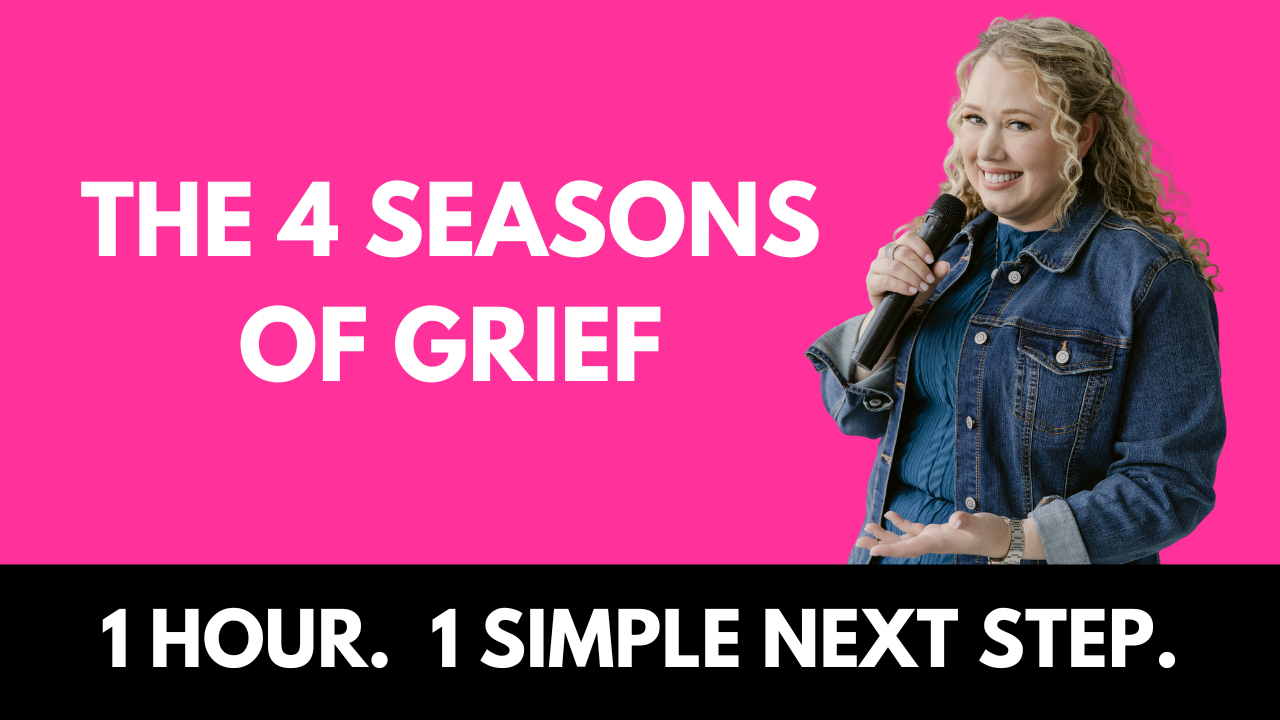
If you feel lost, stuck, or really just unsure what next step that you should take through your journey through grief and to building a life that you love. I'm hosting a free live class on the four Seasons of Grief. The Four Seasons of Grief is my signature process for how I help widows go from being a place of deep grief.
All the way through building a life that they can actually love again. I'm gonna teach you an under an hour. What it has taken me years to learn, to implement, and to coach other widows through. You can join me for the next free live [email protected] slash live, [00:42:00] LIVE. I wanna see you there.
Speaker: before we wrap up. If you're listening and wondering. Am I doing grief right? Am I stuck or am I actually moving forward? I made something just for you. I created a free quiz called The Four Seasons of Grief.
In just a few minutes, you'll find out which season of grief you're in right now, and the one next step you can take today to move forward in a healthy. In a healthy faith-filled way without pretending you're fine when you're not. Just go to brave widow.com/quiz. You'll answer a few simple questions. Get your season and I'll send you a short, practical breakdown of what to focus on in this season so you're not guessing or googling at 2:00 AM.
Again, that's brave widow.com/quiz. Go take the quiz, find your season, and take your next step today.